You open your wardrobe and see plenty of clothes.
Beautiful blouses. Several pairs of trousers. Dresses you still love. Jackets purchased with good intentions. Accessories collected over the years.
And yet, when it is time to get dressed, the same familiar question returns:
Why do I have so many clothes and so few outfits?
The problem may not be the quantity of clothing. It may be the absence of something that connects the pieces you already own.
A blouse may need the right layer to become appropriate for work. A dress may need a different shoe to move from an evening occasion into everyday life. Several neutral outfits may need one expressive accessory to feel intentional rather than unfinished.
Sometimes one well-chosen piece can make several neglected garments wearable again.
This is the idea behind the hybrid garment: a piece that can perform different functions, move between situations, or connect otherwise disconnected parts of a wardrobe.
But versatility should not mean that every garment must be plain, neutral, or interchangeable.
Sometimes the most useful piece is the expressive one that brings several quieter garments into relationship.
Before adding more to your wardrobe, discover what is missing to make what you already own work.
Table of Contents
- 1. Why a Full Wardrobe Can Still Feel Incomplete
- 2. What Is a Hybrid Garment?
- 3. Find the Missing Link Before Buying Anything
- 4. The Connecting Layer: One Piece, Several Outfits
- 5. The Transformative Accessory
- 6. The Expressive Piece Can Be the Most Versatile
- 7. Versatility Is Not the Same as Neutrality
- 8. Build Outfits Around Relationships, Not Individual Garments
- 9. Consider the Cost Per Wear of a Connecting Piece
- 10. How to Identify Your Own Hybrid Garment
- 11. Make Your Wardrobe Work Harder Without Making It Smaller
- Frequently Asked Questions
- Work with Emma
1. Why a Full Wardrobe Can Still Feel Incomplete
More clothes do not automatically create more outfits
We tend to think of a wardrobe as a collection of garments.
Ten blouses.
Six pairs of trousers.
Four jackets.
Several dresses.
A selection of shoes and handbags.
On paper, the possibilities appear almost endless.
But a wardrobe does not function simply because it contains enough individual pieces.
It functions when those pieces work together.
You may own ten beautiful blouses, but if none works with your everyday jackets, you may rarely wear them.
You may own several dresses, but if you have no appropriate shoes for your current lifestyle, they remain waiting for the right occasion.
You may have plenty of neutral clothing but feel that every outfit looks too predictable.
The individual garments may be perfectly good.
What is missing is the relationship between them.
The wardrobe needs connection, not necessarily expansion
When getting dressed becomes difficult, shopping often appears to be the obvious solution.
We assume another blouse, another pair of trousers, or another dress will finally give us more options.
But adding another disconnected garment may simply increase the number of things we own without improving the number of outfits we can create.
A more useful question is:
What is preventing my existing wardrobe from working?
The answer may reveal that one carefully chosen piece could accomplish more than several unrelated purchases.
2. What Is a Hybrid Garment?
A piece that performs more than one function
For the purpose of building an intentional wardrobe, I use the idea of a hybrid garment to describe a piece that can serve several styling purposes.
It might move comfortably between different levels of formality.
It might work with several silhouettes.
It might connect garments that previously seemed unrelated.
Or it might change the character of an outfit through the way it is worn.
Think of:
- A softly tailored jacket that works with trousers, jeans, skirts, and dresses
- A fine cardigan that can be worn alone, layered, or draped over the shoulders
- A shirt that works as a blouse or an open layering piece
- A scarf that connects several colors already present in the wardrobe
- A structured belt that gives shape to dresses, jackets, and longer tops
- An elegant shoe that moves between professional and social occasions
Not every example is literally a hybrid garment. Some are accessories or finishing pieces.
What connects them is their ability to perform more than one useful role.
The purpose is transformation
The value of a hybrid piece is not simply that it can be worn frequently.
It is that it can change what becomes possible with other garments.
A jacket may make a delicate blouse suitable for the office.
A scarf may connect a skirt and sweater that previously looked unrelated.
A belt may give an oversized dress a completely different silhouette.
The hybrid piece becomes a bridge.
Its usefulness extends beyond itself because it increases the usefulness of what you already own.
3. Find the Missing Link Before Buying Anything
Begin with the garments you rarely wear
Imagine a woman who owns several beautiful blouses.
She likes their colors.
They fit well.
They reflect her personal style.
But she rarely wears them.
Her first instinct might be to buy more trousers.
Perhaps she assumes she has not found the right combination.
Yet when she examines her wardrobe more carefully, she discovers that she already owns suitable trousers.
What she lacks is a comfortable jacket or cardigan that makes those blouses practical for her workplace.
The problem was never the trousers.
It was the missing layer.
Diagnose before you purchase
Look at the clothes you like but rarely wear.
Ask yourself:
- What prevents me from wearing this?
- Is the problem fit, comfort, occasion, or styling?
- Does it require a garment I do not own?
- Is the missing piece something that could work with several other items?
- Could a different accessory or styling approach solve the problem?
- Do I actually need to buy anything?
Sometimes the answer will be a connecting garment.
Sometimes it will be an alteration.
Sometimes it will be a new outfit combination.
And sometimes you may discover that the garment simply no longer belongs to your lifestyle.
Not every wardrobe problem should be solved through shopping.
The missing link is the actual obstacle—not the next attractive item you happen to find.
4. The Connecting Layer: One Piece, Several Outfits
A jacket can do more than complete an outfit
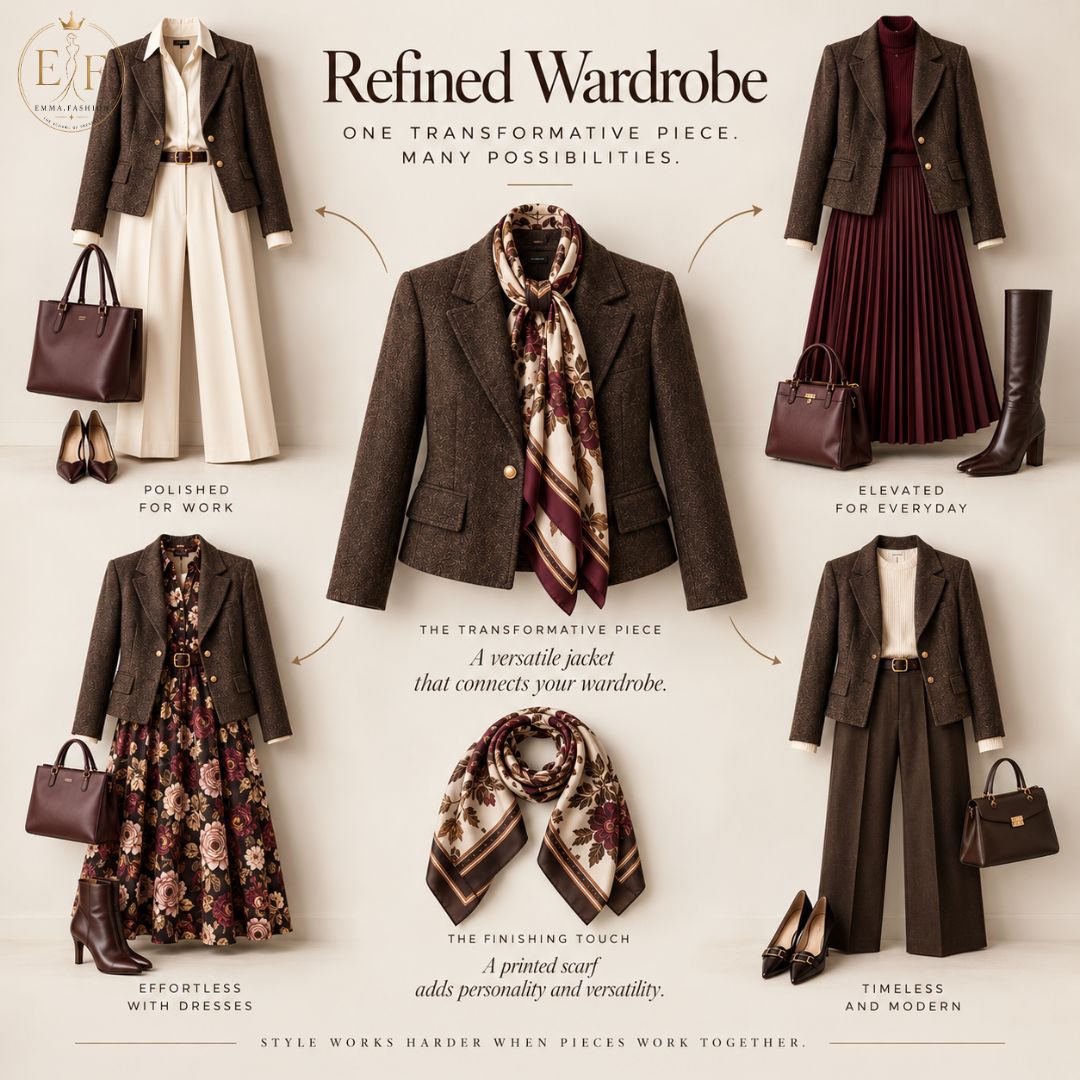
Consider a softly structured jacket in chocolate brown.
It may work with:
- Cream trousers and a silk blouse
- Dark denim and a white shirt
- A printed midi skirt and fine knit
- A simple column dress
- Rust-colored trousers and a neutral top
The jacket provides continuity.
It connects different colors, fabrics, and levels of formality.
It may also make garments that once felt too delicate, casual, or incomplete more appropriate for everyday use.
Instead of purchasing five separate outfits, you have introduced one piece that creates several new combinations.
The right layer depends on your lifestyle
A traditional blazer is not the universal answer.
For someone working in a relaxed environment, the missing link may be a refined cardigan.
For another woman, it may be a short leather jacket that makes her feminine dresses feel more contemporary.
Someone who travels frequently may benefit from a lightweight overshirt.
A woman who prefers dresses might discover that a cropped jacket gives several of them the proportion they were missing.
The important question is not:
Which jacket should every woman own?
It is:
Which layer would connect the greatest number of garments in my wardrobe while still feeling like me?
5. The Transformative Accessory
Sometimes the missing link is much smaller
Not every wardrobe needs another garment.
Sometimes an accessory can change the entire relationship between existing pieces.
Imagine a wardrobe built around cream, chocolate brown, burgundy, and muted olive.
The colors are beautiful individually, but the outfits may feel disconnected.
A printed silk scarf containing several of those shades can create a visual relationship between them.
Wear it with a cream blouse and brown trousers.
Tie it around the neck of an olive dress.
Add it to a burgundy sweater and neutral skirt.
Use it with a simple coat.
The scarf becomes a recurring visual element.
It creates continuity without requiring every outfit to look the same.
Accessories can change the level of formality
A simple black dress offers another example.
With ballet flats and a relaxed cardigan, it may work for daytime.
With a structured belt, elegant shoes, and distinctive earrings, it can become appropriate for dinner.
With a tailored jacket and understated accessories, it may suit certain professional environments.
The dress remains the same.
The finishing pieces change its expression.
A useful accessory does not merely decorate an outfit.
It can give an existing garment another reason to be worn.
6. The Expressive Piece Can Be the Most Versatile
Versatility does not always look quiet
We often associate a versatile wardrobe with neutral colors, simple shapes, and garments designed to disappear into one another.
There is practical value in that approach.
But it is not the only way to create a functional wardrobe.
Imagine a woman whose closet contains:
- Several cream blouses
- Navy and chocolate trousers
- A simple black dress
- Dark denim
- Neutral knitwear
Everything coordinates.
Yet the outfits feel too predictable for her personality.
Adding another beige cardigan may increase the number of possible combinations without improving how she feels wearing them.
What she may actually need is a distinctive piece.
Perhaps a burgundy jacket.
A patterned scarf.
An aubergine handbag.
A beautifully cut coat in burnt olive.
Something that gives the quieter garments a stronger identity.
Expression can create connection
A printed jacket containing cream, navy, and burgundy might work with several garments already in the wardrobe.
Its pattern becomes the bridge between them.
A distinctive handbag may connect different outfits through a recurring accent color.
A sculptural piece of jewelry may make simple clothing feel intentional.
The expressive piece can become the element that gives the wardrobe coherence.
Versatility is not always about blending in. Sometimes it is about bringing everything else together.
7. Versatility Is Not the Same as Neutrality
A useful wardrobe does not need to look like everyone else’s
There is a tendency to approach wardrobe planning through universal lists.
A white shirt.
Black trousers.
A beige trench coat.
A neutral blazer.
A simple black dress.
These can be useful garments.
But their usefulness depends on the woman wearing them.
A white shirt is not versatile if you dislike wearing white shirts.
A black blazer is not essential if black does not suit your preferred palette or the blazer does not fit your lifestyle.
A beige trench coat is not a meaningful investment if you rarely wear coats of that kind.
A wardrobe becomes functional through personal relevance, not compliance with a standard checklist.
Your most versatile color may be someone else’s accent
For one woman, navy may be the foundation of her wardrobe.
For another, chocolate brown.
For someone who wears rich colors consistently, burgundy may coordinate with more garments than beige.
A woman who loves prints may find that one patterned piece connects her wardrobe more effectively than another neutral.
The goal is not to eliminate individuality in the name of practicality.
It is to discover how individuality and practicality can support one another.
A versatile garment is one that works within your wardrobe—not one that appears on every list of wardrobe essentials.
8. Build Outfits Around Relationships, Not Individual Garments
Stop evaluating each purchase in isolation
A garment can be beautiful, flattering, well-made, and reasonably priced.
It can still be a poor addition to your wardrobe.
Why?
Because it may have no useful relationship with anything you already own.
Before purchasing, consider the connections.
Does the new piece work with your existing trousers?
Could it be worn with a dress?
Does it coordinate with your shoes?
Does it create an outfit appropriate for your actual schedule?
Could it help you wear something that has been neglected?
These questions shift shopping from collecting individual garments to building a functioning wardrobe.
Try the three-connection test
Before buying a potential hybrid piece, identify three existing garments or outfits it could improve.
For example, a burgundy cardigan might:
- Make a cream blouse and navy trousers feel more complete.
- Add warmth and color to a simple dress.
- Create a new combination with a printed skirt.
The point is not to force every purchase into exactly three outfits.
It is to establish whether the garment has genuine relationships with what you own.
If you cannot imagine how to wear it without purchasing several additional items, it may not be the missing link you were looking for.
9. Consider the Cost Per Wear of a Connecting Piece
One useful purchase can improve several existing investments
Cost per wear is a helpful way to evaluate clothing.
The calculation is simple:
Purchase price ÷ number of wears = cost per wear
But a connecting piece introduces another dimension.
Imagine purchasing a jacket for $180.
Over time, you wear it 60 times.
Its purchase-price cost per wear becomes $3.
That is useful information.
But perhaps the jacket also allows you to wear three blouses and two dresses that had been sitting unused.
Its contribution extends beyond its own frequency of wear.
It has helped you make better use of garments you already paid for.
Do not confuse potential with actual value
A garment is not valuable simply because you can imagine many theoretical combinations.
The outfits need to suit your real life.
If a beautiful jacket works with ten garments but is too uncomfortable for your workday, its potential versatility may never become actual use.
Consider:
- How often will I realistically wear it?
- Does it suit my everyday activities?
- Is it comfortable?
- Does it require difficult maintenance?
- Will I enjoy wearing it repeatedly?
- Does it genuinely improve the use of my existing wardrobe?
The most economical purchase is not necessarily the cheapest or the most expensive.
It is the one whose usefulness justifies its cost within your circumstances.
10. How to Identify Your Own Hybrid Garment
Start with a wardrobe experiment
You do not need to begin by shopping.
Begin by examining your wardrobe.
Choose five garments you like but rarely wear.
Lay them out where you can see them.
Perhaps you select:
- Two beautiful blouses
- A printed skirt
- A simple dress
- A pair of tailored trousers
Now ask what prevents each one from becoming part of a complete outfit.
Look for recurring problems.
Do several pieces need a layer?
Do they need a practical shoe?
Would a belt improve their proportions?
Could one color connect them?
Are they missing an accessory that makes them feel more personal?
If the same solution appears repeatedly, you may have identified your hybrid piece.
Test the solution before committing
If possible, experiment with something similar that you already own.
Borrow a styling idea from another outfit.
Try a different jacket.
Use a scarf in a new way.
Change the shoe.
Alter the proportion.
Take photographs of the combinations so you can evaluate them more objectively.
Then decide whether a purchase is necessary.
A practical decision filter
Before buying, ask:
Function: What specific wardrobe problem will this solve?
Connection: Which existing garments will it help me wear?
Identity: Does it reflect my personal style?
Context: Does it suit my lifestyle and environment?
Comfort: Will I actually enjoy wearing it?
Value: Is the improvement worth the purchase price?
If the piece passes these questions, it may be a meaningful addition.
If not, continue looking—or reconsider whether you need anything new.
11. Make Your Wardrobe Work Harder Without Making It Smaller
An intentional wardrobe is not necessarily a minimal wardrobe
The goal of wardrobe planning is often presented as owning as little as possible.
But minimalism is not the only expression of intention.
A woman who loves color, prints, jewelry, and variety can have an intentional wardrobe.
So can a woman who prefers a small collection of understated garments.
What matters is whether the wardrobe supports the life and identity of the person who owns it.
An intentional wardrobe contains relationships.
Pieces have a purpose.
Garments are worn.
Outfits can be created without constant frustration.
And the woman getting dressed does not feel that she must choose between practicality and personal expression.
One piece may be enough to change the conversation
Perhaps you do not need another five blouses.
Perhaps you need one jacket that makes the blouses you own appropriate for your workday.
Perhaps you do not need more dresses.
Perhaps you need a comfortable, elegant shoe that makes the dresses you already love practical.
Perhaps your wardrobe does not need another neutral basic.
Perhaps it needs one expressive piece that gives your existing clothes a sense of identity.
Or perhaps you need nothing at all.
You may simply need to discover combinations you have never tried.
This is the real purpose of the hybrid garment.
Not to create an endless number of outfits for the sake of efficiency.
Not to turn every garment into a multifunctional object.
And certainly not to remove personality from the wardrobe.
It is to understand that the value of a garment can come from what it makes possible beyond itself.
A single piece can connect colors.
Bridge occasions.
Change proportions.
Introduce personality.
Restore usefulness to neglected clothes.
And make getting dressed feel easier.
The most transformative addition to your wardrobe may not be the garment that attracts the most attention in the store.
It may be the one that helps you see everything you already own differently.
Before adding more to your wardrobe, discover what is missing to make what you already own work.
Frequently Asked Questions
What is a hybrid garment in wardrobe styling?
A hybrid garment is an adaptable piece that performs more than one styling function. It may work across different occasions, connect several existing garments, or transform an outfit through layering and proportion. In wardrobe planning, the same connecting principle can also apply to accessories such as scarves, belts, shoes, and handbags.
How can one garment make my wardrobe more versatile?
One well-chosen garment can create several new outfit combinations by connecting pieces you already own. For example, a tailored jacket may make multiple blouses, dresses, and trousers suitable for different occasions. Its value comes not only from how often you wear it, but also from how much more useful it makes the rest of your wardrobe.
Does a versatile wardrobe have to consist mainly of neutral basics?
No. Versatility depends on how well garments work together within your personal wardrobe. An expressive jacket, patterned scarf, or distinctive accessory can be highly versatile when it connects several quieter pieces. The goal is to create useful relationships between clothes without sacrificing personal style.
How do I identify the missing link in my wardrobe?
Begin with garments you like but rarely wear. Identify what prevents you from creating complete outfits with them, whether that is a missing layer, suitable shoe, connecting color, better fit, or appropriate accessory. Look for a solution that addresses several recurring problems before deciding whether a new purchase is necessary.
Should I buy a hybrid garment if it works with many outfits?
Only if those outfits are realistic for your lifestyle and the garment suits your personal style, comfort needs, and budget. Theoretical versatility does not guarantee actual use. A worthwhile purchase should solve a genuine wardrobe problem and help you wear clothes you already own, rather than create the need for several additional purchases.
Work with Emma
Discover what your wardrobe is actually missing
A wardrobe can contain beautiful clothes and still feel difficult to use.
Often, the solution is not another shopping trip.
It begins with understanding the relationship between your personal style, lifestyle, existing garments, and everyday needs.
Through Emma.Fashion personal styling, image consulting, and wardrobe guidance, we can examine what you already own, identify the pieces that are not working, and discover what is preventing them from becoming useful outfits.
Sometimes the answer is a connecting layer.
Sometimes it is an accessory, an alteration, or a different way of combining clothes.
And sometimes the most valuable discovery is that you do not need to buy anything at all.
The goal is not to create a smaller wardrobe simply for the sake of owning less.
It is to create a wardrobe that feels more connected, more personal, and easier to use.
A wardrobe works harder when its pieces work together—and when the woman wearing them still recognizes herself in every combination.