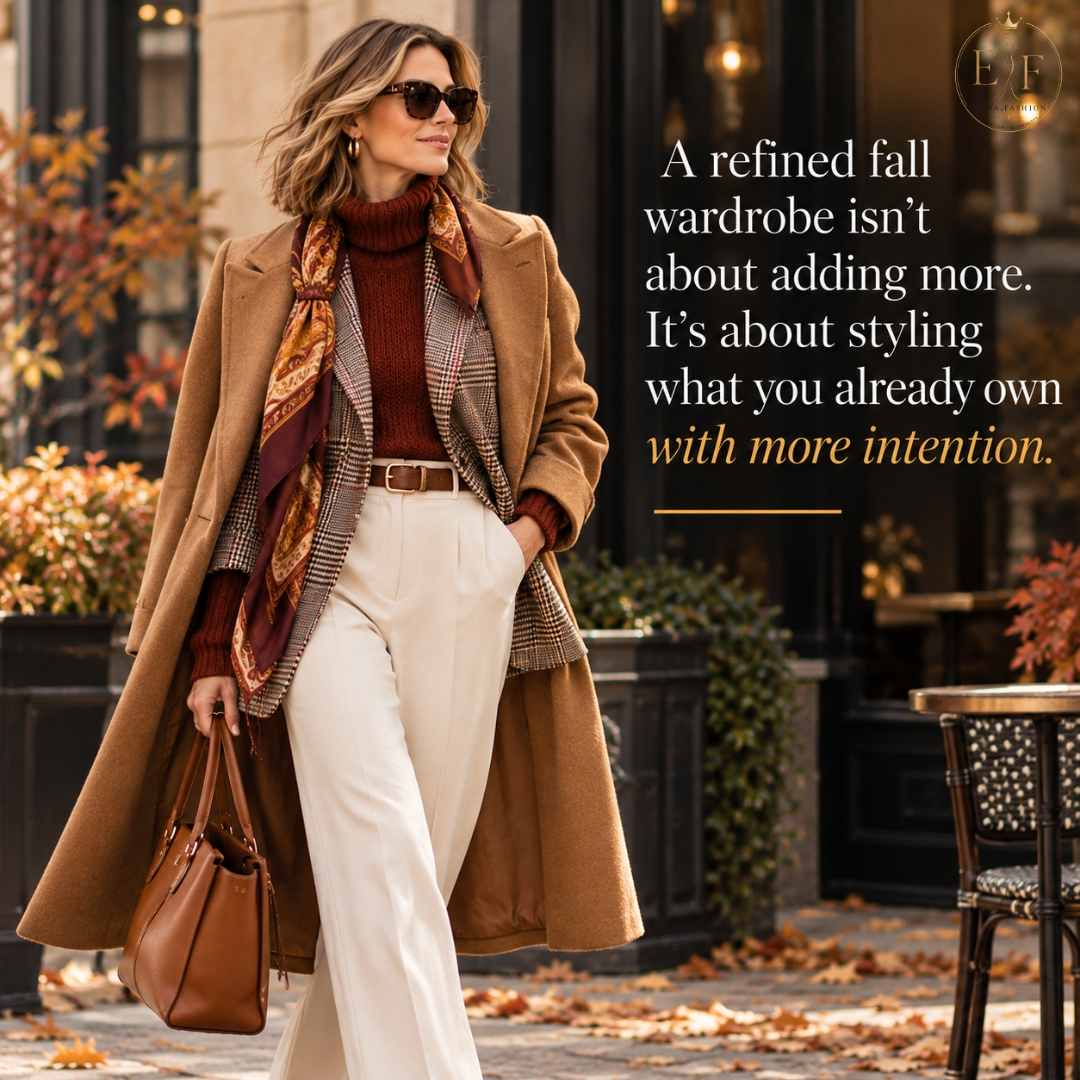
Fall has a way of making us want to add.
Another sweater. Another jacket. A new pair of boots. Perhaps a handbag in the color of the season. But a more polished fall wardrobe does not necessarily begin with more clothes. Often, it begins by looking more carefully at the clothes already in front of us.
A white shirt changes when its cuff is deliberately visible beneath a sweater. Chocolate brown becomes richer beside cognac rather than an identical shade of brown. A simple tonal outfit becomes more interesting when wool, leather, suede, and crisp cotton create depth. And one unexpected color can turn a predictable combination into something distinctly personal.
Polish is often less about what you add to an outfit than about the relationships you create within it.
This fall, before looking for something new, look again at what you already own.The difference may be in the styling.
Table of Contents
- 1. Begin with the Outfit, Not the Shopping List
- 2. Layer So Every Piece Has a Purpose
- 3. Mix Shades Instead of Matching Them
- 4. Use Texture as Part of Your Color Story
- 5. Introduce One Unexpected Color
- 6. Keep Some Lightness in Your Fall Palette
- 7. Pay Attention to Proportion
- 8. Let the Finishing Pieces Do Their Work
- 9. Repeat Something Once
- 10. Know When the Outfit Is Finished
- 11. Let the Pieces Speak to One Another
- Frequently Asked Questions
- Work with Emma
1. Begin with the Outfit, Not the Shopping List
Sometimes the wardrobe already contains the answer
When the season changes, it is tempting to begin by asking:
What do I need to buy for fall?
Try asking a different question first:
What can I do differently with what I already own?
Take out the trousers, skirts, jackets, shirts, knitwear, dresses, shoes, and accessories you naturally reach for during fall. Then look beyond the individual garments.
Look at the relationships between them. Could the shirt you normally wear alone become a layer? Could the dress work beneath a jacket? Could the chocolate trousers you always pair with cream look more interesting with burgundy or purple? Could a belt change the proportion of a familiar coat or cardigan? Could a scarf connect colors that previously seemed unrelated?
The wardrobe may not be missing another garment. It may be missing another way of seeing the garments you already have.
Styling creates value
A useful wardrobe is not simply one that contains versatile pieces. It is one in which you know how to create relationships between those pieces. That is particularly important in fall because layering gives us more opportunities to combine color, texture, proportion, and detail.
Before adding more, experiment. Sometimes the most effective seasonal update costs nothing.
2. Layer So Every Piece Has a Purpose
Do not let one layer completely erase another
Layering is one of the pleasures of fall dressing. But adding layers does not automatically make an outfit more sophisticated. In fact, too many layers without visual intention can make an outfit feel heavy.
Instead, think about visibility. Let a crisp white cuff extend slightly beyond the sleeve of a sweater or jacket. Allow a shirt collar to frame a crewneck knit. Let the hem of a blouse appear intentionally beneath a shorter sweater. Allow a fine turtleneck to create a narrow frame beneath a shirt or jacket.
The effect is subtle, but it gives the eye somewhere to travel.
Think in frames
One layer can frame another.
A cream shirt can bring light toward the face beneath a dark blazer. A burgundy knit can appear between a camel coat and a white shirt. A fine chocolate turtleneck can create depth beneath a lighter jacket.
Rather than thinking:
How many layers can I add?
ask:
What is each layer contributing to the composition?
If a layer adds neither function nor visual interest, perhaps you do not need it.
Polished layering feels considered rather than accumulated.
3. Mix Shades Instead of Matching Them
Fall color becomes richer when it is allowed to vary
One of the easiest ways to make an outfit feel more sophisticated is to stop trying to match every shade perfectly.
Consider the brown family alone:
- Chocolate
- Espresso
- Camel
- Cognac
- Chestnut
- Taupe
- Dark beige
They do not need to be identical to work together. In fact, an outfit composed of slightly different shades often feels more dimensional than one in which every brown has been carefully matched.
Try chocolate trousers with a camel knit and cognac leather. Or an espresso jacket with a dark beige trouser and cream blouse. The subtle variation gives the outfit depth.
Think in color families
You can apply the same idea beyond brown.
Burgundy can live beside rust. Olive can work with forest green. Aubergine can deepen softer purple. Cream can soften camel. Muted clay can warm chocolate.
The colors do not need to match. They need to relate. This is an important distinction.
Matching asks whether two colors are the same. Styling asks whether they have something interesting to say to one another.
4. Use Texture as Part of Your Color Story
Color is affected by surface
Imagine an outfit entirely in shades of brown. If every garment has a similar surface and weight, the combination may feel flat.
Now picture the combination: Chocolate wool trousers, a fine camel knit, a cognac leather belt, and a soft suede handbag.
The palette is still restrained. But the outfit has depth because each material responds to light differently.
Texture changes how we experience color.
Build dimension through contrast
Fall gives us a beautiful opportunity to play with texture.
Think corduroy, suede, fine and chunky knits, wool, crisp cotton, leather, silk, velvet, and fluid fabrics. The interest often comes from how these textures interact. Pair soft with structured, matte with subtle shine, smooth with textured, or fluid with something more substantial. A silk blouse beneath a wool jacket, for example, creates depth because the fabrics respond differently to light and movement. Even something as simple as a suede shoe can make trousers and a sweater feel distinctly more autumnal—without introducing another color.
Sometimes texture is all an outfit needs to feel richer.
You do not always need another print or another accessory.
5. Introduce One Unexpected Color
The element that does not quite belong may be what makes the outfit memorable
Fall color palettes can easily become familiar.
Brown with cream. Burgundy with navy. Camel with black. Olive with beige. They are classics for a reason, and there is nothing wrong with relying on them.
But sometimes one unexpected color is what gives an outfit personality. Think purple with chocolate brown, deep green with rust, sky blue with red and burgundy, butter yellow with espresso, or aubergine with muted clay.
The unexpected color doesn’t need to take over the outfit. In fact, it can be more interesting when it appears quietly—a scarf, a handbag, a shoe, a pair of gloves, a shirt collar peeking from beneath a jacket, or even a piece of jewelry.
You don’t always need more color. Sometimes you simply need one color people didn’t expect.
Let one color create tension
Interesting outfits often have a little visual tension. Everything doesn’t need to blend perfectly. A predominantly warm palette can come alive with a cooler accent. A dark outfit can benefit from one clear note of color. And when everything is neutral, a single saturated shade can introduce personality. The secret is restraint. You want enough contrast to make the eye pause, but not so much that the outfit loses its sense of harmony.
One unexpected color can look intentional. Five unexpected colors may simply look unresolved.
6. Keep Some Lightness in Your Fall Palette
Fall does not require everything to become dark
As the temperatures drop, our wardrobes naturally tend to become darker. We reach for black, charcoal, espresso, burgundy, deep green, and navy—all beautiful colors for fall. But when everything becomes dark, an outfit can start to feel visually heavy.
So keep some lightness in the conversation. Bring in cream, ivory, soft beige, pale blue, lighter camel, or even white. A light shirt beneath a dark sweater, an ivory trouser with a rich brown jacket, or a pale blue accent among burgundy and navy can completely change the balance. Fall doesn’t have to mean darker. Sometimes it simply means richer.
Use light colors strategically
A touch of lightness can completely change the balance of a fall outfit. A cream blouse beneath a chocolate jacket brings softness and light toward the face. White trousers can transition beautifully beyond summer when paired with a camel sweater and cognac accessories. And a pale blue shirt can bring an unexpected freshness to burgundy or brown. Even something as simple as a lighter handbag can break up an otherwise dark palette. Lightness creates contrast, and contrast allows those beautiful, deeper fall colors to feel even richer.
Seasonal dressing does not require us to imitate the darkness of the season.
7. Pay Attention to Proportion
Polish is not only about color
Sometimes an outfit is made up of all the right pieces, yet something still feels slightly off. Before changing the colors or reaching for another accessory, take a look at the proportions. A long jacket over a long top with wide trousers, for example, may create more visual weight than you intended. A cropped jacket can bring beautiful balance to high-rise trousers or a fuller skirt. An oversized knit may feel more intentional with a cleaner silhouette underneath, while a voluminous skirt can benefit from a little more definition through the upper body. These aren’t rules to follow rigidly. Different proportions can work beautifully on different women and with different styles.
The goal is simply balance—knowing when to add volume, when to create definition, and when to let the silhouette breathe.
Create enough contrast between shapes
When an outfit feels slightly off, the solution may be as simple as changing the relationship between the shapes. If everything is oversized, your silhouette can become lost. If everything is fitted, the look can sometimes feel too controlled. Instead, create a little contrast: structured with fluid, relaxed with defined, short with long, volume with restraint. And don’t underestimate small adjustments. Push up the sleeves, partially tuck a sweater to suggest the waist, open the jacket, reconsider the trouser length, or let a shirt cuff peek through.
Before adding another piece, work with the silhouette you already have. Sometimes styling, rather than shopping, is what the outfit needs.
8. Let the Finishing Pieces Do Their Work
Accessories can resolve an outfit
Sometimes an outfit is technically complete, yet it still doesn’t feel quite finished. This is where accessories can bring everything into focus. A sleek shoe can sharpen a relaxed trouser. A belt can define the silhouette while connecting to the color of a handbag. A scarf can quietly bring several colors together, while a structured bag can add polish to softer pieces. Even smaller details can make a difference. Statement gloves can bring personality to a simple coat, and jewelry can introduce just enough light around the face.
Accessories don’t all need to demand attention. Often, their most important role is simply to create a sense of resolution—to make the outfit feel complete.
Look for what the outfit needs
Before reaching automatically for the accessories you always wear, pause and ask yourself: What does this outfit actually need? If it needs structure, perhaps it’s the bag. If it needs color, introduce a scarf. If the silhouette needs definition, add a belt. If it needs a little more refinement, reconsider the shoes. And sometimes, the outfit already has enough. Knowing when not to add anything is part of good styling too.
Finishing an outfit does not always mean adding another finishing piece.
9. Repeat Something Once
Repetition creates visual connection
One of the easiest ways to make an outfit feel intentional is to repeat one element somewhere else in the look—without matching it exactly. A burgundy sweater might pick up the burgundy in a printed scarf. A cognac belt can echo the warmth of brown shoes. Gold earrings might relate to the hardware on a handbag, while a deep green knit can connect to a subtle green detail in a skirt. These repetitions don’t need to be obvious. In fact, they are often more effective when they are subtle. The eye notices the connection, and pieces that once felt separate suddenly begin to belong together.
Avoid making repetition too perfect
The goal isn’t to make every accessory match. Your shoes, handbag, belt, and gloves can belong to the same outfit without being identical. In fact, too much coordination can sometimes make a look feel overly planned. Instead, think about creating an echo. Let a color appear in one place and quietly return somewhere else. Repeat a texture in a smaller detail. Allow the shape or finish of one accessory to relate to another. The idea is connection, not matching—enough repetition to create coherence, but enough variation to keep the outfit interesting.
10. Know When the Outfit Is Finished
More styling is not always better styling
Fall gives us so many beautiful possibilities that it can be tempting to keep adding—another layer, a scarf, a belt, jewelry, a statement shoe, a hat, gloves. Each piece may be beautiful on its own, but polish also comes from knowing when to stop. Once your outfit has a clear focal point, let the other elements support it. If the coat is dramatic, perhaps the scarf can be quieter. If the color combination is already unexpected, the accessories don’t need to compete with it. If your jewelry is sculptural, give it enough space to be noticed. Leave somewhere for the eye to rest You can combine rich color, beautiful texture, and expressive accessories, but they don’t all need to speak at the same volume. Before adding one more thing, ask yourself: What do I want someone to notice first? Then edit accordingly. Sometimes the final step in styling isn’t adding something. It’s knowing what to leave out.
11. Let the Pieces Speak to One Another
Polish is a relationship
A polished outfit isn’t necessarily about expensive clothes, more accessories, or following every seasonal trend. And it certainly doesn’t require rebuilding your wardrobe every fall. Often, what makes an outfit feel refined is simply the relationship between its parts. A white cuff peeks beneath a sweater to bring in a little light. A cognac shoe doesn’t exactly match chocolate trousers, but the colors speak to one another. A suede bag introduces texture. An unexpected purple knit gives a brown palette personality. A touch of cream near the face balances the richness of darker fall shades. Perhaps one color appears again, quietly, somewhere else in the outfit. And then you stop. Because good styling isn’t about how much you add. It’s about knowing what connects—and recognizing when the outfit has said enough.
Look at the whole before adding another piece
This is why dressing well is about more than collecting beautiful clothes. You can have a wardrobe filled with wonderful individual pieces and still feel that your outfits are missing something. Often, the difference is in how the pieces relate to one another. When you look in the mirror, try changing the questions you ask. Instead of “Does this jacket work?” ask, “What is this jacket adding to the outfit?” Instead of “Does this scarf match?” ask, “What is this scarf connecting?” And before reaching for one more accessory, ask, “Is the outfit already saying enough?” That small shift changes the way we dress. We stop simply assembling clothes and begin composing an outfit—and composition requires knowing when to add and when to edit.
So before buying something new this fall, experiment with what you already own. Let the cuff show. Change the layer. Mix your shades of brown. Introduce an unexpected color. Add texture. Bring some lightness back into the palette. Change the shoe. Repeat one detail. Remove something that isn’t necessary. Then stand back and look again.
Sometimes your wardrobe doesn’t need something new. It simply needs you to see it differently.
A polished fall look isn’t created by how many pieces you wear. It’s created by how thoughtfully they speak to one another.
Frequently Asked Questions
How can I make my fall outfits look more polished without buying new clothes?
Begin by restyling what you already own. Experiment with visible layering, mix different shades within the same color family, combine contrasting textures, adjust proportions, and use accessories to create connection. Small changes such as showing a shirt cuff, changing the shoe, adding a belt, or repeating one color can make a familiar outfit feel much more intentional.
What colors make a fall outfit look sophisticated?
Rich shades such as chocolate, espresso, camel, cognac, burgundy, rust, olive, and deep green work beautifully for fall, but sophistication does not depend on using dark colors alone. Cream, ivory, pale blue, lighter beige, and other softer shades can bring freshness and contrast. Mixing related tones often creates more depth than trying to match colors exactly.
How do I mix textures in a fall outfit?
Combine fabrics with different surfaces, weights, or movement. Fine knits can work with wool, crisp cotton with suede, fluid fabrics with structured leather, or corduroy with smoother pieces. You do not need many different textures in one outfit. Even two or three thoughtfully combined surfaces can give a simple color palette more dimension.
Can I wear bright or light colors in fall?
Yes. Fall dressing does not require an entirely dark wardrobe. Light colors can prevent deeper seasonal shades from feeling heavy, while an unexpected brighter color can give an outfit personality. Try cream with chocolate, pale blue with burgundy, purple with brown, or another combination that works with your personal coloring and wardrobe.
Which accessories make a fall outfit look more polished?
The most useful accessory depends on what the outfit needs. A sleek shoe can refine the silhouette, a belt can create definition, a scarf can connect colors, a structured bag can add polish, and gloves or jewelry can introduce personality. Rather than adding every accessory, choose the finishing piece that gives the outfit something it is currently missing.
Work with Emma
A more polished wardrobe may begin with what you already own
Sometimes we assume that feeling uninspired by our wardrobe means we need new clothes.
But often, what is missing is not another garment.
It is a clearer understanding of how to combine the garments already there.
Through Emma.Fashion personal styling, image consulting, wardrobe guidance, and color analysis, we can explore the colors, proportions, textures, accessories, and outfit combinations that make your wardrobe feel more intentional and more distinctly yours.
We can also identify where a genuine wardrobe gap exists—and where a different styling approach may solve the problem without another purchase.
The goal is not to make every outfit more complicated.
It is to make every choice more considered.
Because polish does not come from wearing more.
It comes from understanding how the pieces you choose relate to one another—and knowing when the outfit is complete.