The cheapest garment is easy to recognize.
It is the one with the lowest number on the price tag.
The most affordable garment, however, can be something entirely different.
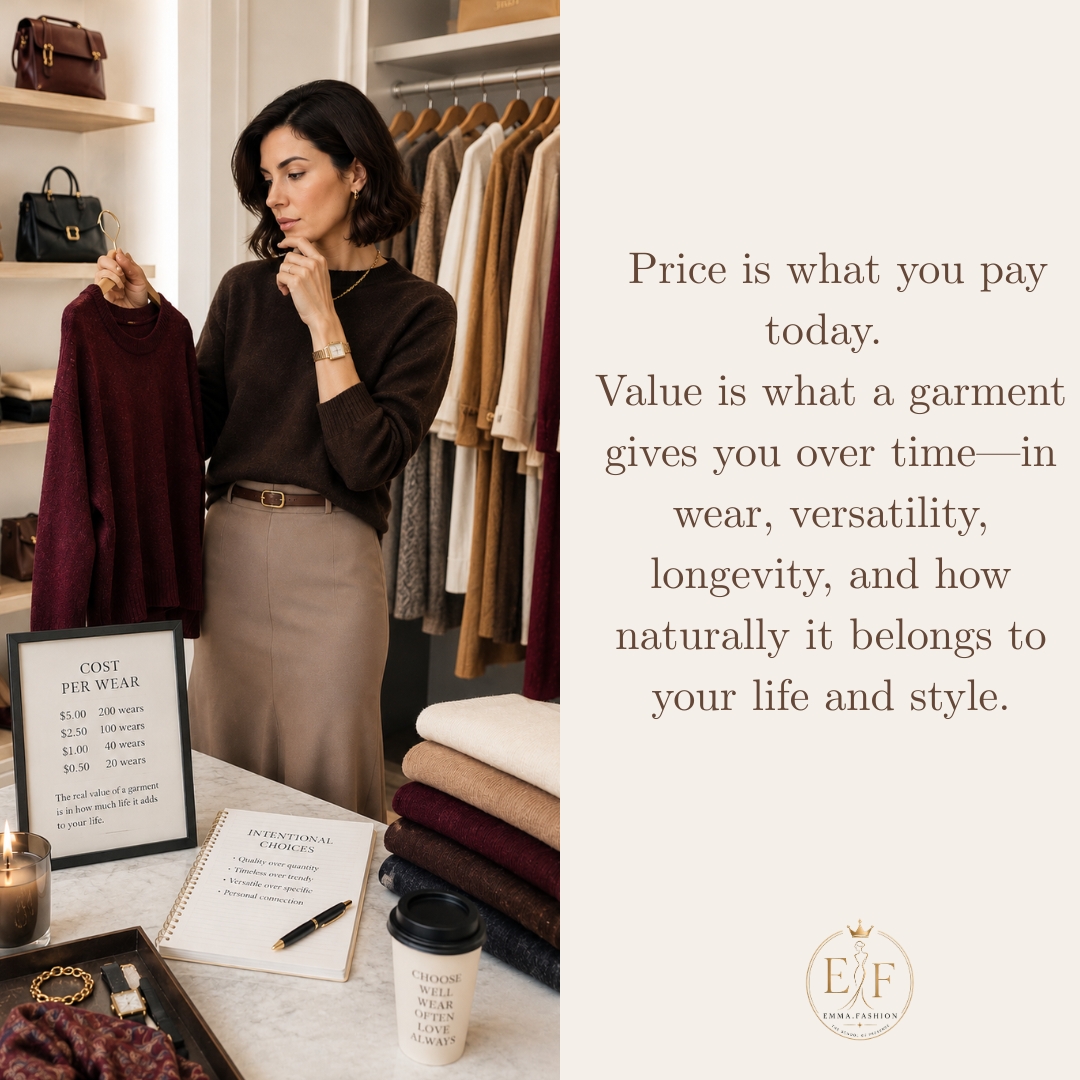
A $30 blouse worn twice before losing its shape has cost you $15 each time you wore it. A $180 jacket worn regularly for five years may eventually cost only a few dollars per wear—and may continue serving you long after the cheaper blouse has disappeared from your wardrobe.
But even that calculation tells only part of the story.
Because the real value of clothing is not determined solely by price, quality, or how many years something could last. It is also determined by whether the garment actually belongs in your life.
The best value is often found in the clothes you wear, enjoy, maintain, and continue choosing.
And that requires us to think differently about what “affordable” really means.
Table of Contents
- 1. Price and Value Are Not the Same Thing
- 2. Start Thinking in Cost Per Wear
- 3. Cheap Becomes Expensive When We Keep Replacing It
- 4. Quality Matters—But Only If You Wear It
- 5. The Most Expensive Mistake May Be the Garment You Never Wear
- 6. Personal Style Is Part of the Value Equation
- 7. Think About Versatility, Not Just Price
- 8. Care Changes the Economics of Your Wardrobe
- 9. Learn to Recognize Value Before You Buy
- 10. Build a Wardrobe Around Better Decisions, Not More Clothes
- Frequently Asked Questions
- Work with Emma
1. Price and Value Are Not the Same Thing
A low price tells us only what something costs today
When we shop, price is immediate.
We see $29.99.
$89.
$250.
And because those numbers are easy to compare, we naturally use them to decide whether something feels affordable.
But the price tag measures only the cost of acquiring the garment.
It tells us nothing about what happens afterward.
Will you wear it?
Will it work with the clothes already in your wardrobe?
Will you still like it next year?
Will the fabric, seams, shape, and finish hold up?
Will it require expensive or inconvenient maintenance?
Will you reach for it often enough to justify bringing it home?
A garment can be inexpensive at the register and surprisingly costly in your wardrobe.
And something that initially feels expensive can eventually become one of the most economical things you own.
Ask a better question
Instead of asking only:
How much does this cost?
Try asking:
What value will this garment give me for what I am spending?
That small change in language can completely change the way we shop.
2. Start Thinking in Cost Per Wear
The simplest calculation can be revealing
Cost per wear is exactly what it sounds like:
Purchase price ÷ number of times worn = cost per wear
Imagine buying a trendy top for $40.
You wear it twice.
Its cost per wear is $20.
Now imagine buying a beautifully fitting pair of trousers for $160.
You wear them 40 times over several years.
Their cost per wear becomes $4.
The trousers were four times more expensive to purchase.
But in terms of actual use, they became far more economical.
Cost per wear changes how we define a bargain
A bargain is not necessarily the garment with the deepest discount.
It may be the coat you reach for every winter.
The blazer that works for meetings, dinners, presentations, and travel.
The trousers that can be worn with five different tops.
The handbag you have carried for years.
The simple dress that repeatedly solves the question of what to wear.
These pieces quietly earn their place in the wardrobe.
The garment that works hardest for you may ultimately be the one that costs you least.
3. Cheap Becomes Expensive When We Keep Replacing It
The purchase price is not always the final price
Sometimes we buy something inexpensive knowing that it may not last very long.
That can be perfectly reasonable.
Not every garment needs to become an heirloom, and not every wardrobe purchase deserves a major investment.
The problem begins when inexpensive clothing enters a cycle of constant replacement.
A sweater pills quickly, so we buy another.
A pair of trousers loses its shape, so we replace it.
A shoe becomes uncomfortable or deteriorates, so another pair takes its place.
Each purchase feels small.
But repeated over time, those small purchases become a much larger expense.
Look at the pattern, not just the transaction
We tend to remember the price of the garment in front of us.
We are less likely to calculate the cost of the three similar garments we bought before it.
That is why understanding your shopping patterns matters.
If you repeatedly replace the same category of clothing, it may be worth asking whether spending more thoughtfully once could cost less than repeatedly spending less.
This does not mean:
Expensive = good.
It means:
Repeatedly replacing poor choices is rarely economical.
4. Quality Matters—But Only If You Wear It
Higher quality can create longer value
Construction, fabric, finishing, fit, and design all influence how a garment performs over time.
A well-made coat may hold its shape for years.
Good leather shoes can often be maintained and repaired.
A quality knit may recover its shape better than one made primarily for a short selling season.
A beautifully constructed blazer may continue looking polished after dozens of wears.
Quality matters because longevity changes the economics of clothing.
But there is an important qualification.
Quality alone does not create value
A beautifully made $500 jacket that remains in your closet is not automatically a better purchase than the $100 jacket you wear every week.
This is where conversations about “investment pieces” can become misleading.
We sometimes assume that spending more automatically makes us more thoughtful consumers.
It does not.
An investment piece is valuable only when there is a return on that investment.
In a wardrobe, that return might be:
- Frequent wear
- Longevity
- Versatility
- Comfort
- Confidence
- Ease of styling
- Suitability for your lifestyle
- Continued enjoyment
Quality creates potential value. Use turns that potential into real value.
5. The Most Expensive Mistake May Be the Garment You Never Wear
Cost per wear can also be emotional
Most wardrobes contain clothes that seemed like good decisions at the time.
The dress purchased for a hypothetical occasion.
The dramatic jacket that looked beautiful in the store.
The shoes that were irresistible but never quite comfortable.
The bargain that was “too good to leave behind.”
The garment bought for the life we imagined rather than the life we actually live.
They may have been inexpensive.
They may have been expensive.
But if we rarely or never wear them, their value remains remarkably low.
A sale price does not create a need
This is one of the easiest traps in shopping.
A $200 garment reduced to $70 can feel like saving $130.
But if you would never have bought the garment without the discount—and never wear it afterward—you did not save $130.
You spent $70.
The question is not:
How much am I saving?
It is:
Would this garment deserve a place in my wardrobe if there were no red sale sign beside it?
Sometimes the most economical decision in fashion is simply to leave something in the store.
6. Personal Style Is Part of the Value Equation
The clothes that feel like you tend to work harder
There is another reason certain garments become extraordinarily good value.
They align with your personal style.
When something genuinely reflects you, you are less likely to tire of it simply because a trend changes.
You know how to style it.
You feel comfortable wearing it repeatedly.
It combines naturally with other things you own.
And because it feels familiar without feeling boring, you return to it.
This is one reason developing personal style can have an economic benefit.
Knowing yourself reduces the number of clothes you need to experiment with before finding what works.
Trend relevance and personal relevance are different
A garment can be extremely fashionable and have very little value in your wardrobe.
Another can appear relatively simple and become indispensable.
Before buying something, ask:
Do I love this because it is interesting right now?
Or:
Can I actually imagine myself wearing this repeatedly?
Both answers can be valid.
Fashion should still contain pleasure, experimentation, and surprise.
But understanding the difference allows you to decide consciously rather than confusing temporary attraction with lasting usefulness.
7. Think About Versatility, Not Just Price
One garment can create many possibilities
A useful wardrobe is built through relationships between clothes.
Consider a beautifully cut blazer.
Perhaps it works with:
- Tailored trousers for work
- Dark jeans for business casual
- A midi skirt for dinner
- A simple dress
- A fine knit and trousers for travel
Its value does not come only from the blazer itself.
It comes from the number of combinations it makes possible.
Try the three-outfit test
Before buying something, imagine at least three outfits you could create with pieces you already own.
Not pieces you plan to buy.
Not the trousers you might find someday.
Not the perfect shoe that would make the garment work.
Your existing wardrobe.
If you can immediately imagine several combinations, the garment is more likely to integrate naturally into your life.
If the new purchase requires three additional purchases before you can wear it, its real cost may be considerably higher than its price tag suggests.
8. Care Changes the Economics of Your Wardrobe
Longevity is partly created after the purchase
We often discuss quality as though it exists entirely inside the garment.
But how we care for clothing matters too.
Overwashing, excessive heat, improper storage, neglecting small repairs, or ignoring care instructions can dramatically shorten the life of otherwise good clothing.
Simple habits can make a difference:
- Wash garments only when necessary
- Follow appropriate care instructions
- Air clothing between wears
- Store knits properly
- Use suitable hangers for structured garments
- Address loose buttons and small repairs early
- Maintain leather shoes and bags
- Rotate frequently worn pieces when possible
Caring for clothes changes our relationship with them
There is also something psychologically important about maintenance.
When we care for something, we are more likely to notice it.
We understand its fabric.
Its construction.
How it wears.
What it needs.
Clothing stops feeling entirely disposable.
And perhaps that is another form of luxury: not constantly replacing what we own, but having things worth looking after.
9. Learn to Recognize Value Before You Buy
Slow down the decision
You do not need to perform an elaborate financial analysis in the fitting room.
But a few questions can reveal a great deal.
Before buying, ask:
Does it fit my life?
Where will I realistically wear it?
Does it fit my wardrobe?
Can I combine it with what I already own?
Does it fit me well?
Or am I buying it with the hope that I will somehow make it work?
Does the quality make sense for the price?
Look at the fabric, seams, lining, buttons, zippers, finishing, and how the garment hangs.
Can I care for it realistically?
A garment requiring maintenance you dislike may not become a practical choice.
Would I want it at full price?
This can be especially useful during sales.
Does it feel like me?
Perhaps the most important question of all.
Value is personal
The same garment can be excellent value for one woman and a poor purchase for another.
A beautifully tailored suit may be indispensable to someone who wears tailoring several times a week.
For someone working from home in a very casual environment, the same suit may spend most of its life waiting for an occasion.
A luxury handbag used almost every day may provide enormous value to one person.
For another, it may be an expensive object that rarely leaves its dust bag.
There is no universal formula.
Value depends on the relationship between the garment and the life of the person wearing it.
10. Build a Wardrobe Around Better Decisions, Not More Clothes
Affordability is ultimately about intention
The goal is not to convince ourselves that expensive clothing is always justified.
It isn’t.
There are excellent affordable garments and disappointing expensive ones.
There are inexpensive pieces we wear for years and luxury purchases we regret almost immediately.
Price can suggest certain things.
It cannot tell us whether a garment will become valuable to us.
That requires a more complete way of thinking.
Look at:
Price.
But also look at:
Quality.
Frequency of wear.
Versatility.
Longevity.
Maintenance.
Lifestyle.
Personal style.
How the garment makes you feel when you actually wear it.
Because the most affordable wardrobe is not necessarily the wardrobe built from the cheapest clothes.
It is the wardrobe in which fewer purchases become better purchases.
Where clothes are chosen with enough awareness that they are worn rather than merely owned.
Where quality is appreciated, but price is never confused with value.
Where personal style helps us distinguish between what attracts our eye and what truly belongs to us.
And where we begin to understand that the smartest fashion decision is sometimes buying better.
Sometimes buying less.
And sometimes buying nothing at all.
The cheapest garment costs less when you buy it. The most affordable garment continues giving value every time you wear it.
Frequently Asked Questions
What does cost per wear mean in fashion?
Cost per wear is the purchase price of a garment divided by the number of times you wear it. A $150 pair of trousers worn 50 times has a cost per wear of $3, while a $30 top worn only twice has a cost per wear of $15. It is a useful way to think beyond the initial price and consider the actual value a garment provides over time.
Does buying more expensive clothing always save money in the long run?
No. A higher price does not automatically mean better quality, greater longevity, or better value. An expensive garment you rarely wear can be a poor investment, while an affordable garment that fits well, lasts, and is worn frequently can offer excellent value. The goal is to consider quality, usefulness, longevity, and personal relevance alongside price.
How can I tell whether a garment is worth the price?
Consider how well it is made, how often you expect to wear it, whether it works with your existing wardrobe, how easily you can care for it, and whether it genuinely suits your lifestyle and personal style. A garment is more likely to be worth its price when it can be worn repeatedly and continues to serve you well over time.
Is shopping during sales always a good way to save money on clothes?
Not necessarily. A sale is valuable when it allows you to buy something you genuinely need or would have wanted regardless of the discount. Buying something simply because the price has been reduced can lead to a wardrobe filled with garments you rarely wear. If you would not want the item without the sale sign, the discount alone may not make it a good purchase.
How can personal style help me spend less on clothing?
Understanding your personal style can make shopping more selective. When you know the silhouettes, colors, fabrics, and details you genuinely enjoy wearing, it becomes easier to distinguish between a temporary attraction and a garment that will become part of your real wardrobe. Better self-knowledge can mean fewer impulse purchases and more clothes that are actually worn.
Work with Emma
A better wardrobe begins with understanding what belongs in it
Creating a wardrobe that feels beautiful, useful, and valuable is not simply about setting a clothing budget.
It begins with understanding your personal style, your lifestyle, your coloring, your proportions, and the way you actually get dressed.
Through Emma.Fashion styling, image consulting, wardrobe guidance, and color analysis, we can identify what serves you, what no longer does, and where future purchases can make the greatest difference.
The goal is not to persuade you to spend more on clothes.
Nor is it to build a wardrobe around arbitrary lists of things every woman is supposedly required to own.
It is to make your wardrobe more intentional.
To buy with greater clarity.
To wear more of what you own.
To recognize quality without being seduced by price alone.
And to create a wardrobe in which value is measured not simply by what you paid, but by how well your clothes support the woman who wears them.