We often describe personal style as though it begins entirely within us.
We talk about personality, preferences, body shape, color, lifestyle, and identity. We ask what feels authentic and what makes us feel most like ourselves.
But long before we consciously develop a personal style, a place has already begun teaching us how to dress.
We absorb the visual language around us. We notice what women wear to work, to dinner, to church, to celebrations, to walk through the city, or to spend an ordinary afternoon. We learn what “casual” looks like. What “elegant” means. How much effort is considered normal. When we are overdressed. When we are underdressed.
Most of these lessons never feel like lessons.
They become part of our visual memory.
And sometimes it takes leaving a place to discover just how deeply that place has dressed us.
Table of Contents
- 1. Before Personal Style, There Is Visual Memory
- 2. I Didn’t Know There Was a Geography in My Clothes
- 3. Every Place Has a Visual Language
- 4. Moving Makes the Invisible Visible
- 5. Adaptation Is Necessary—but Imitation Is Not
- 6. Integration Begins When Two Places Are Allowed to Meet
- 7. Climate Changes More Than Fabric
- 8. Place Shapes Our Understanding of Appropriateness
- 9. Travel Can Enter Our Style Too
- 10. Some Places Remain in the Wardrobe
- 11. Personal Style Is a Geography of Its Own
- Frequently Asked Questions
- Work with Emma
1. Before Personal Style, There Is Visual Memory
We do not learn to dress in isolation
Before we know the vocabulary of personal style, we are already observing it.
As children, we see how adults around us dress.
We notice what our mothers wear.
What teachers wear.
What people wear to important occasions.
What is considered ordinary clothing and what signals that something special is happening.
Later, our world expands.
We observe classmates, colleagues, people on the street, shop windows, magazines, films, neighborhoods, professions, and social environments.
Gradually, we develop an understanding of what clothes mean.
Place quietly establishes a baseline
A metropolitan city may normalize a degree of polish that feels unnecessary somewhere else.
A coastal environment may make ease, practicality, and exposure to heat and water central to everyday dressing.
A rural environment may establish another relationship with clothing.
A culture with strong traditions around social occasions may create a different understanding of what it means to be properly dressed.
None of these is inherently more stylish than another.
They are different visual languages responding to different lives.
And when we remain within one environment for a long time, we may not recognize its influence at all.
It simply feels normal.
2. I Didn't Know There Was a Geography in My Clothes
When the way you dress simply feels ordinary
I don’t remember thinking of my style as particularly European when I lived in Europe.
It was simply the way I dressed.
I grew up in a metropolitan city where dressing with a certain degree of refinement was part of the visual language around me.
Dresses and skirts felt natural to me.
Tailoring was familiar.
I had been designing clothes and having them made by a tailor since I was young.
Getting dressed with intention did not feel particularly formal or remarkable.
It was simply ordinary life.
I didn’t realize how much that environment had shaped me until I left it.
Then the geography changed
When I moved to the United States with my six-month-old son, I arrived in a beach town where the visual language was entirely different.
The climate was different.
The rhythm was different.
And the clothes were different.
Around me, women moved easily through their days in shorts, T-shirts, casual tops, sandals, and flip-flops.
Clothing responded naturally to heat, water, movement, and a lifestyle that was far more relaxed than the one I had known.
For the first time, I became conscious of something I had never needed to think about before.
I had a geography in my clothes.
The dresses I instinctively reached for, my preference for skirts, my appreciation for tailoring, even my understanding of what it meant to look “dressed” had not developed entirely from individual taste.
A place had helped teach me those things.
And now I was living somewhere that was teaching me another language.
3. Every Place Has a Visual Language
Clothes respond to the life around them
When we describe regional style, it is easy to reduce places to stereotypes.
Parisian women dress this way.
New Yorkers dress that way.
Coastal women wear this.
Southern women wear that.
Real personal style is much more complex.
But environment does influence clothing.
Climate matters.
Architecture matters.
Transportation matters.
Professional culture matters.
Social customs matter.
The amount of walking we do matters.
The places where people gather matter.
Even the rhythm of the day matters.
What feels natural is partly contextual
Imagine wearing an outfit that feels perfectly ordinary in one environment and taking it somewhere entirely different.
Suddenly, you may become conscious of yourself.
Nothing about the outfit has changed.
The context around it has.
This reveals something important about personal style.
What we experience as “natural” is partly personal and partly learned.
We absorb our environment until its expectations become almost invisible.
Only when the context changes do we begin to see them.
4. Moving Makes the Invisible Visible
Distance can reveal what proximity concealed
At first, I tried to understand my new environment by observing.
Observation became one of my strongest tools for adapting.
I watched what women wore to go shopping, to meet friends, to spend time near the beach, to move through an ordinary day.
There was an ease to it that made perfect sense here.
So I experimented.
I became more casual.
I considered fabrics differently because of the climate.
I wore fewer layers.
I discovered that clothes needed to move differently through this life.
But complete adaptation never felt quite right.
Relocation can create a strange tension
If I simply copied what I saw around me, something of myself seemed to disappear.
And if I dressed exactly as I had before, I sometimes felt as though I were wearing clothes from another geography.
Neither felt entirely true.
This tension can happen whenever our environment changes significantly.
We may move to another country.
Another region.
A different city.
A new workplace.
A different social environment.
Suddenly, the visual rules we once understood instinctively no longer provide all the answers.
We become conscious of choices that previously required no thought.
And that discomfort can reveal something useful:
We begin to see which parts of our style belong to context and which have become part of identity.
5. Adaptation Is Necessary—but Imitation Is Not
Belonging does not require disappearing
When we enter a new environment, adaptation is a form of social intelligence.
Ignoring context entirely can make clothing impractical or inappropriate.
A different climate may demand different fabrics.
A new professional culture may change expectations around formality.
A more active lifestyle may require different shoes and silhouettes.
There is nothing inauthentic about responding to reality.
The difficulty begins when adaptation becomes imitation.
If we simply reproduce what everyone around us wears, we may solve the problem of fitting in while creating another problem:
We no longer recognize ourselves.
Context should influence style, not erase it
There is an important difference between asking:
What do people wear here?
and:
How do I dress like myself here?
The first question teaches us about the environment.
The second integrates that information with identity.
Both matter.
Personal style becomes more sophisticated when we can respond to context without surrendering the elements that make our expression personal.
6. Integration Begins When Two Places Are Allowed to Meet
I stopped choosing between the two
Gradually, without realizing it at first, I began doing something else.
I stopped choosing between the two places.
I began allowing them to meet.
The ease of the beach town entered my wardrobe, but so did the refinement I had brought with me.
A dress could be simpler.
A silhouette could become more relaxed.
Sandals could replace a more formal shoe.
A beautiful fabric, a feminine detail, a piece of jewelry, or a sense of polish could remain.
I wasn’t preserving European style exactly as I had known it.
Nor was I completely adopting the style of my new environment.
I was translating.
And somewhere in that translation, my personal style became more personal.
Integration creates a third possibility
This is what interests me most about the relationship between style and place.
We often imagine only two choices.
Preserve the old.
Or adopt the new.
But integration offers another possibility.
We can ask:
What did the place I came from teach me that still feels true?
What is my present environment teaching me that makes sense for the life I live now?
How can those two things exist together?
This is not compromise in the sense of becoming less yourself.
It can actually produce something more individual.
Because you are no longer simply reproducing the visual language of either environment.
You are creating your own dialect.
7. Climate Changes More Than Fabric
Weather eventually changes habits
Climate may appear to be the most practical influence on regional style.
Linen in heat.
Wool in cold.
Layers where temperatures fluctuate.
Sandals where warm weather lasts much of the year.
But climate influences more than fabric selection.
It can alter our entire understanding of dressing.
Living somewhere warm may change our relationship with:
- Layering
- Structure
- Hosiery
- Outerwear
- Footwear
- Fabric weight
- Color
- Formality
- How much of the body clothing covers
- How garments need to move
Over time, these practical adaptations can become aesthetic preferences.
What begins as necessity can become part of style
Perhaps you begin wearing linen because the climate demands it.
Years later, you realize you have developed a genuine appreciation for its relaxed texture.
Perhaps you start wearing flat sandals because your new environment requires more walking.
Eventually, they become part of how you understand elegance.
This is how places continue shaping us.
They do not simply tell us what to wear.
They introduce us to possibilities we might never have considered otherwise.
8. Place Shapes Our Understanding of Appropriateness
Even “casual” has a geography
Words such as casual, formal, elegant, and appropriate sound universal.
They are not.
A casual dinner in one city may involve clothing that would appear relatively dressed-up somewhere else.
Professional dress can vary dramatically between industries, regions, countries, and individual workplaces.
What feels appropriate for an afternoon gathering in one culture may feel either too formal or too relaxed in another.
This is why dress codes cannot always be understood through garment lists alone.
Context provides meaning.
Etiquette requires observation
When entering an unfamiliar environment, observation is not conformity.
It is information.
Look at how people use clothes within that context.
Notice the level of formality.
Consider the setting, climate, activity, and social expectations.
Then interpret those signals through your own style.
Modern style etiquette is not about following every local convention without question.
It is about understanding the environment well enough to make an intentional choice.
You can respect the language of a place without losing your own accent.
9. Travel Can Enter Our Style Too
We do not need to live somewhere for it to influence us
Some places enter our wardrobe through travel.
Perhaps you visit a city and notice how women combine colors.
You spend time somewhere coastal and discover a new appreciation for natural fabrics.
You travel to a colder climate and fall in love with the visual strength of a beautiful coat.
You encounter a craft tradition, textile, pattern, piece of jewelry, or way of combining garments that stays in your memory long after you return home.
These experiences expand our visual vocabulary.
Inspiration is different from costume
There is a distinction between allowing a place to influence us and dressing as an imagined version of its inhabitants.
The most meaningful influences tend to become subtler over time.
A color.
A texture.
A proportion.
A way of layering.
An appreciation for simplicity.
A new relationship with ornament.
The influence becomes integrated rather than performed.
It no longer says:
I visited this place.
It simply becomes another element in the way you dress.
10. Some Places Remain in the Wardrobe
Leaving does not always mean leaving behind
Years passed.
My life changed.
My wardrobe changed.
I adapted to a different climate, culture, and rhythm.
And still, traces of that first geography remained.
Not because I was trying to preserve the past.
Because some of what a place teaches us eventually becomes indistinguishable from who we are.
The appreciation for dresses.
The femininity.
The tailoring.
The desire for a certain degree of polish.
Their expression could change without requiring their disappearance.
Places can remain in surprisingly small details
Today, when I think about the geography of personal style, I no longer think only about where someone lives.
I think about all the places that continue to live in her.
A city may remain in the way she wears a coat.
A coastline may remain in her preference for ease.
A childhood home may remain in her relationship with color.
A former profession may remain in her love of tailoring.
A country she left decades ago may still appear in the way she understands elegance.
We carry places with us long after we stop living there.
Sometimes they appear in our accent.
Sometimes in our gestures.
Sometimes in what feels familiar.
And sometimes, quietly, they are hanging in our closets.
11. Personal Style Is a Geography of Its Own
Style becomes layered because life becomes layered
Perhaps this is part of what makes personal style truly personal.
It is not created in a vacuum.
It is layered.
A little of where we began.
A little of where we have lived.
A little of where we have traveled.
A little of the professions we have entered.
A little of the people we have known.
A little of the lives we have inhabited in each place.
And then something that belongs only to us:
The way we decide to put those influences together.
Belonging to the present does not require abandoning the past
This matters especially during transitions.
When we move, change careers, enter a new social environment, or build a life somewhere very different from where we began, there can be pressure to choose.
Hold tightly to the familiar and risk feeling disconnected from the present.
Or adapt so completely that we lose the visual language through which we once recognized ourselves.
But integration allows another possibility.
We can belong to the present without pretending we arrived here without a history.
We can allow a new environment to teach us something without asking it to replace everything we already know.
We can become more relaxed without losing refinement.
More practical without abandoning beauty.
More responsive to context without becoming visually anonymous.
Personal style can become a record of integration
This is why I no longer see my own transition as a movement from one style to another.
The more interesting transformation happened when the two stopped competing.
The place I came from gave me one vocabulary.
The place where I built a new life gave me another.
Neither needed to disappear.
Personal style became the place where they could meet.
And perhaps this is why style sometimes becomes richer with age.
We have accumulated more than clothes.
We have accumulated geographies.
The wardrobe begins to contain not only what we like, but where we have been, what we have learned, what we have adapted to, what we have kept, and what we have made our own.
Style may adapt to a new environment without becoming disconnected from its origins. Integration allows us to belong to the present while carrying the places that helped form us.
Perhaps the geography of personal style is not simply about where we dress. It is about all the places that have taught us how.
Frequently Asked Questions
How does where you live influence your personal style?
Where you live can influence your personal style through climate, lifestyle, social customs, professional expectations, architecture, transportation, and the way people around you dress. Over time, these influences can become part of your visual memory, shaping what feels casual, elegant, appropriate, practical, or familiar without you necessarily realizing where those preferences began.
Can you adapt to a new environment without losing your personal style?
Yes. Adaptation does not require abandoning your identity. Begin by observing what makes sense in the new environment, then translate those practical or cultural influences through the elements of style that still feel authentic to you. The goal is not to dress exactly as you did before or copy everyone around you, but to create an integration between continuity and change.
Why can moving to another country or city change the way you dress?
Moving can introduce a different climate, lifestyle, level of formality, social rhythm, and visual culture. It can also make you more aware of habits you previously considered simply personal. Distance often reveals how much your original environment shaped your understanding of clothing, while the new environment introduces different ways of dressing that may gradually become part of your style.
Does personal style have to match the place where you currently live?
Personal style does not need to imitate the dominant style of your environment, but context still matters. Clothing needs to function within your climate, activities, profession, and social settings. A thoughtful personal style responds to those realities while preserving the colors, silhouettes, details, levels of refinement, or other qualities that continue to feel like you.
Can places you no longer live continue to influence your style?
Yes. Some preferences formed through earlier environments can remain long after you leave because they have become part of how you understand beauty, comfort, elegance, or self-expression. A former city, country, climate, profession, or childhood environment may continue appearing subtly in your colors, silhouettes, fabrics, accessories, or ideas about what it means to feel dressed.
Work with Emma
Your wardrobe carries more of your story than you may realize
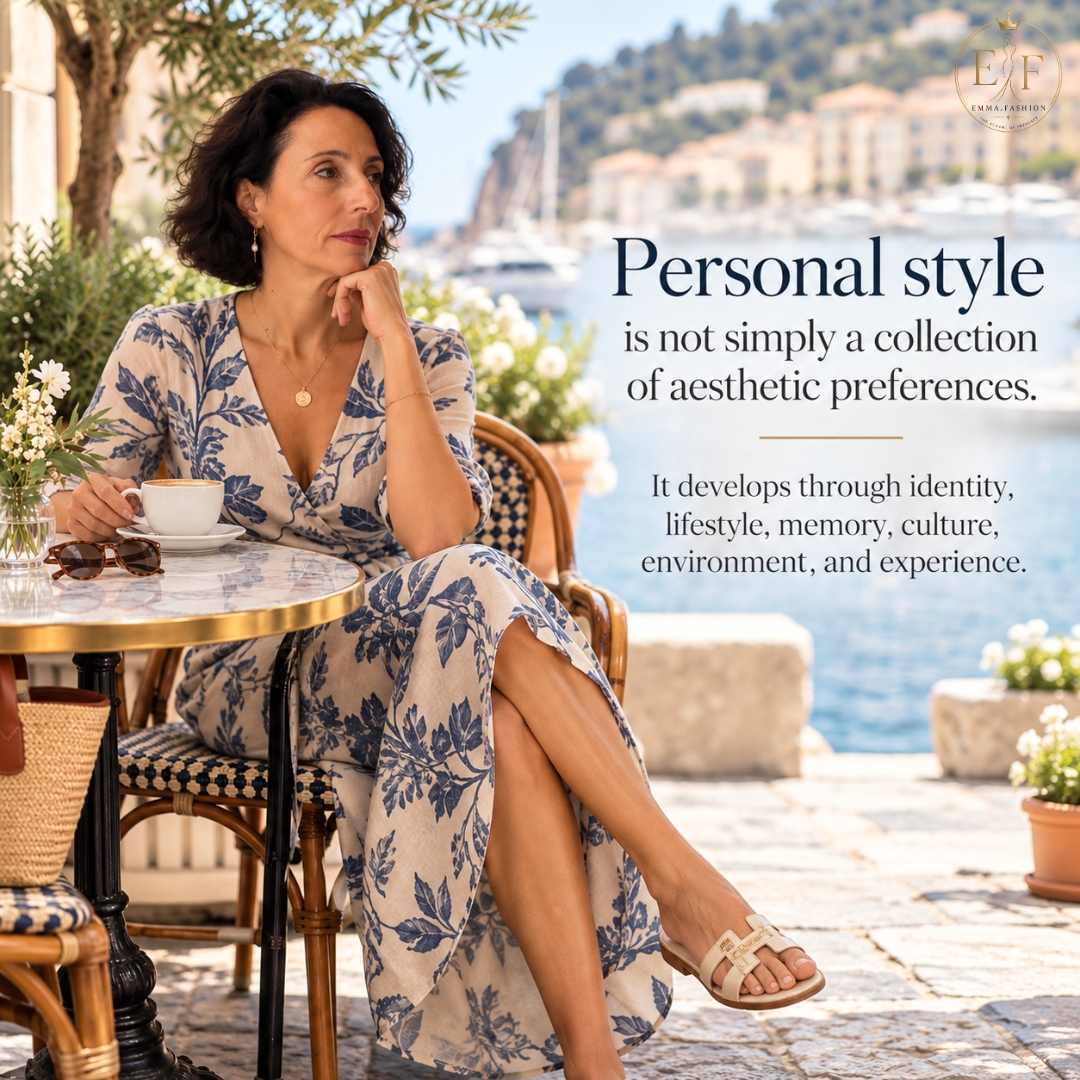
Personal style is not simply a collection of aesthetic preferences.
It develops through identity, lifestyle, memory, culture, environment, and experience.
Sometimes a wardrobe transition becomes difficult because the clothes that once made perfect sense belonged to another place, another rhythm, or another chapter of life.
The answer does not always need to be reinvention.
Through Emma.Fashion personal styling, image consulting, wardrobe guidance, and color analysis, we can identify what still belongs to you, what needs to adapt to your present environment, and how those influences can be integrated into a style that feels current without feeling disconnected from your history.
You do not have to choose between the woman you were there and the woman you are here.
Personal style can hold both.
Because sometimes the most authentic wardrobe is not the one that belongs perfectly to one place, but the one that reveals how thoughtfully we have learned to carry our places with us.