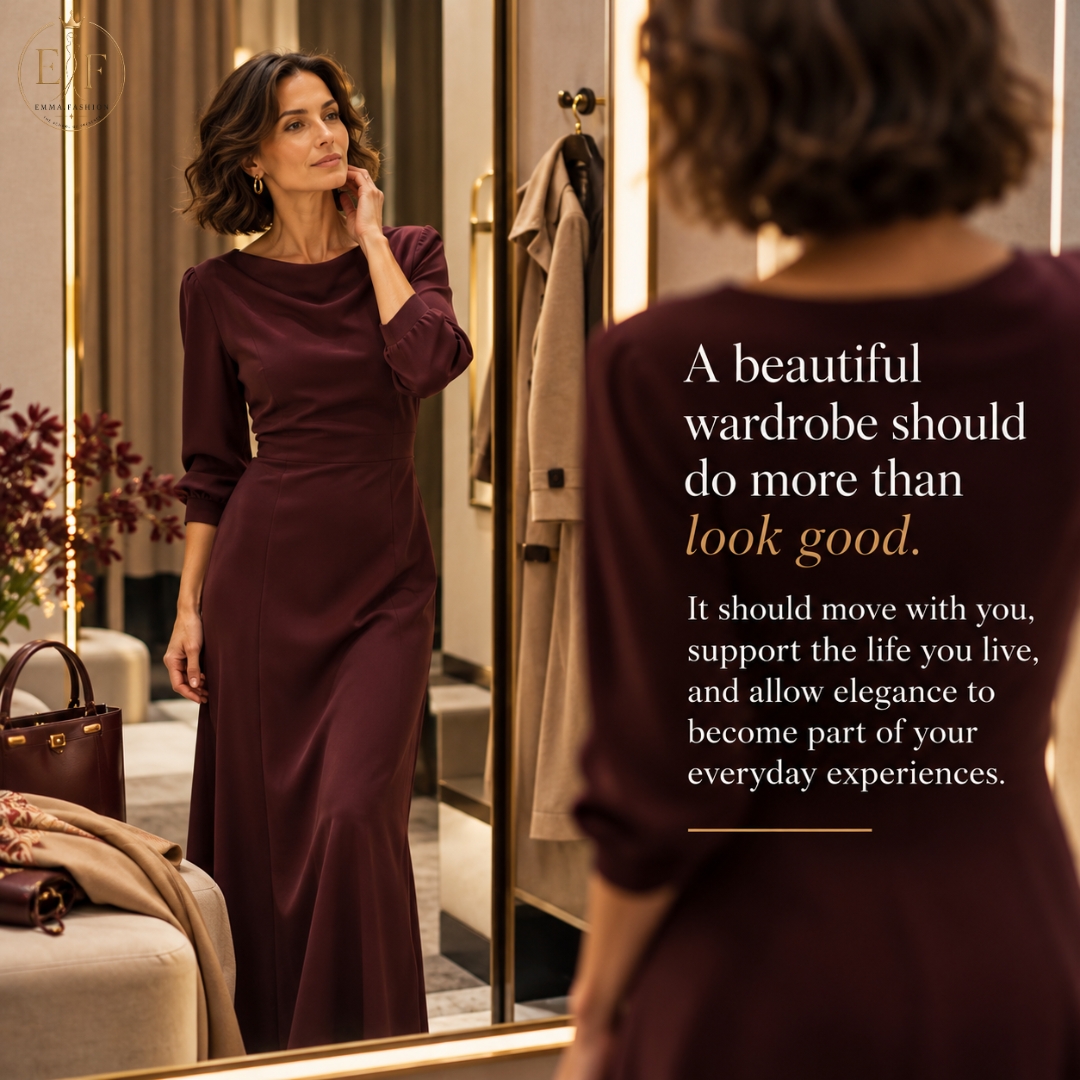
A woman stands in front of a fitting-room mirror. The dress falls beautifully. The color brings warmth to her face, the waist sits in the right place, and for a moment, the decision seems simple. She can already imagine wearing it.
Then she reaches for her bag. The sleeve pulls. She sits down, and the skirt rises further than she expected. She thinks about the walk from the parking lot, the coat she will need, and whether she can move through an ordinary afternoon without adjusting the neckline.
The dress is still beautiful. But a different question has entered the room: Can this beauty become part of my life?
Women rarely experience clothing as a single perfect image. They experience it while commuting, carrying bags, caring for children, working, traveling, and moving between roles. A garment accompanies a body in motion, a changing environment, and a day that may ask for more than one kind of presence.
This is where style beyond the fitting room begins. At Emma.Fashion, I see personal style as a relationship between what we wear, who we are, and how we live. The mirror gives us useful information. The day gives us the rest.
Table of Contents
- 1. A Wardrobe Is Lived In
- 2. The Difference Between Looking Right and Feeling at Ease
- 3. Dress for the Whole Day
- 4. Let Practicality Express Your Style
- 5. Try On the Garment—and the Life Around It
- 6. When Your Life Changes, Reconsider What Works
- 7. Beauty Belongs in the Ordinary
- Frequently Asked Questions
- Work with Emma
1. A Wardrobe Is Lived In
When we consider an outfit, we often picture its most composed moment: standing upright, bag in hand, everything arranged. Yet most of a day happens between those moments.
We sit at desks. Reach across tables. Climb stairs. Carry groceries. Take off a jacket and put it on again. A scarf shifts, a fabric creases, and shoes meet actual pavement.
These ordinary actions belong in our understanding of style. They help us recognize why some clothes become trusted companions while others remain attractive possibilities hanging in the closet.
A jacket may have the perfect silhouette, yet feel restrictive whenever you drive. A lovely bag may become uncomfortable once it holds what you need. A skirt may look elegant standing still but make you shorten every step.
The issue is the relationship between the piece and its purpose. A garment can be beautiful and still be unsuitable for a particular day.
2. The Difference Between Looking Right and Feeling at Ease
There is a particular ease in wearing clothes you can trust.
You know the neckline will stay where you want it. Your shoes allow you to walk at your natural pace. You can sit, greet someone, or reach for a document without first arranging yourself around your outfit.
That ease leaves more of your attention available for the people and responsibilities in front of you.
This does not mean every garment must feel like loungewear. A structured jacket can feel reassuring. A defined waist can feel comfortable. A beautiful shoe can offer enough support for the occasion. What matters is how the garment feels on your body and what it asks of you while you wear it.
Some attention is simply part of dressing: smoothing a skirt when you sit or adjusting a scarf when you arrive. But if you spend the day protecting an outfit from your movements, it is worth asking whether it serves you well.
Presence becomes easier when you do not have to keep negotiating with your clothes.
3. Dress for the Whole Day
An outfit may suit a meeting perfectly and still overlook everything required to get there.
Perhaps the morning includes a school drop-off, a train journey, and a ten-minute walk. Perhaps the office is cool, lunch is outdoors, and the evening brings a dinner invitation. The meeting is one part of the day. Dressing thoughtfully means considering the transitions as well.
Begin with a few concrete questions: Where will I go? How will I get there? What will I carry? How much walking, sitting, or standing will I do?
Then consider how you want to feel and what the setting asks of you.
For example, a woman who loves dresses might choose a fluid midi dress, a jacket that accommodates movement, and refined flats for a day of appointments. A bag large enough for her essentials completes the outfit. Each choice supports her preference for elegance while answering the practical demands of the day.
Another day may call for different shoes or a more formal silhouette. Style can remain recognizable while adapting to circumstances.
4. Let Practicality Express Your Style
Practical choices can carry personality.
A flat shoe can be sleek, feminine, understated, or expressive. A useful bag can have a beautiful shape. A warm coat can bring proportion and color to an outfit. Washable fabrics can have softness, movement, and a finish you enjoy.
The useful question is: What would make this function feel like me?
If you need comfortable walking shoes, consider the shape, color, and texture that belong with the clothes you wear most. If you carry several things, look for a bag whose capacity and weight work together. If you need layers, choose pieces that still feel complete when the outer layer comes off.
These decisions are part of styling. They connect aesthetic preferences to actual needs.
You do not have to abandon a refined wardrobe because your life is busy. You may need to become more precise about which forms of refinement work for you.
5. Try On the Garment—and the Life Around It
A fitting room can become a place of practical observation.
Before deciding, move as you expect to move in the garment. Sit if a seat is available. Walk several steps. Reach forward. Bend your elbows. Put on the coat you would wear over it, or consider whether your usual bag strap interferes with its collar or sleeves.
Notice what changes. Does the waistband press when you sit? Does the fabric become more transparent when stretched? Can you take a comfortable stride? Does the garment return to place after you move?
At home, try the complete outfit with the shoes and undergarments you intend to wear, while keeping to the retailer’s return conditions. A piece may work well on its own but reveal a missing connection when you style it.
That connection may already be in your wardrobe. A different shoe, a suitable camisole, or a small alteration may solve the problem. Other times, the garment simply requires more accommodation than you want to give it.
Recognizing this before committing is a form of clarity.
6. When Your Life Changes, Reconsider What Works
Sometimes clothes stop working because the life around them has changed.
A move introduces a different climate. A new job changes the balance between desk work and walking. Caring for a child makes easy movement more important. Retirement reshapes the occasions around which a wardrobe was built.
Your taste may remain familiar while your daily needs shift. You can still love the same colors, proportions, or sense of elegance and choose different fabrics, shoes, and combinations.
Before replacing everything, identify what no longer fits the day. Is it the level of formality? The amount of care required? The footwear? The absence of a connecting layer?
One thoughtful adjustment may bring several pieces back into use. And some garments may belong to a chapter you want to remember rather than to your working wardrobe. You can honor their meaning without asking them to serve a life they no longer suit.
7. Beauty Belongs in the Ordinary
There is pleasure in wearing something beautiful on an ordinary day: a soft knit in a color you love, earrings that feel familiar, a dress that moves easily as you walk.
Beauty does not always need a special occasion. It needs a place in your life.
The clothes we return to often bring several things together. They feel like us. They suit our bodies. They respect the setting. They allow us to do what the day requires.
Over time, that relationship gives a garment meaning. It becomes the coat you reach for before a long walk, the dress you trust for a busy afternoon, or the jacket that helps you feel composed when the day asks a little more of you.
Style is not proven in the fitting room. It is proven in the relationship between the garment, the woman, and the day she must actually live.
A beautiful garment becomes meaningful when it can enter a life. Allow it to enter yours.
Frequently Asked Questions
How can I tell whether a beautiful garment will work for my everyday life?
Consider how the garment feels and functions beyond the fitting-room mirror. Sit, walk, reach, and move as you would during an ordinary day. Think about your activities, climate, footwear, and the other pieces you would wear with it. A garment is more likely to become part of your wardrobe when it supports both your personal style and the practical demands of your life.
Can comfortable clothing still look elegant and polished?
Yes. Comfort and elegance are not opposites. A well-cut jacket, fluid trousers, refined flats, or a beautifully made dress can provide ease while maintaining structure and polish. The goal is to choose garments that express your style without unnecessarily restricting movement or requiring constant adjustment.
What should I consider before buying clothes for a busy lifestyle?
Think about the activities that make up your actual week, including commuting, working, walking, caring for family, traveling, and social occasions. Consider comfort, fabric care, footwear, layering, and how easily the garment combines with what you already own. A useful purchase should have a realistic place in your life rather than depend on an imagined occasion.
How can I maintain my personal style when my lifestyle changes?
Begin by identifying the elements of your style that still feel authentic, such as preferred colors, silhouettes, textures, or levels of refinement. Then adapt their expression to your new circumstances. You may need different fabrics, shoes, layers, or proportions without abandoning the qualities that make your style recognizable.
Why do some clothes look beautiful but remain unworn?
A garment may be visually appealing without fitting the practical needs of your life. It might restrict movement, require difficult care, lack compatible pieces, or suit occasions that rarely occur. Understanding the difference between admiring a garment and enjoying wearing it can help you make more intentional wardrobe decisions.
Work with Emma
Create a wardrobe that belongs to your real life
A beautiful wardrobe should do more than look appealing when everything is perfectly arranged.
It should support the way you move, work, travel, care for others, and participate in the experiences that make up your life.
Through Emma.Fashion personal styling, image consulting, wardrobe guidance, and color analysis, we can explore the relationship between your personal style, your lifestyle, and the clothes you actually wear.
Together, we can identify which garments support you, which need a different styling approach, and where thoughtful adjustments may make your wardrobe more functional without sacrificing beauty.
The goal is not to choose practicality instead of elegance.
It is to bring them into alignment.
Because personal style becomes meaningful when the clothes you love can become part of the life you live.