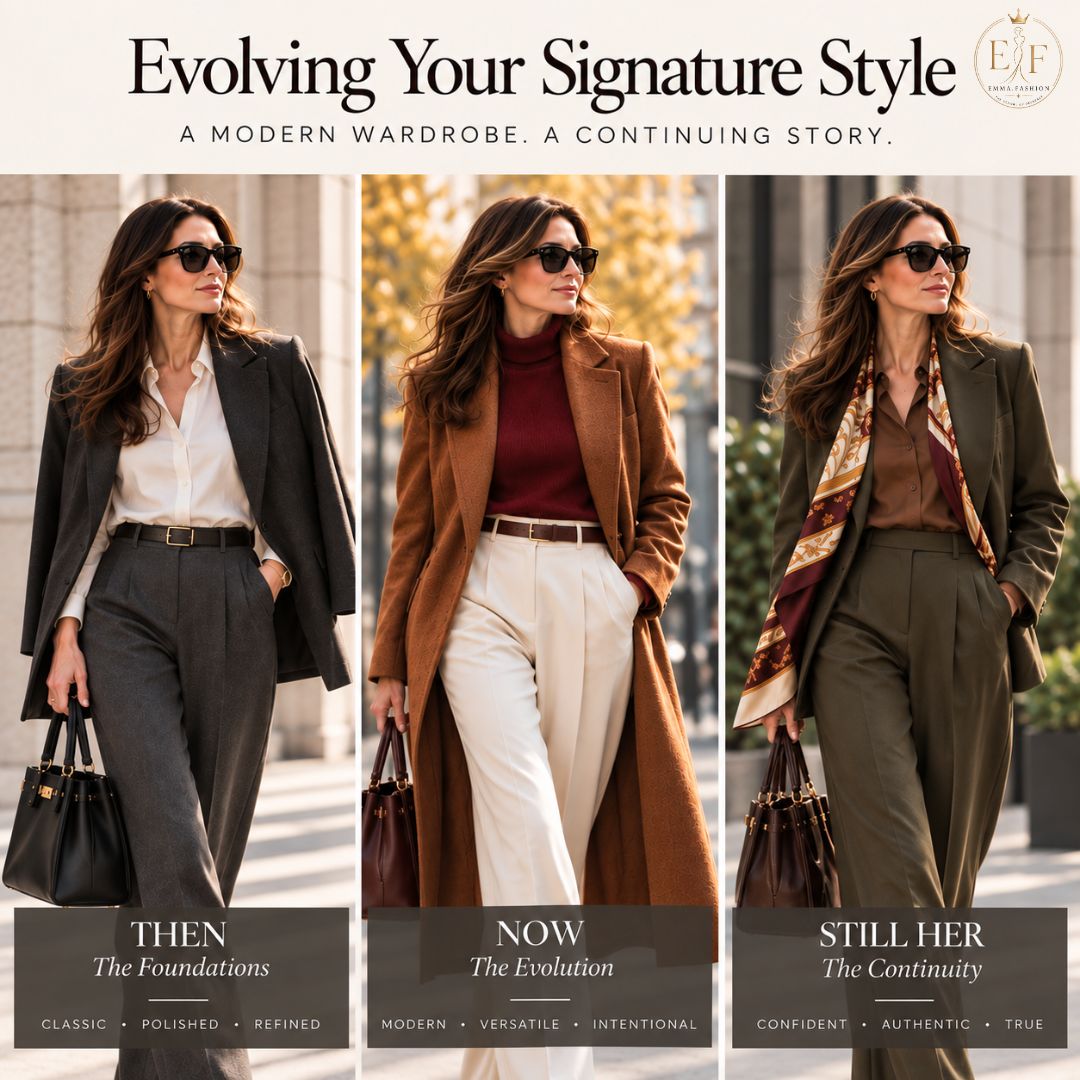
There is comfort in discovering a signature style.
Certain colors begin to feel unmistakably yours. You recognize the silhouettes that make you feel most like yourself. Perhaps you return to tailored jackets, fluid trousers, vivid scarves, sculptural jewelry, feminine dresses, monochromatic dressing, or a particular combination of refinement and ease.
Over time, repetition creates recognition.
Other people may begin associating certain details with you. More importantly, you recognize yourself in what you wear.
But then life changes.
Your body changes. Your work changes. Your environment changes. Your responsibilities shift. Your taste becomes more discerning. Something you once loved begins to feel slightly disconnected from the woman standing in front of the mirror.
And this is where signature style can become complicated.
What once gave us clarity can begin to feel like an obligation if we confuse consistency with sameness.
A signature style should provide continuity, not confinement.
The goal is not to dress as you once did, but to carry what is still true into the woman you are becoming.
Table of Contents
- 1. Signature Style Is Not a Uniform
- 2. Separate the Essence from the Expression
- 3. Notice What No Longer Feels Like You
- 4. Identify What Is Still True
- 5. Allow Your Silhouettes to Evolve
- 6. Update the Details Before Replacing the Identity
- 7. Let Lifestyle Change the Translation
- 8. Keep Recognition Without Repetition
- 9. Make Room for the Unexpected
- 10. Edit the Wardrobe of Your Former Self
- 11. Dress for Continuity and Becoming
- Frequently Asked Questions
- Work with Emma
1. Signature Style Is Not a Uniform
Recognition does not require repetition of the exact same formula
When we hear signature style, we often imagine a recognizable visual formula.
The woman who always wears black.
The woman known for beautiful scarves.
The woman in sharply tailored jackets.
The woman who never appears without red lipstick.
The woman whose wardrobe is almost entirely neutral.
These signatures can be powerful because repetition creates familiarity.
But repetition becomes limiting when we begin believing:
This is what I wear because this is who I am.
The distinction may seem small, but it matters.
Personal style expresses identity.
It should not imprison it.
Your signature should belong to you—not the other way around
If you once built your wardrobe around pencil skirts and fitted blazers, you do not need to continue wearing that exact combination simply because people associate it with you.
Perhaps the structure still feels right.
But today, that structure might appear through fluid trousers and a softly tailored jacket.
The visual language has changed.
The underlying idea has not.
A signature style is strongest when it can evolve without becoming unrecognizable.
2. Separate the Essence from the Expression
Ask what you actually loved about the look
One of the most useful ways to evolve personal style is to separate essence from expression.
The expression is the visible garment.
The essence is what that garment gave you.
Perhaps you have always loved tailored clothing.
But what exactly did you love about it?
Was it the blazer?
Or was it:
- Structure
- Authority
- Clean lines
- Refinement
- Precision
- A sense of being composed
Those qualities can be expressed through many different clothes.
Perhaps you have always worn floral dresses.
Was the floral print itself essential?
Or were you responding to:
- Femininity
- Movement
- Softness
- Color
- Romance
- A connection to nature
Again, the essence can survive even if the expression changes.
Keep the meaning and change the form
This distinction creates freedom.
You can release the garment without necessarily releasing the part of yourself it represented.
A fitted blazer can become a relaxed architectural jacket.
A high heel can become an elegant pointed flat.
A traditional floral can become an abstract botanical print.
A statement necklace can become sculptural earrings.
A bright wardrobe can become more tonal while retaining one vivid accent.
The signature remains recognizable because the meaning underneath it remains consistent.
3. Notice What No Longer Feels Like You
Sometimes clothes still fit physically but not psychologically
There is a particular moment that often happens during a wardrobe transition.
You put something on.
It still fits.
The color still flatters you.
There is nothing objectively wrong with it.
And yet you look in the mirror and think:
This isn’t me anymore.
That feeling deserves attention.
We sometimes resist it because the garment once played an important role in our identity.
Perhaps it belonged to a successful professional period.
A younger version of ourselves.
A former lifestyle.
A city we once lived in.
A relationship.
A social identity.
A version of femininity we once understood differently.
Letting go can feel as though we are rejecting that woman.
But evolution does not require rejection.
Gratitude and continuation are different things
You can appreciate what a garment represented without continuing to wear it.
You can say:
That was me.
Without needing to say:
That must remain me.
This is one of the quiet maturities of personal style.
We learn to distinguish between clothes that carry meaningful history and clothes that still carry meaningful relevance.
Both can matter.
Only one needs to determine how we dress today.
4. Identify What Is Still True
Before changing everything, look for the thread
Style evolution does not always require reinvention.
In fact, starting from the assumption that everything needs to change can make us lose precisely what made our style personal in the first place.
Instead, ask:
What has remained remarkably consistent?
Perhaps you have always loved:
- Strong shoulders
- Fluid fabrics
- Long lines
- Defined waists
- Minimal jewelry
- Dramatic jewelry
- Rich color
- Monochromatic palettes
- Natural textures
- Tailoring
- Softness
- Contrast
- Simplicity
Look beyond individual garments.
Look for patterns.
Your adjectives may reveal more than your clothes
You can also ask how you have consistently wanted to feel.
Perhaps your words are:
Refined. Effortless. Distinctive.
Or:
Modern. Feminine. Relaxed.
Maybe they are:
Creative. Elegant. Unexpected.
These words can become much more useful than trying to preserve a particular outfit formula.
A blazer can change.
A hemline can change.
A shoe can change.
But refined can travel with you for decades.
Your signature may live less in what you wear than in the qualities you repeatedly choose to express.
5. Allow Your Silhouettes to Evolve
Familiar does not always mean current
Silhouette is one of the places where a signature style can quietly become frozen in time.
Perhaps you discovered that a particular jacket shape looked wonderful on you fifteen years ago.
So you kept buying it.
The same length.
The same shoulder.
The same waist.
The same trousers underneath.
Nothing is necessarily wrong with those clothes.
But eventually, the combination may communicate the period in which you discovered your style more strongly than it communicates who you are today.
Change proportion without abandoning preference
If you love tailoring, keep tailoring.
But experiment with proportion.
Try:
- A slightly longer jacket
- A softer shoulder
- Fluid trousers
- A shorter jacket with a higher-rise trouser
- A relaxed suit
- A tailored vest
- A blazer over an unexpected feminine piece
If you love dresses, you do not need to stop wearing dresses.
Explore a different length.
A cleaner neckline.
A more contemporary sleeve.
A new relationship between volume and waist definition.
The objective is not to chase every new silhouette.
It is to prevent familiarity from becoming automatic.
Current style does not require abandoning your visual language. Sometimes it simply requires updating its grammar.
6. Update the Details Before Replacing the Identity
Small changes can create significant movement
When a wardrobe begins feeling dated, we sometimes assume we need entirely new clothes.
Often, the first place to look is at the styling.
Shoes can change the era of an outfit.
So can:
- Eyewear
- Jewelry
- Handbags
- Belts
- Hair
- Makeup
- The way a shirt is tucked
- The way sleeves are worn
- Trouser length
- Layering
- The relationship between fitted and relaxed pieces
Imagine a classic trouser suit you have owned for years.
Perhaps you once wore it with a silk blouse, pumps, and a structured handbag.
Today, try the same suit with a fine crewneck knit, modern flat, sculptural earring, and softer bag.
The suit has not changed.
The woman wearing it appears to have moved forward.
Evolution does not always require consumption
This is important.
Style evolution can easily become another reason to shop.
But before buying a new identity, experiment with the wardrobe you already own.
Remove something.
Change the shoe.
Alter the proportion.
Separate a matching set.
Introduce a different texture.
Wear the familiar piece in an unfamiliar way.
Sometimes the wardrobe is not outdated.
The styling habit is.
7. Let Lifestyle Change the Translation
Personal style must survive real life
A signature style cannot remain authentic if it ignores the life you actually live.
Perhaps your style developed while working in a formal corporate environment, but today your professional life is more flexible.
Perhaps you moved from a metropolitan city to a smaller community.
Perhaps you travel more.
Work from home.
Attend fewer formal events.
Walk more.
Enter leadership.
Retire.
Become a mother.
Return to work.
Your identity may contain continuity through all of these changes.
Your wardrobe cannot always remain the same.
Adaptation is not loss of self
Suppose refinement has always been important to you.
In one life stage, refinement may have meant:
Tailored suit + silk blouse + pumps.
In another, it might become:
Fluid trousers + fine knit + elegant flat + beautiful jewelry.
The level of formality has changed.
The underlying value has not.
This is the difference between adapting and disappearing.
When we understand the essence of our style, we can translate it into different environments without feeling that we have surrendered ourselves to them.
The question is not, “How do I keep dressing as I always have?”
It is:
“How does my style speak this language now?”
8. Keep Recognition Without Repetition
Signature style is often created through recurring signals
You do not need to wear the same combination repeatedly to remain recognizable.
Instead, consider maintaining several recurring elements.
Perhaps yours are:
- A particular family of colors
- Beautiful scarves
- Strong tailoring
- Gold jewelry
- Interesting eyewear
- A defined waist
- A mixture of feminine and structured pieces
- A distinctive shoe
- One unexpected color
- Natural fabrics
- Clean architectural lines
These become visual threads.
They appear differently from outfit to outfit, but they create continuity.
Think vocabulary rather than uniform
Language gives us a useful analogy.
You can express thousands of different ideas using a recognizable vocabulary and voice.
Personal style can work the same way.
You do not need to repeat the same sentence.
You need enough consistency in the language that it still sounds like you.
Signature style is not repetition of an outfit. It is recognition of a voice.
9. Make Room for the Unexpected
Personal style needs curiosity
Once we become confident in our style, another risk appears.
We become very good at knowing what we like.
Perhaps too good.
I don’t wear that color.
That silhouette isn’t me.
I never wear prints.
I only wear gold.
I don’t wear flats.
I am a classic dresser.
These statements can provide useful boundaries.
But they can also become doors we stop opening.
Try without immediately adopting
You do not need to reinvent yourself every season.
But allow yourself to experiment.
Try the unusual color.
Put on the oversized jacket.
Experiment with the flat shoe.
Wear the sculptural earring.
Try the dress you would normally walk past.
The goal is not necessarily to buy it.
The goal is to remain curious about yourself.
Sometimes you will confirm:
No. That still isn’t me.
That is useful information.
But occasionally you may discover:
I didn’t know this could be me.
And that is where style evolution becomes interesting.
We do not always discover who we are by repeating what we already know.
10. Edit the Wardrobe of Your Former Self
Some clothes belong to a woman you still recognize but no longer are
Wardrobes accumulate identities.
The professional you once were.
The body you once had.
The lifestyle you once lived.
The occasions you once attended.
The version of femininity you once preferred.
The aspirations you once carried.
This is why editing a wardrobe can become emotional.
We are not always deciding whether to keep a skirt.
Sometimes we are deciding what relationship we want to maintain with a former version of ourselves.
Ask whether the garment carries memory or possibility
When you encounter something you no longer wear, ask:
Does this garment belong to my past, or does it still have a future with me?
If it belongs to the past, you may still choose to keep it because it carries meaningful memory.
But recognize the reason.
You are preserving an artifact.
You are not necessarily preserving a wardrobe option.
For other pieces, ask whether they can be translated.
Could the jacket be altered?
Could the dress be styled differently?
Could the jewelry that once accompanied formal clothes become the distinctive element in a simpler outfit?
Could one part of the old signature survive while the rest is released?
This allows the wardrobe to evolve without demanding that every former self disappear.
Editing is not erasing. It is deciding what continues with you.
11. Dress for Continuity and Becoming
Personal style lives between memory and possibility
There are two tempting ways to approach style as we change.
One is to cling to the familiar.
This is who I have always been.
The other is to reject everything and reinvent ourselves completely.
That woman no longer exists.
But perhaps personal style becomes richest somewhere between those two extremes.
We carry something forward.
We release something.
We reinterpret something.
And we discover something we could not have worn authentically before.
Let your signature become a thread
Imagine your style across twenty or thirty years.
The clothes will change.
Your body may change.
Your hair may change.
Your lifestyle almost certainly will.
The cultural context will change around you.
If your signature style depends on one jacket, one silhouette, one trend, or one period of your life, eventually it will become difficult to preserve.
But if the signature lives in something deeper—your relationship with color, your preference for refinement, your love of contrast, your sense of femininity, your restraint, your creativity, your ease—then it can travel with you.
The expression evolves.
The thread remains.
Perhaps that is the difference between simply having a recognizable look and developing genuine personal style.
One asks:
How do I continue looking like myself?
The other asks:
What is still true about me—and how does the woman I am now want to express it?
A signature style should not become a costume we continue wearing out of loyalty to our past.
Nor should evolution require abandoning everything that made us recognizable to ourselves.
It should allow continuity and change to exist together.
Because becoming someone new does not always mean leaving yourself behind.
Sometimes it means finally understanding which parts of yourself were meant to come with you.
A signature style should provide continuity, not confinement. The goal is not to dress as you once did, but to carry what is still true into the woman you are becoming.
Frequently Asked Questions
What is a signature style?
A signature style is a recognizable visual language created through the colors, silhouettes, proportions, textures, accessories, and styling choices you return to consistently. It does not require wearing the same type of outfit every day. A strong signature style creates continuity while leaving enough room for your wardrobe to evolve with your identity, lifestyle, and taste.
How do I update my signature style without losing what makes it personal?
Begin by identifying what you genuinely love beneath the individual garments. You may discover that the essence of your style is refinement, structure, femininity, ease, color, creativity, or another recurring quality. Keep those elements while experimenting with new silhouettes, proportions, accessories, and ways of styling them. The expression can change while the underlying identity remains recognizable.
How do I know when my personal style needs to evolve?
You may notice that clothes you once loved still fit but no longer feel like you, that your wardrobe reflects a former lifestyle more than your current one, or that your usual outfits feel repetitive rather than reassuring. These feelings do not necessarily mean you need an entirely new wardrobe. They may simply indicate that your external style needs to catch up with changes already taking place in your identity or life.
Do I need to replace my wardrobe when my style changes?
No. Begin by restyling what you already own. Change proportions, shoes, accessories, layering, and combinations before deciding what needs to be replaced. Some garments may become relevant again when worn differently, while others may genuinely belong to a former version of your life. Style evolution is often more about editing and reinterpretation than starting over.
Can a signature style change as I get older?
Yes. A signature style should be able to mature with you. Aging does not require abandoning individuality or becoming more conservative, but your preferences, body, lifestyle, and understanding of yourself may change. The goal is not to preserve the exact clothes of an earlier version of yourself, but to carry forward the qualities that remain authentic while allowing their expression to evolve.
Work with Emma
Your style can evolve without becoming unfamiliar
Sometimes the difficulty is not discovering your personal style.
It is understanding what to do when the style that once felt completely right no longer expresses the whole woman you have become.
Through Emma.Fashion personal styling, image consulting, wardrobe guidance, and color analysis, we can identify the elements of your style that remain authentic, the pieces and habits that belong to an earlier chapter, and the new possibilities that deserve room to emerge.
The goal is not to replace your identity with a new aesthetic.
It is to create alignment between continuity and change.
To recognize what still feels like you.
To release what no longer needs to define you.
To translate your signature into the life you live now.
And to leave enough space for something new to become part of your visual language.
Because personal style is not a finished portrait.
It is a relationship with yourself—and like you, it should be allowed to evolve.