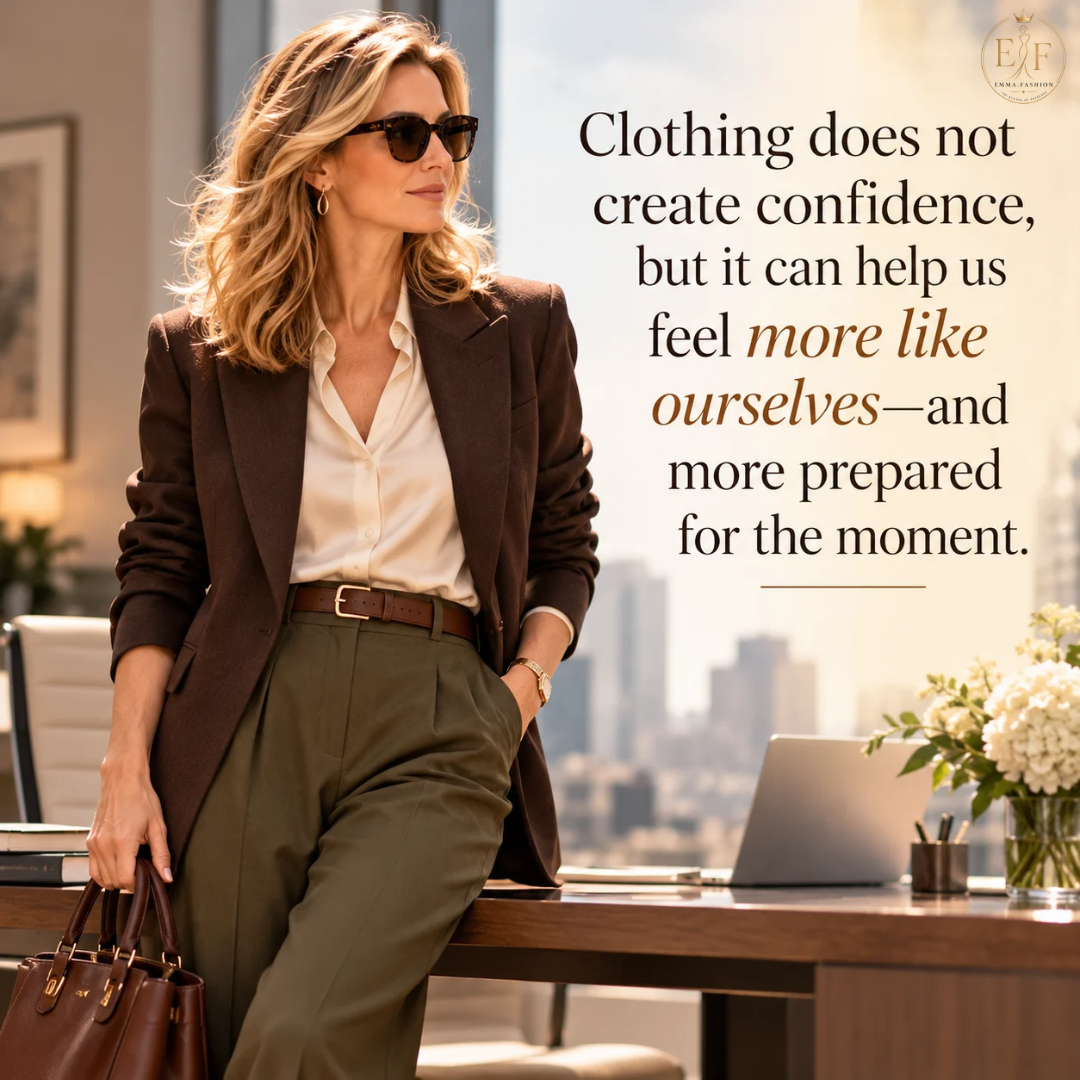
We often hear that the secret to dressing confidently is simple: wear what makes you feel good, forget what others think, and be yourself.
There is value in that advice. But it overlooks something important about how we experience clothing. We do not dress in isolation. We dress for work, relationships, responsibilities, celebrations, unfamiliar environments, and the ordinary moments that make up our lives.
A woman may feel more confident because her clothes express something authentic about her. She may also feel more at ease because she understands the setting and knows her appearance is appropriate for the occasion. One experience comes from feeling connected to herself. The other comes from feeling prepared to participate in the world around her.
These experiences are not necessarily in conflict. In fact, some of our most comfortable moments of self-expression occur when the two come together.
Clothing does not manufacture confidence. It can, however, reduce inner friction—helping a woman feel recognizable to herself and prepared for the moment she is entering.
Table of Contents
- 1. Confidence Is More Than a Feeling About Our Appearance
- 2. Why Clothing Can Change How We Feel
- 3. The Confidence of Recognizing Yourself
- 4. The Confidence of Understanding the Setting
- 5. Why Dressing Only for Yourself Is Not the Whole Story
- 6. When Clothing Creates Inner Friction
- 7. The Difference Between Feeling Confident and Looking Confident
- 8. How to Dress for Readiness Rather Than Approval
- 9. When Confidence Must Come Before the Clothes
- 10. Authenticity and Context: Where Confidence Finds Alignment
- Frequently Asked Questions
- Work with Emma
1. Confidence Is More Than a Feeling About Our Appearance
Imagine two women preparing for an important professional meeting.
The first chooses an outfit she genuinely loves. The colors flatter her, the silhouette reflects her personality, and she feels beautiful wearing it.
But when she arrives, she realizes that the environment is considerably more formal than she expected. She begins wondering whether her clothes communicate the professionalism she intended.
The second woman chooses an outfit that fits the expectations of the workplace perfectly. It is polished, appropriate, and carefully coordinated.
Yet when she looks in the mirror, she barely recognizes herself. The outfit feels like something she believes a professional woman should wear rather than something that expresses the professional woman she is.
Both women have made reasonable choices. And both may experience discomfort. The first feels connected to herself but uncertain about the context. The second feels prepared for the context but disconnected from herself. Neither experience means that the woman lacks confidence.
It suggests that confidence in clothing involves more than liking what we see in the mirror.
We also want to feel that our appearance belongs to the moment we are entering.
2. Why Clothing Can Change How We Feel
Clothing carries meaning
We do not experience clothing as fabric alone.
A tailored jacket may remind us of professional responsibility. A familiar dress may bring a sense of ease. A garment associated with an important achievement may evoke memories of capability. A particular color may feel connected to our personality, while another may make us feel unusually visible or unlike ourselves. These associations can influence how we experience getting dressed.
In psychology, the concept of enclothed cognition explores how wearing clothing may influence certain psychological processes through the symbolic meaning of the garment and the experience of wearing it.
This does not mean that putting on a blazer automatically makes someone competent, or that wearing an elegant dress creates confidence. The relationship is more complex.
Clothing may influence attention, self-perception, expectations, and behavior in particular circumstances. Those effects depend on meaning, context, and the individual, and they should not be confused with a permanent change in personality or ability.
The garment does not contain the quality
Consider a woman putting on a jacket before giving a presentation. The jacket does not give her knowledge of the subject. It does not create the experience she has gained. It does not guarantee that her audience will respond positively. But if the jacket feels familiar, comfortable, and appropriate, it may help her enter the situation with less concern about her appearance. Her attention can remain on what she has prepared to say.
The clothing has not created her capability. It has helped her feel ready to use it. That distinction matters.
3. The Confidence of Recognizing Yourself
Personal style creates a sense of continuity
There is a particular comfort in looking in the mirror and feeling that the woman looking back is recognizable. Not because every detail is perfect, or the outfit is fashionable. But because something about the combination feels consistent with who you are. Perhaps you have always preferred dresses, or you feel most natural in tailored trousers and a simple blouse. Probably color is essential to your expression, or you prefer understated clothing with one distinctive accessory. These preferences may seem small, but over time they become part of your visual identity.
When clothing reflects that identity, getting dressed can feel less like creating an image and more like expressing something already familiar.
Authenticity reduces the need to perform
Imagine a woman who feels most comfortable in refined, feminine clothing. She begins working in an environment where everyone dresses casually. Wanting to fit in, she gradually replaces her dresses with outfits similar to those worn by her colleagues. The clothes are appropriate and they may even be practical. But she begins to feel that something is missing. Her discomfort may not come from the garments themselves. It may come from the distance between her appearance and her sense of identity.
The solution is not necessarily to return to the exact clothes she wore before. She might discover a more relaxed expression of femininity through soft tailoring, simple dresses, beautiful flats, or carefully chosen fabrics. She can respond to her environment without abandoning herself.
Confidence becomes easier when adaptation does not require self-erasure.
4. The Confidence of Understanding the Setting
Appropriateness can provide reassurance
Now consider a different experience. You are invited to an event where you know very little about the expected dress. You choose an outfit you love, but as the event approaches, you begin to wonder:
Will everyone be more formal?
Will I look too casual?
Will my clothes seem out of place?
Will I be comfortable participating?
The uncertainty may have little to do with your opinion of yourself. It comes from not knowing how your appearance will relate to the situation.
When you understand the setting, some of that uncertainty disappears. You know what the occasion requires, and how much formality is expected. You know whether you will be walking, sitting, presenting, celebrating, or participating in a particular activity. And you can make your choices accordingly.
Context is not the enemy of authenticity
Sometimes we interpret concern for appropriateness as a lack of confidence. We assume that a truly confident woman should dress however she wants, regardless of the environment. But awareness of context is not necessarily insecurity. It can be a form of social intelligence.
A woman may choose more conservative clothing for a professional meeting because she understands the expectations of the organization. She may choose a modest outfit for a religious ceremony because she respects the setting. She may wear practical shoes for an outdoor celebration because she wants to participate comfortably. None of these choices requires her to surrender her identity.
Understanding the context allows personal style to become responsive rather than merely expressive.
5. Why Dressing Only for Yourself Is Not the Whole Story
We are individuals, but we are also social beings
“Dress for yourself” is often presented as the ultimate expression of confidence. And in one sense, it is an important reminder.
Our clothing choices should not be governed entirely by the desire to please others. But the advice becomes incomplete when it suggests that other people and social settings should have no influence on how we dress.
Clothing communicates through formality, color, silhouette, cultural associations, and the relationship between our appearance and the occasion. We may not control how every person interprets our clothing, but we can make thoughtful choices about what we intend to express.
Consideration is not the same as seeking approval
There is a difference between asking:
Will everyone approve of what I am wearing?
and asking:
Does what I am wearing respect the occasion and allow me to participate comfortably?
The first question can place our sense of worth in the hands of others. The second reflects awareness and judgment. We do not need universal approval to dress appropriately. Nor do we need to ignore social expectations to remain authentic.
Personal style and etiquette are not opposing forces.
Personal style asks us to remain ourselves. Etiquette asks us to remain considerate of others.
When these two qualities work together, clothing can express individuality without creating unnecessary distance from the people around us.
6. When Clothing Creates Inner Friction
The small discomforts that occupy our attention
Think about the last time you wore something that looked beautiful but did not feel quite right. Perhaps the neckline required constant adjustment, or the shoes were uncomfortable. Maybe the outfit was more formal than the occasion required. Or probably you had chosen something simply because it was fashionable, even though it did not feel like you. You may have spent part of the day thinking about your clothes instead of the experience in front of you. This is what I mean by inner friction.
It is the tension that can arise when clothing, identity, physical comfort, and context do not work together.
It may appear as:
- Feeling unlike yourself in an otherwise attractive outfit.
- Constantly adjusting a garment that does not move comfortably.
- Wondering whether you misunderstood the dress code.
- Feeling overly visible when you intended to remain understated.
- Feeling insufficiently prepared for an important occasion.
- Wearing something that reflects an earlier version of your life but no longer suits your present circumstances.
These experiences are not always signs of insecurity. Sometimes they are useful information.
Clothing can reduce friction without solving everything
When we identify the source of discomfort, the solution may be surprisingly simple: a different shoe, a more suitable fabric, a familiar silhouette, a jacket that provides structure,a color that feels more natural, or an outfit that better reflects the occasion. Small changes can make it easier to stop monitoring our appearance. But we should be careful not to expect clothing to solve discomfort that comes from other sources.
A new outfit cannot resolve every fear of judgment. It cannot eliminate uncertainty about a new responsibility. It cannot replace self-knowledge, preparation, or experience.
Clothing can remove some obstacles to presence. It cannot do the inner work of confidence for us.
7. The Difference Between Feeling Confident and Looking Confident
Appearance and inner experience are not identical
We often describe an outfit as confident: a blazer with strong shoulders, or a top with bold color. Maybe a sharply tailored suit or a dramatic accessory. These elements can create an impression of authority, visibility, or self-assurance. But looking confident and feeling confident are different experiences.
A woman may look exceptionally polished while feeling uncertain. Another may wear a simple outfit and feel completely at ease. Neither her level of confidence nor her competence can be reliably determined from clothing alone. This is especially important in professional image consulting.
The purpose of a strong personal image is not to manufacture a personality for public consumption. It is to help appearance, behavior, communication, and presence support one another.
Confidence is expressed through more than clothes
Consider two women entering a meeting in similarly tailored outfits. One is preoccupied with whether she looks impressive. The other is focused on the people she is meeting and the contribution she intends to make. Their clothing may be almost identical. But their experience of the moment is different.
The distinction is not necessarily visible at first glance. Over time, however, presence becomes evident through how a person listens, speaks, moves, responds, and engages.
Clothing may support that presence. It cannot substitute for it.
8. How to Dress for Readiness Rather Than Approval
Begin with the purpose
Instead of asking only, What will make me look confident?, try asking:
What will help me feel prepared for this particular moment?
That question brings clothing back into relationship with your life.
Before choosing an outfit, consider three things.
1. What feels authentic to me?
Think about the elements of style that help you recognize yourself.
Perhaps you prefer:
- Defined or relaxed silhouettes.
- Feminine details or understated tailoring.
- A familiar color palette.
- Simple clothing with expressive accessories.
- Structure, softness, or a combination of both.
You do not need to repeat the same outfit every day. You are looking for continuity in how you express yourself.
2. What does the setting require?
Consider the occasion:
Is it professional, social, formal, casual, or ceremonial?
Will you be meeting new people?
Are there cultural or organizational expectations?
What activities will you need to perform?
Understanding the environment can reduce uncertainty before you arrive.
3. What will allow me to participate comfortably?
This question is often overlooked. Can you walk naturally in the shoes? Sit comfortably? Move your arms? Manage the temperature? Carry what you need? Remain focused without adjusting your clothes repeatedly?
An outfit should support your participation rather than become another responsibility to manage.
A practical exercise: The readiness check
The next time you prepare for an important occasion, put on your complete outfit and ask yourself:
- Identity: Do I recognize myself in this?
- Context: Does this outfit make sense for where I am going?
- Comfort: Can I move and participate naturally?
- Purpose: Does my appearance support what I am there to do?
If one answer is no, consider whether a small adjustment could resolve it. You may not need an entirely different outfit. You may simply need to bring one element into better alignment.
9. When Confidence Must Come Before the Clothes
Some situations will feel uncomfortable regardless of what we wear
There are moments when no outfit can make us feel completely ready: the first day in a new profession, a difficult conversation, a public presentation, an unfamiliar social environment, or a major life transition.
We may choose clothing carefully and still feel nervous. That does not mean the outfit has failed. It means we are human.
Confidence is not always the absence of uncertainty. Sometimes it is the willingness to participate while uncertainty remains.
Do not make clothing responsible for your courage
A woman preparing for a presentation may feel better in a familiar suit. But she still needs to understand her subject. She still needs to practice, to manage the discomfort of being visible, and she still needs to speak.
The suit can accompany her through the experience. It cannot have the experience for her. The same is true of social confidence.
Beautiful clothes may help us feel prepared to enter a room, but connection develops through attention, warmth, conversation, and the willingness to engage with others.
We should allow clothing to support us without asking it to prove our worth.
Sometimes the most confident thing a woman can do is enter the room before she feels entirely ready.
10. Authenticity and Context: Where Confidence Finds Alignment
The strongest relationship is not between clothing and approval
It is between the woman, her identity, and the moment she is entering.
When clothing feels authentic but ignores the occasion, it may create unnecessary discomfort. When clothing meets every expectation but feels disconnected from the woman wearing it, it may create another kind of tension. But when personal expression and context work together, the outfit can become less demanding.
The woman no longer needs to spend as much attention wondering whether she looks like herself or whether she belongs in the setting. She can turn toward the purpose of being there.
This does not guarantee confidence. Nor does it mean every outfit must achieve perfect alignment. It means clothing can become one less source of distraction.
Presence begins when attention moves beyond appearance
Perhaps this is the most valuable role clothing can play. Not to make us more impressive. Not to guarantee approval. Not to convince us that we have become someone different. But to help us feel sufficiently at ease that our attention can move outward. Toward the conversation, the work, the people, the experience.
A woman who feels comfortable in her clothing may find it easier to stop thinking about how she appears and begin participating in what is happening around her. And that is where presence becomes meaningful. Because presence is not simply the impression we create. It is also the quality of attention we bring to the moment.
Clothing does not create confidence. But when it reflects who we are, respects where we are, and supports what we need to do, it can help us feel ready.
Not because the clothes have changed who we are, but because they allow us to feel more fully ourselves.
Frequently Asked Questions
Can clothing really affect how confident we feel?
Clothing can influence how we experience ourselves in certain situations through its personal meaning, physical comfort, and relationship to the setting. An outfit that feels authentic and appropriate may help reduce self-consciousness and support a sense of readiness. However, clothing does not automatically create confidence, competence, or self-worth.
What is the relationship between clothing and self-perception?
Clothing can carry associations connected to identity, roles, memories, and personal expectations. These meanings may influence how we feel and behave while wearing particular garments. Research on enclothed cognition explores some of these relationships, although the effects depend on the circumstances and should not be interpreted as proof that clothing can transform personality or guarantee confidence.
Should I dress for myself or consider what other people think?
The most useful approach is to distinguish social awareness from seeking approval. Your clothing should reflect your identity and preferences, but it can also respond thoughtfully to the occasion, cultural expectations, and people around you. Dressing appropriately does not require abandoning authenticity, just as dressing authentically does not require ignoring context.
How can I dress confidently in an unfamiliar professional environment?
Begin by understanding the workplace’s expectations and the activities you will perform. Choose clothing that meets the appropriate level of formality while preserving elements of your personal style, such as preferred colors, silhouettes, or accessories. Prioritize comfort and movement so your attention can remain on your work rather than on managing your appearance.
What should I do if I look polished but still feel insecure?
Recognize that looking polished and feeling confident are not the same thing. Consider whether your discomfort comes from the outfit, the setting, or the experience itself. A clothing adjustment may help when the problem involves comfort or appropriateness, but uncertainty about your abilities or fear of judgment may require preparation, practice, self-reflection, and experience rather than a different outfit.
Work with Emma
Build a personal image that supports your presence
A wardrobe can look beautiful and still leave you feeling disconnected from yourself.
It can also meet every expectation of a particular environment without expressing the woman you are.
Through Emma.Fashion personal styling, image consulting, wardrobe guidance, and color analysis, we can explore how your clothing communicates your identity while responding to your lifestyle, profession, and social environments.
The goal is not to create an image of confidence for others to admire.
It is to develop a personal style that feels recognizable, appropriate, and comfortable enough to support your presence.
Sometimes that means refining a silhouette.
Sometimes it means understanding the expectations of a new environment.
And sometimes it means recognizing that you already have the right clothes, but need to trust your choices rather than continually question them.
Clarity comes before confidence.
When you understand who you are, what you want to communicate, and what the moment requires, clothing becomes a useful expression of that understanding.
It does not need to create your confidence.
It can simply help you carry it into the world.