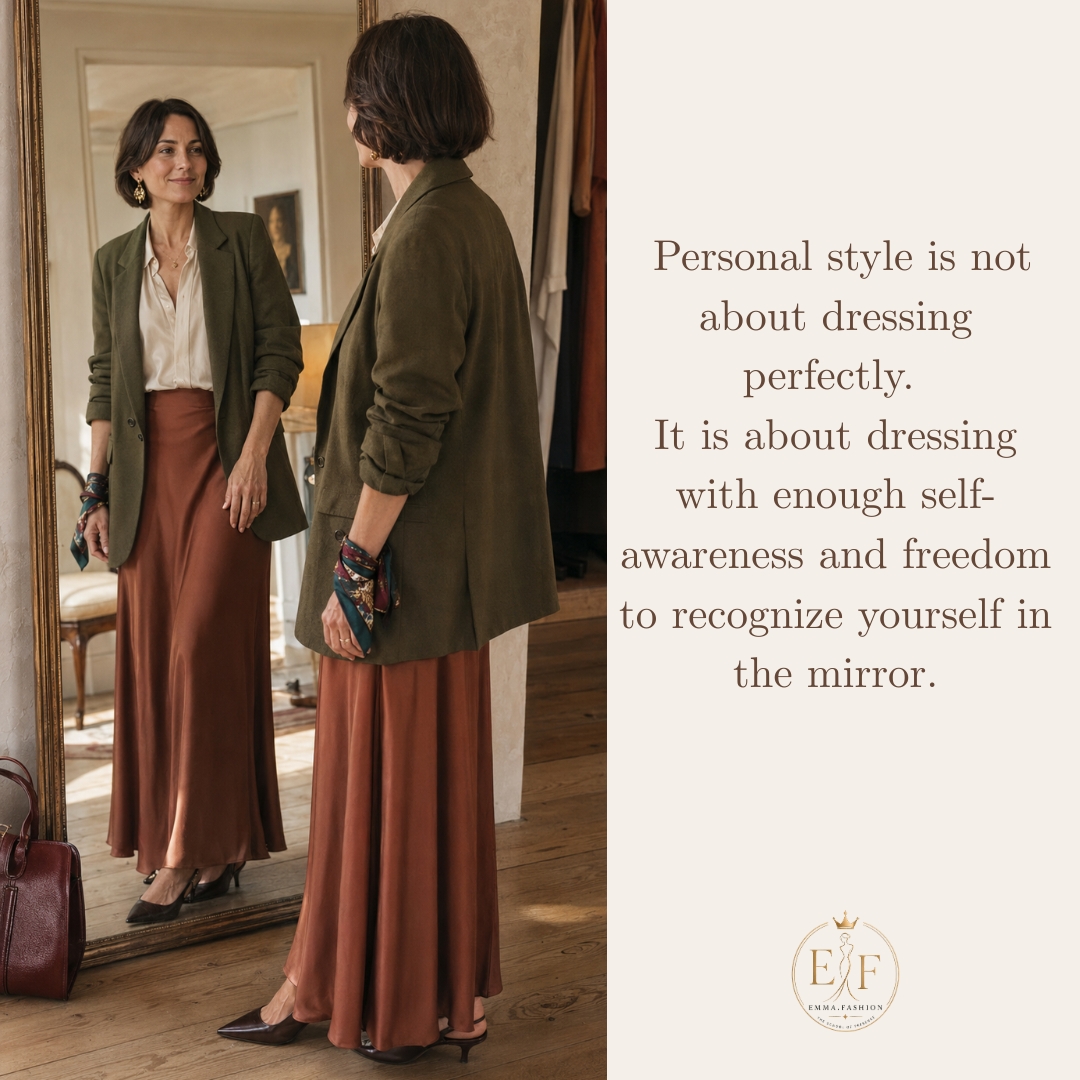
Personal style begins with a deceptively simple question: Does this feel like me?
Before asking whether something is flattering, fashionable, age-appropriate, sophisticated enough, worth buying, or currently on trend, that question brings the attention back to the woman wearing the clothes. It shifts dressing away from external approval and toward self-awareness.
Personal style today is less about committing to a single aesthetic and more about developing your own visual language. A wardrobe can contain something classic, something romantic, something minimal, something unexpected, and still feel coherent when each choice belongs to the same person.
This does not mean that proportion, occasion, quality, lifestyle, or social context suddenly become irrelevant. Style does not require us to abandon discernment. It asks us to understand the difference between a guideline that helps us communicate intentionally and a rule that has quietly begun to erase our individuality.
The goal is not to dress perfectly.
It is to dress with enough awareness and freedom that when you look in the mirror, you recognize yourself.
Table of Contents
- When Dressing Well Becomes Following Instructions
- The Difference Between Being Well-Dressed and Having Style
- Personal Style Is a Visual Language
- The Most Important Style Question: Does This Feel Like Me?
- Why Repetition Makes Style More Personal
- Personal Style Does Not Require an Unlimited Budget
- Age-Appropriate or Self-Appropriate?
- Your Body Matters but It Is Not the Whole Story
- Context Is Not the Enemy of Individuality
- How to Begin Dressing More Like Yourself
- When Your Wardrobe Starts to Recognize You
- Frequently Asked Questions
- Work with Emma
When Dressing Well Becomes Following Instructions
There is no shortage of advice telling women how to dress.
Dress for your body type. Dress for your age. Buy the essentials. Invest in classics. Wear these colors. Avoid those silhouettes. Every wardrobe needs this. This is no longer fashionable. That is back in style.
Some of these recommendations can be genuinely useful. Understanding proportion can help us create visual balance. Color knowledge can reveal why certain shades bring vitality to the face. Dress codes help us understand context. Fabric, fit, construction, and tailoring matter.
The difficulty begins when guidance becomes obedience.
A woman can become so skilled at following style advice that she gradually loses contact with her own preferences. She knows what supposedly flatters her, what women her age are expected to wear, what the current season has declared relevant, and which pieces every wardrobe is said to require.
And yet she opens her closet and feels strangely absent from it. Everything may be correct. Nothing feels particularly hers.
This is one of the quiet contradictions of modern fashion. We have access to more advice, inspiration, products, images, and opinions than perhaps any generation before us, yet all of that information can make it more difficult to hear our own aesthetic instincts.
When dressing becomes a checklist, we can forget that clothing is also a relationship with the self.
The Difference Between Being Well-Dressed and Having Style
Being well-dressed and having personal style are related, but they are not identical.
A well-dressed woman may understand fit, quality, coordination, proportion, and occasion beautifully. Her clothing can be impeccable.
Personal style adds another dimension: recognition.
There is something about the way she puts things together that feels distinctly hers. It may be a beautiful watch she wears almost every day, masculine tailoring softened by delicate jewelry, long skirts paired with simple knitwear, or sculptural earrings against an understated dress. Perhaps it is loafers worn with feminine pieces or an unexpected touch of color within an otherwise restrained wardrobe.
None of these details needs to be dramatic. What makes them memorable is the consistency with which they become part of her visual language.
Style develops when choices begin to repeat with intention. Preferences become patterns. Patterns become recognizable. Over time, those patterns create a visual identity.
This is why someone can wear an expensive, perfectly coordinated outfit and still appear somewhat anonymous, while another woman in a familiar jacket, beautifully fitted trousers, and the earrings she has worn for years can feel unmistakably herself.
One is wearing a successful outfit. The other is speaking a visual language she has made her own.
Personal Style Is a Visual Language
We often talk about personal style as though everyone needs to discover an aesthetic category.
Classic.
Minimalist.
Romantic.
Bohemian.
Creative.
Sporty.
Dramatic.
These descriptions can be useful starting points, but they become limiting when we begin treating them as identities we have to obey.
Human beings are more complex than aesthetic categories.
You may appreciate the structure of classic tailoring but dislike feeling overly traditional. You may love romantic fabrics without wanting an entirely feminine wardrobe. You may prefer minimalist clothing during the week and expressive accessories when you travel or socialize.
None of this means your style is inconsistent.
Your visual language can contain several influences because you contain several dimensions.
Coherence often comes from something deeper than wearing one aesthetic from head to toe. It may emerge through recurring colors, proportions, textures, jewelry, footwear, grooming, or simply the feeling you want your clothing to communicate.
Your wardrobe may express composure softened by femininity, creativity balanced with refinement, or a polished sensibility with an unexpected edge.
These subtle combinations often reveal far more about who you are than any aesthetic label ever could.
The purpose of understanding style categories is to give yourself vocabulary—not another set of rules.
The Most Important Style Question: Does This Feel Like Me?
When trying on clothing, many women instinctively ask:
Does this make me look thinner?
Is this flattering?
Is this too young for me?
Is this fashionable?
Can I wear this at my age?
What would I wear with it?
These questions have their place. But they can easily become louder than the most revealing question of all:
Does this feel like me?
That question is different because it cannot be answered by an influencer, salesperson, stylist, magazine, algorithm, or trend forecast.
It requires self-knowledge.
You may put on something that technically flatters your figure and still feel uncomfortable in it. You may try a highly recommended wardrobe essential and realize you never reach for it. You may wear a current silhouette that looks excellent in the mirror but makes you strangely self-conscious throughout the day.
And then there are clothes that seem to disappear once we put them on.
We stop adjusting them. We stop checking ourselves in every reflection. We move naturally, speak naturally, and become less conscious of what we are wearing.
The clothes are still there, but they no longer demand our attention.
And in that ease, something important happens: we become more present, because our attention is free to return to the moment rather than remain occupied with managing how we look.
This is an important distinction.
The right clothing does not always make you think more about your appearance. Sometimes it allows you to think about it less.
That ease can be one of the strongest signs of alignment between clothing and identity.
Why Repetition Makes Style More Personal
Modern fashion culture often associates style with novelty.
New season.
New arrivals.
New trend.
New purchase.
New outfit.
Yet personal style is frequently built through the opposite process: repetition.
Think about the pieces you have loved for years. The jacket you instinctively reach for. The earrings that somehow work with everything. The trousers you have had altered until the proportion feels exactly right. The handbag that has softened with use. The scarf you have tied ten different ways.
These objects begin to carry more than aesthetic value. They carry familiarity.
They become connected to experiences, places, relationships, professional chapters, travels, celebrations, ordinary mornings, and different versions of ourselves.
Eventually, certain pieces become recognizable to other people too.
Someone says, “That is so you.”
That sentence is significant.
It means the garment has stopped functioning merely as fashion and has entered the language of identity.
Repetition does not diminish style. Repetition can create style.
The challenge is learning the difference between repeating something because you have stopped paying attention and repeating something because it genuinely belongs to you.
One is habit without awareness.
The other is signature.
Personal Style Does Not Require an Unlimited Budget
There is another rule worth questioning: the assumption that becoming more stylish requires buying more.
It does not.
A larger wardrobe can provide more options, but more options do not automatically create greater clarity.
Sometimes they create the opposite.
Personal style develops through discernment: understanding what you enjoy wearing, what supports your life, what feels natural on your body, what communicates the qualities you value, and what deserves space in your wardrobe.
That may involve buying something new.
It may also involve tailoring something you already own, changing the way you combine familiar pieces, repairing beautiful shoes, rediscovering forgotten jewelry, or deciding that something no longer represents you.
A modest wardrobe can have tremendous personality when its pieces have been chosen thoughtfully.
Consider the difference between asking:
“What should I buy this season?”
and:
“What would genuinely add something to the wardrobe I already have?”
The second question assumes that your wardrobe has an identity worth protecting.
That small change in perspective can transform consumption.
You stop building a collection of attractive objects and begin cultivating a wardrobe that has continuity.
Age-Appropriate or Self-Appropriate?
Few fashion rules carry as much emotional weight for women as the idea of dressing for one’s age.
The intention behind age-awareness is not always unreasonable. Our bodies, lives, professional roles, priorities, and preferences evolve. What felt natural at 25 may no longer express who we are at 45, 60, or 75.
But evolution is different from restriction.
There is no moment when a woman suddenly loses the right to creativity, sensuality, color, modernity, experimentation, beauty, or visibility because she has crossed a particular birthday.
The more meaningful question is not simply, “Is this appropriate for my age?”
It may be:
Does this represent the woman I am now?
A woman may naturally move away from something she once loved—not because she is “too old” for it, but because it no longer feels aligned with her present self.
Another woman of exactly the same age may wear it beautifully because it remains completely congruent with her personality.
Maturity can bring one of the greatest advantages in personal style: a growing understanding of what deserves our attention and what does not.
Age can refine style rather than restrict it.
The goal is not to dress younger. Nor is it to prove that we are dressing appropriately older.
It is to allow our outer expression to evolve with the woman inside it.
Your Body Matters but It Is Not the Whole Story
“Dress for your body” sounds sensible.
But a body is not a styling problem to solve.
Understanding proportion is valuable. Clothing interacts with our physical form, and good fit can create comfort, ease, balance, and confidence.
Yet when every decision is filtered through the question of whether something makes the body appear taller, thinner, longer, smaller, or more conventionally proportioned, style can become an endless exercise in correction.
The body begins to determine everything. Personality becomes secondary.
Personal style asks for a broader conversation.
Yes, consider your body.
But also consider:
- How do you want to move?
- Which fabrics give you sensory comfort?
- Which silhouettes make you feel most natural?
- Which details reflect your personality?
- What kind of presence do you want to bring into the room?
- What does your actual day require from your clothing?
- Which pieces make you feel more like yourself rather than more acceptable to someone else?
Sometimes the most technically “flattering” choice is not the most expressive one. And sometimes the piece that gives a woman character, ease, or presence matters more than whether it creates an idealized proportion.
Your clothing exists to support your life. Your life does not exist to maintain a flattering silhouette.
Context Is Not the Enemy of Individuality
Stopping dressing by the rules does not mean ignoring context.
Personal style and appropriateness are not opposites.
What we wear to a board meeting, wedding, funeral, creative studio, dinner, beach, religious ceremony, or quiet weekend naturally changes because clothing is also social communication.
Understanding context is a form of awareness.
The distinction is whether you enter that context as yourself or temporarily erase yourself in order to belong.
Even environments with clear expectations usually leave room for individuality.
Personality can appear through:
- Color
- Jewelry
- Texture
- Hairstyle
- Makeup
- Eyewear
- Shoes
- Proportion
- Fabric
- A signature accessory
- The way familiar pieces are combined
This becomes especially meaningful in professional settings, where people sometimes assume that credibility requires visual sameness.
Appropriateness provides the framework.
Personal style determines how you inhabit it.
The most sophisticated dressers often understand both. They know when the occasion deserves restraint and where there is space for expression.
That balance is not conformity. It is social intelligence.
How to Begin Dressing More Like Yourself
Developing personal style rarely requires reinventing yourself.
Often it begins by paying closer attention to what is already there.
Notice What You Repeat
Look at what you actually wear rather than what you imagine you wear.
Which garments repeatedly leave the closet?
Which combinations feel effortless?
Which shoes do you instinctively choose?
Which colors appear again and again?
Your real wardrobe behavior often reveals more about your style than your inspiration boards do.
Notice What You Keep Admiring but Never Wear
Sometimes we love an aesthetic without wanting to inhabit it.
You can appreciate dramatic fashion and prefer understated clothing on your own body. You can admire minimalism and still need color. You can love romantic dresses in photographs but feel most yourself in trousers.
Admiration is not always identification. Knowing the difference can prevent many unnecessary purchases.
Identify Your Personal Contrasts
Some of the most interesting personal styles emerge through contrast.
Perhaps you like:
- Classic with creative
- Feminine with structured
- Minimal with dramatic jewelry
- Tailored with relaxed
- Romantic with modern
- Elegant with slightly unexpected
- Refined with effortless
These tensions often contain more personality than a single style label.
Question the Rule Before You Break It
Not every rule deserves rebellion.
Ask what the rule is trying to accomplish.
Is it about proportion?
Respect for an occasion?
Professional expectations?
Practicality?
Or is it simply a cultural assumption repeated so often that it began to sound like truth?
Once you understand the purpose of a guideline, you can decide intelligently whether it serves you.
Create Your Own Rules
Eventually, personal style develops its own principles.
They may sound something like:
“I prefer beautiful fabrics against my skin.”
“I feel most myself when one element is slightly unexpected.”
“I would rather own fewer shoes and maintain them beautifully.”
“I like structure, but I need movement.”
“I rarely wear prints, but I love expressive jewelry.”
“I prefer repeating clothing I love to constantly creating new outfits.”
These are not universal fashion rules.
That is precisely why they are valuable.
They are yours.
When Your Wardrobe Starts to Recognize You
There is a point in developing personal style when the wardrobe begins to feel less like a collection of clothes and more like an extension of a life.
Pieces speak to one another. New purchases have somewhere to belong.
You know which trends interest you and which can pass without consequence.
You become less vulnerable to the anxiety of constantly needing something different because novelty is no longer confused with identity.
Perhaps most importantly, getting dressed becomes easier. Not because you have finally learned every rule, but because you have learned yourself.
There will still be experimentation. Personal style is not a finished project. We change through careers, relationships, motherhood, aging, travel, loss, reinvention, new environments, and new understandings of ourselves.
Our clothing naturally changes with us.
The purpose is not to create such a rigid identity that you become trapped by your own signature. It is to develop enough self-awareness that you can evolve without disappearing.
Fashion can offer possibilities. Style advice can offer knowledge. Color analysis can offer insight. Tailoring can offer proportion. Etiquette can offer context.
But none of these should replace the woman at the center of the decision.
Perhaps that is where personal style truly begins—not when you stop listening to every rule, but when your own voice finally becomes part of the conversation.
The goal is not perfection. The goal is recognition.
To look in the mirror and feel that the woman reflected there has not been dressed according to an idea of who she is supposed to be.
She has simply become more visible as herself.
Frequently Asked Questions
Do I need to ignore fashion rules to develop personal style?
No. Personal style is not about rejecting every rule. It is about understanding the purpose of a guideline and deciding whether it supports your body, lifestyle, personality, values, and the context in which you are dressing. Useful principles can provide structure without becoming restrictions. The difference is that you remain the person making the final decision.
How do I know if an outfit truly feels like me?
Pay attention to how you behave once you are dressed. Clothing that feels aligned often allows you to stop thinking about the outfit and become more present in your life. You feel comfortable, recognizable to yourself, and free to move and interact naturally. If you spend the day adjusting, performing, or feeling as though you are wearing someone else’s identity, that information is worth noticing.
Can I have personal style without following one aesthetic?
Yes. A strong personal style does not require a single aesthetic label. Your wardrobe can contain different influences while remaining coherent through recurring colors, silhouettes, textures, accessories, proportions, and the emotional qualities that consistently appeal to you. Personal style belongs to a person, not to a category.
Do I need to keep buying new clothes to stay stylish?
No. Repetition can strengthen personal style because frequently worn pieces become part of your visual identity. A thoughtful wardrobe evolves through editing, combining, tailoring, maintaining, and occasionally adding pieces that genuinely contribute something meaningful. Newness can be enjoyable, but it is not the foundation of style.
How can I balance personal expression with dressing appropriately?
Context and individuality can coexist. Consider the expectations of the environment first, then express personality within them through color, proportion, texture, accessories, grooming, or subtle styling choices. Appropriateness creates the framework; personality gives it character. The result is clothing that respects where you are without requiring you to stop being yourself.
Work with Emma
If your wardrobe looks appropriate on paper but no longer feels entirely like you, the answer may not be another list of things to buy. It may be a deeper understanding of the woman your wardrobe is meant to represent.
Through personal styling, image consulting, wardrobe guidance, and color analysis, Emma.Fashion approaches style from the inside outward—considering personality, lifestyle, coloring, proportions, professional context, and the presence you want to communicate.
The purpose is not to replace your instincts with another set of rules. It is to give you the knowledge to make more intentional choices, recognize what genuinely belongs to you, and build a wardrobe in which fashion supports your identity rather than defining it.
Emma.Fashion Journal helps women cultivate timeless style through the thoughtful integration of fashion, psychology, etiquette, identity, and personal presence.