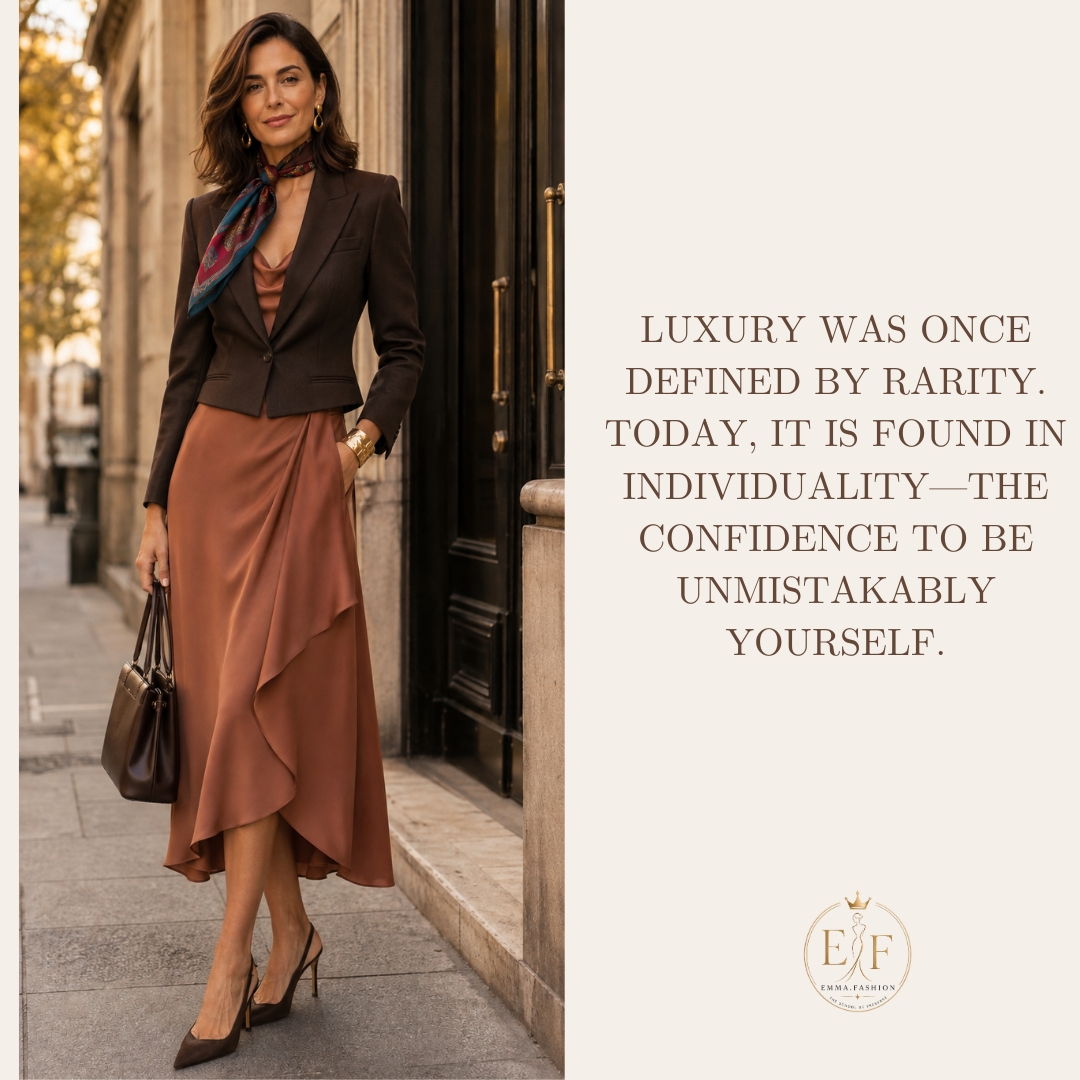
For decades, luxury was built around distance. It belonged behind velvet ropes, private doors, limited production, waiting lists, craftsmanship known to relatively few, and objects that were deliberately difficult to obtain. Part of its power came from the fact that not everyone could possess it.
That language has not disappeared. Rarity, craftsmanship, heritage, and exceptional quality still matter. But something else has become increasingly valuable in a world where images circulate instantly, trends are reproduced almost as quickly as they appear, and almost any aesthetic can be imitated within days: personality.
This is the deeper idea behind when personality becomes luxury. When so much can be copied, the quality that cannot be purchased intact is a developed sense of self. The woman whose appearance feels recognizably hers possesses something more elusive than the season’s most coveted object. She possesses distinction—the ability to participate in fashion without disappearing into it.
Table of Contents
- The Old Language of Luxury
- Why the Meaning of Luxury Is Changing
- When Everything Can Be Copied, Personality Cannot
- Authenticity Is Not the Same as Casualness
- Distinction: When Personality Becomes Visible
- The Difference Between Expensive and Personal
- Why Recognizability Matters
- The New Luxury Wardrobe
- How to Cultivate Personality in Your Style
- Luxury as the Freedom Not to Perform
- Frequently Asked Questions
- Work with Emma
The Old Language of Luxury
Traditional luxury understood the psychology of desire extraordinarily well.
Something became desirable partly because access to it was restricted. Limited production, extraordinary materials, specialized craftsmanship, private environments, heritage, price, and scarcity separated luxury from the ordinary marketplace.
The object communicated more than beauty. It communicated access.
For generations, this distinction helped create the symbolic vocabulary of luxury: the handbag that was immediately recognizable, the watch associated with achievement, the couture garment requiring hundreds of hours of handwork, the hotel that offered privacy unavailable elsewhere.
There is nothing inherently superficial about this. Exceptional craftsmanship deserves appreciation. Materials matter. Construction matters. Heritage matters. Beauty created through knowledge, patience, and human skill remains meaningful.
But luxury has never existed entirely inside the object.
Its meaning has always depended on what the object represents.
And what we value is changing.
Why the Meaning of Luxury Is Changing
We live in an age of extraordinary visual access.
A runway show can be seen around the world within minutes. A celebrity outfit can generate thousands of interpretations almost immediately. A carefully constructed aesthetic can move from a small cultural circle into mass visibility with remarkable speed.
The result is an interesting paradox.
We have more opportunities for self-expression than perhaps any previous generation, yet visual culture can produce remarkable sameness.
The same handbag appears repeatedly. The same silhouettes circulate through social media. The same interiors, poses, color palettes, beauty references, and carefully constructed versions of effortless living begin to merge into one another.
When access increases, having the object becomes less powerful as a marker of individuality.
Something else begins to matter.
Interpretation.
How did you wear it?
Why did you choose it?
What did you combine it with?
Does it belong naturally within your life?
Does it say something about you—or merely reveal what you have been looking at?
This is where personality acquires value.
When Everything Can Be Copied, Personality Cannot
A garment can be copied. An outfit can be recreated. A color palette can be borrowed. A handbag can be purchased. Even an entire aesthetic can be reproduced with surprising accuracy. But a mature personal style cannot simply be transferred from one woman to another because it is not composed only of clothes.
It contains biography. It carries memories, preferences, cultural influences, profession, age, lifestyle, temperament, values, physicality, aesthetic sensitivity, and years of learning what feels natural and what does not.
This is why two women can wear exactly the same dress and create entirely different impressions.
One may make it restrained with a sculptural flat and minimal jewelry. Another may add vintage earrings and a dramatic coat. Another may wear it with an inherited bracelet, a signature lipstick, and the shoes she has loved for years.
The dress remains the same. The woman changes its meaning.That difference is personality. And unlike an object, it cannot be ordered.
Authenticity Is Not the Same as Casualness
Authenticity is one of the most overused words in contemporary culture.
It is sometimes interpreted as spontaneity: showing everything, editing nothing, rejecting polish, or presenting oneself exactly as one happens to feel in a particular moment.
But authenticity and lack of consideration are not the same thing. A beautifully tailored jacket can be authentic. So can an elaborate evening dress.
A woman who genuinely loves ceremony, elegance, precision, color, glamour, restraint, eccentricity, minimalism, or romanticism does not become less authentic because her appearance is considered.
Authenticity means that the consideration comes from somewhere real.
The question is not, Did I make an effort?
It is, Whose idea of myself am I expressing?
Personal style becomes authentic when the outer expression feels continuous with the inner person.
That may require editing. It may require discipline. It may require excellent tailoring, thoughtful grooming, or understanding which colors bring the face to life.
Authenticity is not the absence of refinement. It is refinement without disguise.
Distinction: When Personality Becomes Visible
There is a word for what happens when personality and appearance become coherent over time: distinction.
Distinction is often confused with extravagance. Yet a distinctive woman does not necessarily dress dramatically, wear expensive clothes, or command attention through novelty.
What makes her distinctive is recognizability.
She may have worn variations of the same beautifully cut trousers for twenty years, favored architectural jewelry and a palette of cream, cognac, and red, balanced masculine tailoring with distinctly feminine shoes, and reserved prints for scarves collected during her travels.
Individually, none of these choices is revolutionary. Together, repeated over time, they begin to form a visual language.
This is why distinction cannot be created by asking:
What could I wear that would make people notice me?
That question often leads toward performance.
A more useful question is:
What do I return to because it continues to feel like me?
Distinction grows from that repetition. Not repetition without imagination, but consistency with evolution.
The Difference Between Expensive and Personal
Price and personal value occasionally meet. But they are not synonymous.
An expensive wardrobe can still feel anonymous.
A woman may wear the correct labels, impeccable fabrics, current silhouettes, and highly desirable accessories and still communicate very little about herself.
Everything may be beautiful. Nothing may be personal.
Another woman may own fewer things. Her coat is beautifully maintained rather than new. Her jewelry mixes one exceptional piece with objects gathered over many years. Her trousers have been altered to the exact proportion she prefers. She understands her colors. She knows which fabrics she enjoys touching and which shoes allow her to move naturally.
Her wardrobe has accumulated meaning.
This does not diminish the pleasure of luxury fashion. Quite the opposite. It gives beautiful objects somewhere meaningful to belong.
The luxury piece no longer carries the identity.
The woman gives identity to the luxury piece.
That is an important reversal.
Why Recognizability Matters
The most memorable personal style rarely depends on constant novelty.
It depends on patterns.
Human beings recognize consistency. We gradually associate certain qualities with people: a way of speaking, a gesture, a fragrance, a sense of humor, a particular elegance, a preference for color, a manner of entering a room.
Clothing participates in this process.
When visual choices consistently emerge from the same personality, they create continuity. Over time, the woman becomes recognizable not because she repeats the same outfit, but because different outfits appear to have been spoken in the same language.
This is the foundation of signature style.
It is also why chasing a completely different aesthetic every season can sometimes weaken rather than expand personal expression. Fashion changes; a woman’s identity provides the filter through which those changes acquire relevance.
As explored in How to Overcome Personal Style Over Fashion Trends, the objective is not to reject what is current. It is to prevent fashion from replacing the person wearing it.
A trend can enter a distinctive wardrobe.
It simply has to learn her language first.
The New Luxury Wardrobe
If personality is becoming part of luxury, the wardrobe begins to change as well.
Its value is no longer measured primarily by quantity, novelty, labels, or the number of recognizable pieces it contains.
Instead, its richness can come from coherence.
A deeply personal wardrobe may contain:
- Exceptional pieces chosen for craftsmanship and longevity
- Tailored garments altered to the woman’s preferred proportions
- Signature colors that appear repeatedly in different ways
- Fabrics that suit both her sensory preferences and lifestyle
- Jewelry connected to memory, travel, family, or personal milestones
- Contemporary pieces filtered through an established style identity
- Vintage or older garments whose beauty has increased through continued use
- Accessories that have become recognizable parts of her presence
Such a wardrobe is difficult to reproduce because its value lies in the relationships between the pieces and the woman.
The old coat matters because of how she wears it. The scarf matters because of where she found it. The unusual combination works because it reflects her eye. The beautifully made handbag contributes quality, but it does not have to announce her worth.
This is curation in its most personal sense—not creating a perfect wardrobe for display, but allowing possessions to acquire meaning through use.
How to Cultivate Personality in Your Style
Trying to become distinctive can produce exactly the opposite result.
The objective is not to invent a signature for the sake of being recognizable. A forced signature quickly becomes another costume.
Instead, begin with observation.
Notice Repetition
Look at what you repeatedly choose when no one is telling you what is fashionable.
Which silhouettes return?
Which colors make you feel most present?
Which fabrics feel natural against your body?
Which accessories survive every wardrobe edit?
Repetition often reveals identity before we have words for it.
Separate Admiration from Identification
One of the most useful distinctions in personal style is learning the difference between I find this beautiful and this belongs to me.
We can admire many aesthetics without needing to inhabit them.
A dramatic minimalist interior may fascinate you while your wardrobe remains romantic. A highly avant-garde collection may stimulate your imagination while your actual style is refined and classical.
Taste is broad.
Identity is more selective.
Edit Trends Through Your Own Language
When a new trend appears, resist asking only whether it is fashionable.
Ask whether it continues something already present in you.
A woman who has always loved strong tailoring may interpret a dramatic shoulder naturally. Someone drawn to romantic softness may respond instead to movement, transparency, or color.
Fashion becomes more interesting when it enters into conversation with an existing identity.
Invest in Specificity
Luxury does not always mean buying more expensive things. Sometimes it means becoming more specific.
The exact trouser length.
The shade of burgundy that illuminates your complexion.
The neckline you repeatedly feel beautiful wearing.
The handbag proportion that works with your body and daily life.
The jewelry scale that feels present without overwhelming you.
Specificity transforms shopping from acquisition into discernment, and discernment is one of the quietest forms of sophistication.
Luxury as the Freedom Not to Perform
Perhaps the deepest modern luxury is not possessing something others cannot have.
Perhaps it is no longer requiring others to validate what you have chosen.
There is freedom in knowing what you like before an algorithm tells you to like it.
There is freedom in wearing something again because it still feels beautiful.
There is freedom in declining a trend without criticizing it.
There is freedom in buying an extraordinary object because its craftsmanship moves you rather than because its logo explains its value to everyone else.
And there is freedom in entering a room without asking your clothing to create a more impressive person than the one already inside it.
This is where luxury becomes psychological.
It becomes the luxury of self-knowledge.
The luxury of discernment.
The luxury of enough.
The luxury of choosing rather than proving.
The luxury of allowing beauty to enhance identity rather than manufacture it.
For decades, luxury was powerful because it was difficult to access.
In a world of endless images, endless products, endless references, and endless invitations to become someone slightly different, perhaps another form of rarity has emerged.
A woman who knows herself.
She can enjoy fashion without obeying it. She can appreciate luxury without depending upon it. She can evolve without repeatedly abandoning herself.
Her clothes may be exquisite or simple, contemporary or inherited, restrained or expressive. But there is something in the way she wears them that cannot be purchased separately.
Her personality.
And perhaps that is why when personality becomes luxury, the most valuable quality is no longer simply being difficult to obtain.
It is being impossible to confuse with anyone else.
Frequently Asked Questions
What does it mean when personality becomes luxury?
It means individuality, authenticity, and recognizability have become forms of value in a culture filled with imitation and visual sameness. Luxury is no longer communicated only through what something costs or how rare it is, but also through the clarity with which a person expresses who she is.
Is personal style a form of luxury?
Personal style can become a form of luxury when it reflects self-knowledge rather than consumption. A wardrobe carefully edited around identity, lifestyle, quality, and personal preferences can feel more distinctive than one assembled primarily around expensive or recognizable objects.
What is the difference between luxury and status?
Status often depends on external recognition: a price, label, symbol, or object whose value is socially understood. Luxury can include status, but its modern meaning is broader. Time, craftsmanship, individuality, discretion, experience, and the freedom to make choices based on personal values rather than social approval can all communicate luxury.
How can I make my style more distinctive?
Begin by identifying what you consistently love rather than searching for something deliberately unusual. Notice recurring colors, silhouettes, fabrics, accessories, proportions, and moods. Distinction grows when these preferences are refined and repeated until they become part of your recognizable visual language.
Does authentic style mean ignoring fashion trends?
No. Authentic style does not require rejecting fashion. It means filtering fashion through your own identity. Trends can introduce new possibilities, but personal style determines which of those possibilities belong in your wardrobe and how they are interpreted.
Work with Emma
Developing personal style is not about constructing a more impressive version of yourself. It is about becoming clearer about what already belongs to you—and learning how to express it with intention.
Through Emma.Fashion personal styling, image consulting, wardrobe guidance, and color analysis, we can explore the colors, silhouettes, fabrics, details, and visual signatures that reflect your personality while respecting your lifestyle, profession, age, and the environments in which you move.
The goal is not to give you another aesthetic to follow. It is to help you recognize your own more clearly, so that fashion and luxury become tools for expression rather than definitions of who you are.
Emma.Fashion Journal helps women cultivate timeless style through the thoughtful integration of fashion, psychology, etiquette, identity, and personal presence.