Her wardrobe accompanies those transitions. When she looks at a new fashion season, the useful question is how its ideas might support the way she lives.
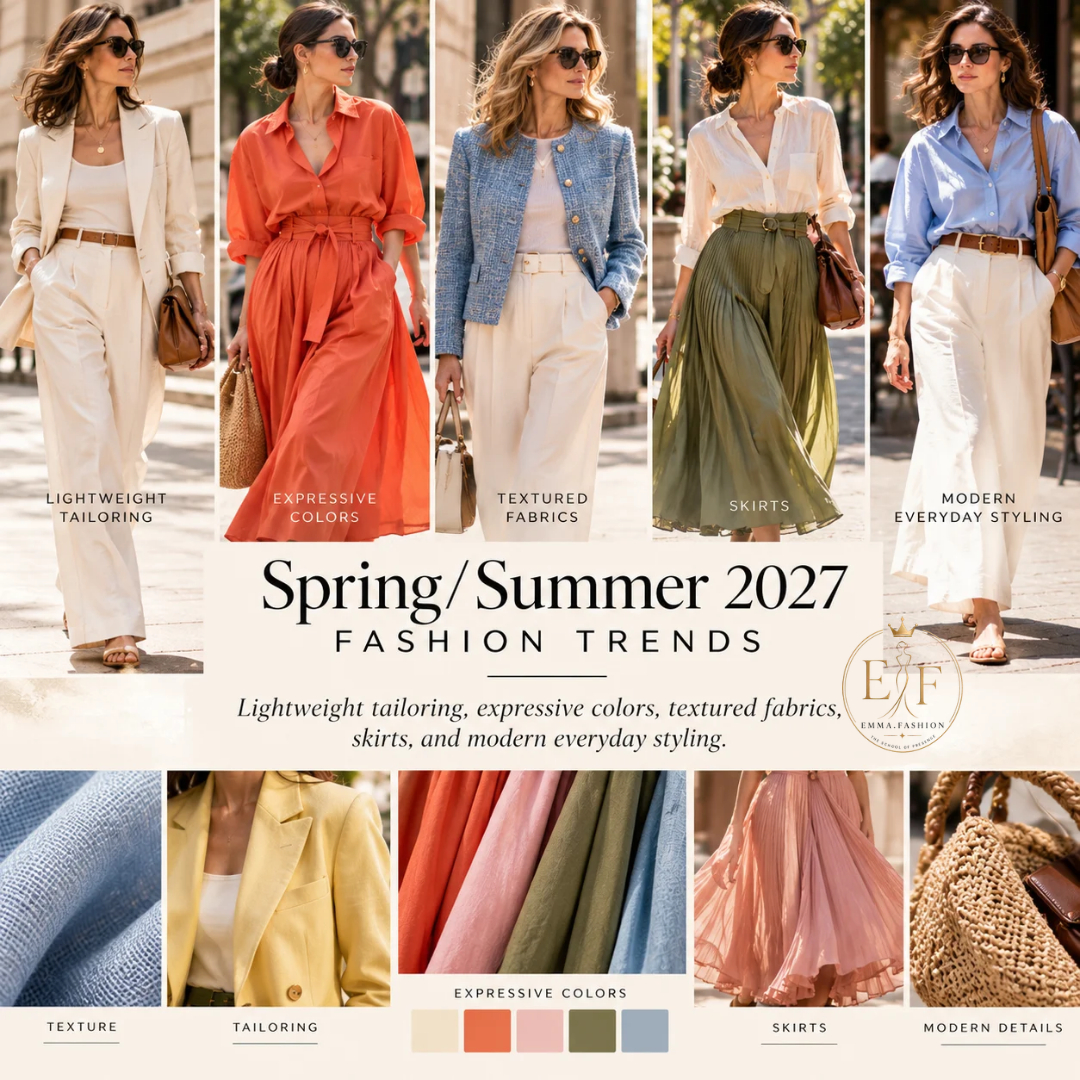
The Spring/Summer 2027 collections offer an interesting tension. Lightness, practical construction, and familiar separates appear alongside transparency, decorative surfaces, and expressive glamour. Across selected collections in New York, London, Milan, and Paris, everyday clothing becomes a place for both function and imagination.
Drawing on The Impression’s runway reviews, this examination looks at eight tendencies and their possible place in a modern wardrobe. The styling suggestions are Emma.Fashion’s interpretation: an invitation to select, adapt, and make the season personal.
Table of Contents
- 1. Tailoring Becomes Lighter and More Flexible
- 2. The Skirt Receives Renewed Attention
- 3. Transparency and Lingerie Details Become Part of Layering
- 4. Utility Gains a More Refined Expression
- 5. Color Moves Between Gentle Tones and Vivid Contrasts
- 6. Texture and Handwork Give Simple Shapes Character
- 7. Evening Details Find a Place in Daytime Dressing
- 8. Familiar Style Evolves Through New Proportions and Combinations
- 9. What the Season Offers the Modern Woman
1. Tailoring Becomes Lighter and More Flexible
Celine explored lighter fabrics and freer combinations, while Bottega Veneta reduced the weight of leather and opened its woven constructions. Chanel introduced smocked tweed with stretch. These are different approaches to a shared concern: how considered clothing can allow greater ease.
For a woman moving between warm streets and cool interiors, the practical translation is a light jacket that provides shape without excessive bulk. An unlined blazer, a supple cardigan jacket, or a fluid trouser can be useful starting points.
Look beyond the outline in the mirror. Reach forward, sit down, and carry your usual bag. Check whether the fabric feels comfortable against your skin and whether the layer works with the tops you actually wear.
The practical takeaway: Look for tailoring that retains its refinement while allowing you to move naturally through the day.
Runway references: Celine; Bottega Veneta; Chanel.
2. The Skirt Receives Renewed Attention
Prada built its collection around variations on the knee-length skirt, using surface, construction, and adjustable fastenings to develop a familiar silhouette. Ulla Johnson offered fluid skirts alongside cropped tailoring.
This creates possibilities for women who enjoy the simplicity of a dress but need the flexibility of separates. A skirt can accompany a shirt at work, a knit for lunch, and a more decorative top for dinner.
Choose the length and shape that suit your proportions and activities. A knee-length skirt need not replace a midi you love. Test the waistband when seated, the stride when walking, and the coverage when bending. Proportion matters too: a shorter jacket may bring definition to a fuller skirt without requiring a tightly fitted waist.
The practical takeaway: Consider the skirt as a versatile separate that can move between occasions, rather than a trend requiring you to abandon your preferred silhouette.
Runway references: Prada; Ulla Johnson.
3. Transparency and Lingerie Details Become Part of Layering
Sheer knits and tulle appeared at Chanel; lace and airy layers featured at Ulla Johnson; Valentino brought camisoles, satin bustiers, and other evening references into its styling.
For everyday life, the adaptable idea is the relationship between layers. A sheer blouse over a camisole can offer visual lightness with coverage. A lined lace skirt can introduce texture, while a satin top beneath a jacket can work for dinner.
Choose the degree of transparency deliberately. Check the outfit in daylight and when seated. Workplace expectations, personal comfort, and the occasion should guide the underlayer. A trend can be expressed through a sleeve, neckline detail, or fabric contrast without reproducing the runway’s exposure.
The practical takeaway: Transparency can become a styling detail rather than the defining feature of an outfit. Adapt the degree of exposure to your comfort and the setting.
Runway references: Chanel; Ulla Johnson; Valentino.
4. Utility Gains a More Refined Expression
Max Mara explored practical and modular details within tailoring. Burberry lightened its outerwear, while Bottega Veneta approached summer through natural fibers and more open constructions.
For commuting, travel, and active days, utility becomes meaningful through details that genuinely help: accessible pockets, manageable layers, secure fastenings, and room to move.
A lightweight field jacket over a simple dress could suit a day of sightseeing. A coordinated vest and trouser combination might provide an alternative to a suit in an appropriate workplace. For family activities, a washable skirt or trouser may serve better than a delicate piece requiring constant attention.
Judge usefulness through the garment itself. A utility reference does not guarantee durability, easy care, or practical pockets.
The practical takeaway: Functional clothing can still express refinement. Look for practical details that serve your actual activities rather than simply suggesting utility through appearance.
Runway references: Max Mara; Burberry; Bottega Veneta.
5. Color Moves Between Gentle Tones and Vivid Contrasts
There is no single palette across these collections. Ulla Johnson worked with shades including butter yellow, dusty rose, lavender, moss, and faded rust. Carolina Herrera used bright color alongside pastels, while Valentino explored combinations such as green with fuchsia and citron with lavender.
The opportunity is to choose a color relationship that refreshes what you own. A softly colored blouse may lift familiar neutrals. A stronger bag or skirt can introduce energy into a restrained wardrobe.
Begin with your own coloring, preferences, and existing clothes. Try the shade near your face in natural light. For work, you might keep the silhouette familiar and let color provide the change; for a social occasion, you may enjoy a more expressive pairing.
The practical takeaway: You do not need to adopt an entirely new seasonal palette. One thoughtfully chosen color can refresh familiar combinations while remaining consistent with your personal style.
Runway references: Ulla Johnson; Carolina Herrera; Valentino.
6. Texture and Handwork Give Simple Shapes Character
Crochet, embroidery, and fringing appeared at Bottega Veneta. Burberry amplified decorative texture, and Carolina Herrera developed florals through print, embroidery, and appliqué. Surface became an important source of interest.
This can be especially useful for a woman who prefers uncomplicated outfits. A textured knit with plain trousers, an embroidered shirt with a simple skirt, or a woven bag with a favorite dress can create richness within a familiar combination.
Consider care and contact as well as appearance. Raised details may catch on jewelry, and delicate openwork may be inconvenient when carrying children or luggage. For a frequently worn piece, choose a surface you can comfortably live with.
The practical takeaway: Texture can give simple outfits character without requiring additional layers, complicated styling, or a dramatic silhouette.
Runway references: Bottega Veneta; Burberry; Carolina Herrera.
7. Evening Details Find a Place in Daytime Dressing
Valentino mixed evening references with more casual elements, while Saint Laurent concentrated on gold and disciplined silhouettes. Carolina Herrera combined decorative statements with recognizable daywear.
A useful everyday translation is to let one expressive element lead. Wear a satin blouse with tailored trousers for a dinner following work. Try a metallic flat with a simple dress, or a beautiful earring with a shirt and skirt.
These are styling possibilities rather than a requirement to dress up every activity. Consider the setting, the practical demands, and the impression you wish to communicate. The aim is to give beautiful pieces opportunities to be worn with ease.
The practical takeaway: A touch of glamour can become part of ordinary dressing when it is balanced with familiar garments and suited to the occasion.
Runway references: Valentino; Saint Laurent; Carolina Herrera.
8. Familiar Style Evolves Through New Proportions and Combinations
Chanel reworked recognizable house elements through softened construction, raw edges, and lighter treatments. Celine allowed varied moods and personalities within a coherent wardrobe.
For a woman whose lifestyle is changing, this offers a thoughtful approach to continuity. A treasured jacket can be separated from its matching skirt. Pearls might accompany a simple knit. A familiar dress can meet a different occasion through footwear and a layer.
Try these possibilities before assuming an older piece has lost its place. Some garments will adapt; others may need alteration or may belong among your memories. Personal style develops through those decisions, allowing your wardrobe to remain recognizable while responding to your present life.
The practical takeaway: Updating personal style does not always require replacing familiar garments. Sometimes a change in proportion, layering, or combination is enough to make them relevant again.
Runway references: Chanel; Celine.
9. What the Season Offers the Modern Woman
Taken together, these tendencies suggest several ways of balancing expression with practical needs. Lighter construction addresses comfort; flexible separates offer combinations; texture and color provide opportunities for individuality. Sheer layers and glamour require more selective interpretation.
The modern woman has many different lives. Her working conditions, climate, responsibilities, body, and preferences determine which ideas will be useful. A woman in a formal office may adapt the season through a colored blouse or lighter tailoring. Someone traveling frequently may prioritize manageable layers. Another may find renewed pleasure in a skirt that works for both daytime and an evening gathering.
Before purchasing, try one complete outfit with what you own. Walk in the shoes, carry the bag, add the necessary layer, and imagine the actual occasion.
Fashion trends are possibilities, not instructions
There is an important distinction between observing fashion and adopting it.
The runway introduces ideas through proportion, construction, fabric, color, and styling. But those ideas are presented within a creative vision, not necessarily the circumstances of an ordinary day.
The woman wearing the clothes must complete the interpretation. She decides which proportions suit her body. Which colors belong to her wardrobe. Which fabrics respond to her climate. Which garments support her professional and personal responsibilities. And which details express something she genuinely enjoys.
A new season can sharpen our attention to the wardrobe we already have. Its most valuable ideas are the ones that help us feel comfortable, expressive, and appropriately dressed for the experiences we wish to enter.
Fashion offers possibilities. Personal style develops through the choices that make those possibilities part of a life.
Frequently Asked Questions
What are the main Spring/Summer 2027 fashion trends?
The Spring/Summer 2027 collections examined here highlight lighter and more flexible tailoring, renewed interest in skirts, sheer layering, refined utility, soft and vivid color combinations, decorative textures, daytime glamour, and updated proportions. These tendencies appeared across selected collections in New York, London, Milan, and Paris, although individual designers interpreted them differently.
How can I wear Spring/Summer 2027 trends without changing my personal style?
Begin with the elements that already feel authentic to you, such as your preferred colors, silhouettes, fabrics, and level of refinement. Then introduce one seasonal idea that works with your existing wardrobe. You might experiment with lighter tailoring, a new color combination, textured accessories, or a different way of layering familiar garments. The goal is to adapt fashion to your identity rather than replace your style with a trend.
Can sheer clothing and lingerie-inspired trends be appropriate for everyday wear?
Yes, when interpreted with consideration for comfort, coverage, and context. A sheer blouse over a camisole, a lined lace skirt, or a satin top beneath a jacket can introduce the trend without reproducing the runway’s degree of exposure. The workplace, occasion, and your personal preferences should guide how much transparency feels appropriate.
Do I need to buy new clothes to follow Spring/Summer 2027 trends?
No. Many of the season’s ideas can be explored through garments you already own. Try separating matching sets, changing proportions, layering familiar pieces differently, combining colors in new ways, or introducing texture through accessories. Before buying anything, identify whether the new piece would genuinely improve your wardrobe and suit your daily activities.
Which Spring/Summer 2027 trends are most practical for professional women?
Lighter tailoring, flexible separates, refined utility, and thoughtful color updates may be particularly useful, depending on the workplace. An unlined blazer, fluid trousers, a versatile skirt, or a softly colored blouse can introduce seasonal freshness while maintaining a professional appearance. The most appropriate choices depend on your industry’s expectations, climate, comfort, and daily responsibilities.
Work with Emma
### Translate fashion into a wardrobe that belongs to your life
A new fashion season can be inspiring, but inspiration becomes useful only when we understand how to interpret it.
Not every trend needs to enter your wardrobe.
And not every beautiful runway idea will suit your lifestyle, body, profession, or personal preferences.
Through Emma.Fashion personal styling, image consulting, wardrobe guidance, and color analysis, we can explore which seasonal ideas complement your identity and how to integrate them into the clothes you already own.
Perhaps the most useful update is a lighter jacket.
A different color combination.
A skirt that offers more flexibility.
Or a new way of wearing something familiar.
The goal is not to reproduce the runway.
It is to develop a wardrobe that feels current while remaining recognizable, practical, and personal.
**Fashion can introduce new possibilities. Your personal style determines which of them deserve a place in your life.**