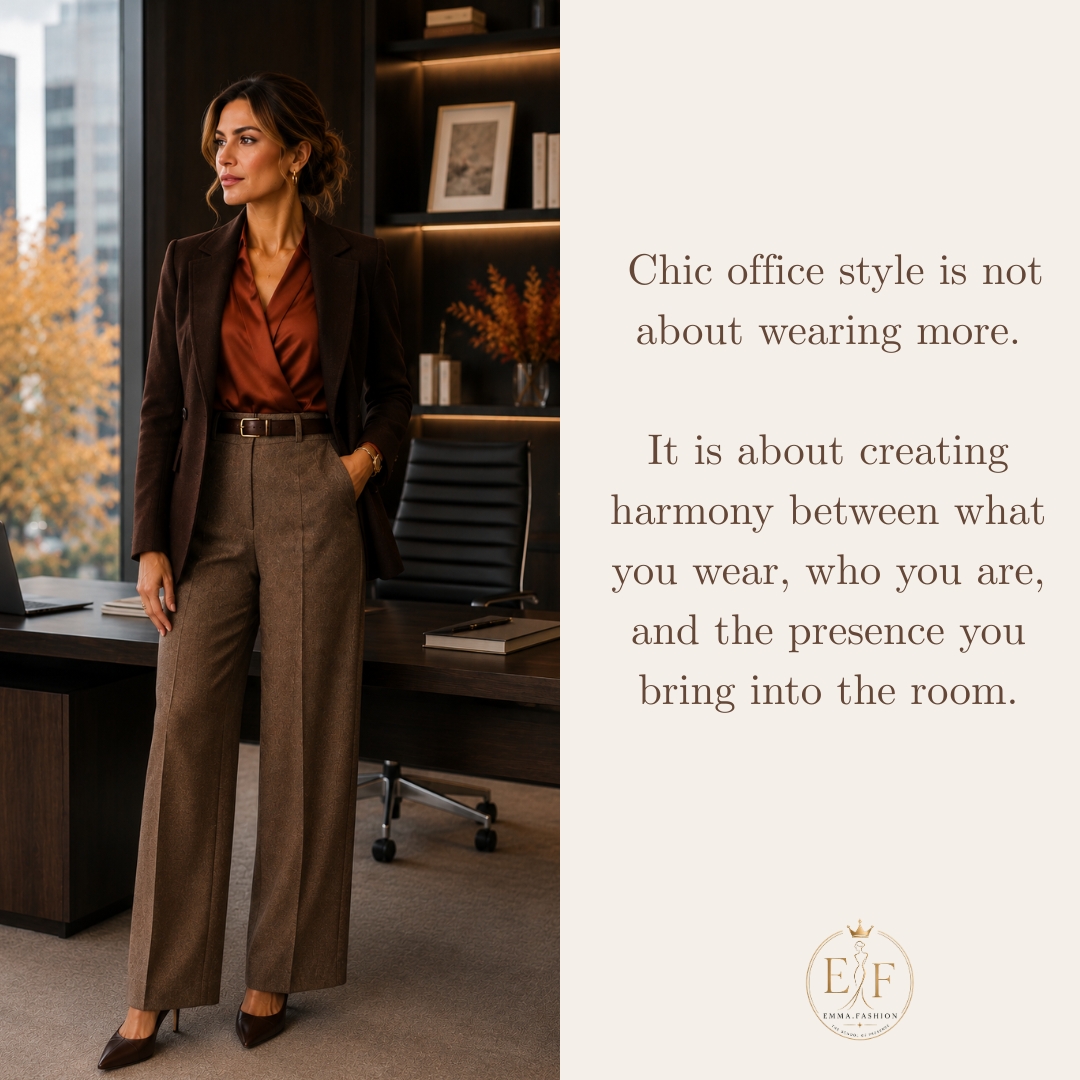
As fall arrives, dressing for the office often becomes more interesting. Layers return. Textures become richer. Colors deepen. Jackets, trousers, loafers, boots, scarves, and structured handbags once again become part of the daily vocabulary of getting dressed.
But knowing how to look more chic at the office this fall is not simply a matter of adding seasonal trends to your wardrobe. Chic professional style is usually created through something quieter: proportion, coordination, quality, restraint, and an awareness of where you are going and how you want to be experienced when you arrive.
Looking chic at the office is often associated with having more: more fashionable clothes, more accessories, more expensive pieces, more visible effort.
But sophistication rarely comes from adding more.
A chic office outfit has clarity. The proportions feel balanced. The colors relate to one another. Accessories have a purpose. The outfit looks considered without appearing overly constructed.
Fall is an especially beautiful season for professional dressing because it gives us more opportunities to work with color, texture, tailoring, and layers.
The question is not necessarily What should I buy?
A better question might be:
How can I style what I wear with greater intention?
Table of Contents
- 1. Start with the Outfit, Not the Individual Pieces
- 2. Build a Richer Fall Color Palette
- 3. Use a Third Piece to Complete the Look
- 4. Pay Attention to Proportion
- 5. Add Interest Through Texture
- 6. Make Tailoring Feel Current
- 7. Let Your Shoes Change the Outfit
- 8. Use Accessories with Restraint
- 9. Elevate Business Casual
- 10. Create Your Own Office Outfit Formulas
- 11. Don’t Forget the Most Important Element: Presence
- Frequently Asked Questions
- Work with Emma
1. Start with the Outfit, Not the Individual Pieces
Chic is often about composition
Consider a very simple combination:
Trousers + sweater + shoes.
Nothing particularly remarkable.
But now look at how those pieces relate to one another.
Are the trousers the right length for the shoes?
Does the sweater look better tucked, partially tucked, or left untucked?
Would a belt create definition?
Does the outfit need the structure of a blazer or trench?
Does the handbag complement the palette without matching everything exactly?
The individual garments may be quite simple.
The composition is what makes them look sophisticated.
Before you buy something new
Try restyling what you already own.
Change the shoe. Add a belt. Tuck the blouse differently. Roll the sleeves. Replace the black handbag with burgundy. Layer a blazer over a knit you usually wear alone.
Sometimes the wardrobe does not need more clothes.
It needs a different eye.
2. Build a Richer Fall Color Palette
Move beyond automatic black
Black will always have a place in professional dressing, but fall gives us an opportunity to introduce neutrals with greater warmth and depth.
Consider:
- Espresso brown
- Chocolate
- Deep olive
- Burgundy
- Oxblood
- Camel
- Muted clay
- Warm beige
- Charcoal
- Navy
- Cream
These colors feel distinctly autumnal without requiring us to rely heavily on trends.
Try unexpected color combinations
Instead of black trousers, a white blouse, and black pumps, consider:
Chocolate trousers + cream blouse + burgundy shoes.
Or:
Deep olive trousers + butter-yellow knit + brown leather shoes + burgundy handbag.
The silhouettes remain professional, but the color gives the outfit personality.
Choose the colors that belong to you
You do not need every fashionable color of the season.
If warmer colors flatter you, you may naturally gravitate toward camel, chocolate, rust, cream, or olive.
If cooler colors suit you better, charcoal, navy, oxblood, cooler burgundy, or even an icy-blue accent may feel more harmonious.
A trend becomes useful only when it enters into conversation with the woman wearing it.
3. Use a Third Piece to Complete the Look
One additional layer can change everything
One of the simplest ways to make an office outfit appear more intentional is to add a third piece.
Start with:
Trousers + blouse.
Add a blazer.
Or:
Straight-leg jeans + fine knit.
Add a short trench.
Or:
Pencil skirt + crisp shirt.
Add a tailored vest.
The additional layer gives the outfit depth and often creates a sense of completion.
The best third pieces for fall
Consider:
- A modern trench
- A softly tailored blazer
- A cropped jacket
- A cardigan-jacket
- A tailored vest
- A lightweight wool coat
- A fine scarf
Not every outfit needs another layer.
The point is to recognize that layering is not merely practical when the temperature drops.
It is a styling tool.
4. Pay Attention to Proportion
Look at the silhouette before the details
You can wear beautiful clothes and still feel that something is slightly wrong.
Very often, the problem is proportion.
Wide-leg trousers, for example, usually benefit from some definition through the upper body.
Try them with:
- A fine fitted knit
- A tucked silk blouse
- A shorter blazer
- A waist-length cardigan
- A crisp shirt with a deliberate partial tuck
This does not mean the top must be tight.
The idea is simply to allow the line and volume of the trousers to remain visible.
Balance volume with structure
If your blazer is oversized, consider a more streamlined layer underneath.
If your skirt is narrow and structured, a softer blouse or knit may provide balance.
If both the top and bottom are voluminous, ask whether the eye has somewhere to rest.
There are no rigid formulas here.
Instead, train yourself to look at the whole silhouette rather than each garment separately.
Step away from the mirror
Before leaving home, stand several feet away from the mirror and look at the outline of your outfit.
Sometimes changing the tuck of a blouse, pushing up a sleeve, switching shoes, or changing the jacket length is enough to bring everything into balance.
5. Add Interest Through Texture
Fall style does not need excessive decoration
Autumn gives us wool, suede, leather, cashmere, tweed, fine knits, brushed fabrics, and silk.
These materials interact differently with light and create dimension even within a restrained palette.
Imagine:
Espresso trousers + chocolate fine knit + suede belt + polished leather shoes.
There may be very little contrast in color.
Yet the outfit still has depth.
Let one or two textures lead
For the office, restraint usually creates the most sophisticated result.
A suede handbag can soften tailored separates.
A silk scarf can add movement to a wool blazer.
A fine cashmere knit can elevate simple trousers.
You do not always need another print or another accessory.
Sometimes texture is enough.
6. Make Tailoring Feel Current
Classic does not have to mean predictable
Tailoring remains one of the strongest tools in professional dressing.
But modern tailoring does not require wearing a complete suit with a conventional blouse and pump.
Try a blazer with:
- Dark straight-leg jeans
- Fluid wide-leg trousers
- A fine crewneck knit
- A midi skirt
- Loafers
- Refined flats
- Minimal ankle boots
Separate your suits
If you own a beautiful suit, do not save it exclusively for occasions when you need to wear both pieces together.
Wear the trousers with a fine knit and loafers.
Later, pair the jacket with dark denim and a crisp shirt.
You retain the refinement of tailoring while making it more adaptable to contemporary professional life.
This is especially important for women who love classic style.
You do not need to abandon classic clothes to look current.
Change the proportion, color, layering, or footwear instead.
7. Let Your Shoes Change the Outfit
Think of shoes as punctuation
Shoes have a surprisingly large influence on how an outfit is perceived.
The same trousers can feel entirely different with a pointed pump, loafer, ballet flat, ankle boot, or refined sneaker.
For example:
Brown tailoring + burgundy pump adds personality.
Trousers + fine knit + polished loafer feels relaxed but refined.
Midi skirt + sleek ankle boot creates more weight and structure.
Tailored suit + elegant flat softens the formality.
Remember the environment
This is also where style etiquette becomes important.
A creative agency, law office, school, medical setting, corporate headquarters, and home office may have completely different expectations.
Instead of asking whether a particular shoe is professional, ask:
Does this shoe support both my outfit and the environment I am entering?
Context is part of elegance.
8. Use Accessories with Restraint
Style the outfit instead of decorating it
When an outfit feels plain, our instinct is often to add something.
Then something else.
Instead, ask what the outfit actually needs.
Does it need structure? Add a belt.
Does it need color? Introduce a scarf or handbag.
Does it need polish? Choose a watch or refined jewelry.
Does it already feel complete? Leave it alone.
Knowing when to stop is part of styling.
Build a small accessory vocabulary
For fall, this might include:
- A structured leather handbag
- A beautiful belt
- A silk scarf
- Simple gold or silver jewelry
- An elegant watch
- One distinctive piece of jewelry
- A polished everyday shoe
And don’t be afraid to repeat them.
The watch you wear frequently, the earrings you return to, your favorite handbag shape, or the scarves that repeatedly appear with your jackets can gradually become part of your visual identity.
Personal style is not built by looking different every day.
Recognition often develops through thoughtful repetition.
9. Elevate Business Casual
Casual dress requires more intention, not less
One of the most difficult areas of contemporary professional style is not formal dressing.
It is business casual.
When dress codes become relaxed, the boundaries become less obvious.
If almost anything is acceptable, the responsibility for making the outfit feel intentional shifts to you.
Make denim office-ready
If jeans are appropriate in your workplace, try:
Dark straight-leg jeans + crisp white shirt + blazer + leather belt + loafers.
Or:
Dark denim + fine knit + short trench + pointed pump + structured handbag.
The jeans remain casual.
The surrounding pieces provide polish.
The same principle can apply to a T-shirt in a relaxed workplace. Choose one with good fabric and an excellent fit, then combine it with more structured elements.
A useful rule is:
The more casual one element becomes, the more intentional the rest of the outfit can be.
But this does not mean deliberately overdressing.
Style etiquette is about understanding context.
We acknowledge the environment without disappearing into it.
10. Create Your Own Office Outfit Formulas
Make getting dressed easier
Chic style should not require reinventing yourself every morning.
Identify several combinations that consistently work for you and use them as starting points.
Formula 1: Refined Tailoring
Wide-leg trousers + fine knit + blazer + pointed shoe + structured handbag
Formula 2: Modern Business Casual
Dark straight-leg jeans + crisp shirt + short trench + loafer + leather belt
Formula 3: Feminine Professional
Midi or pencil skirt + fine knit + elegant pump or ankle boot + understated jewelry
Formula 4: Tonal Fall Dressing
Chocolate trousers + espresso knit + camel or cream outer layer + burgundy accessory
Formula 5: Color with Restraint
Deep olive trousers + butter-yellow top + brown shoes + burgundy handbag
These are not uniforms.
They are frameworks.
Change the colors. Change the textures. Change the accessories.
But keep the proportions and combinations that consistently make you feel like yourself.
Eventually, getting dressed requires less effort while your style becomes more recognizable.
11. Don't Forget the Most Important Element: Presence
Clothes create an introduction
There is one part of chic office style that cannot be purchased.
Presence.
We often separate appearance from etiquette, but other people experience them together.
Imagine a beautifully dressed woman entering a meeting while looking at her phone. She gives a quick greeting, sits down, opens her laptop, and remains partially distracted while other people speak.
Now imagine another woman wearing a relatively simple outfit.
She enters calmly. She acknowledges the people around her. She listens. She speaks clearly when she has something meaningful to contribute. Her attention remains in the room.
The clothes created an initial visual impression.
Her behavior created the lasting one.
Behavior continues the conversation
Clothes introduce us. Behavior continues the conversation.
Professional style is expressed not only through clothing but through the way we carry ourselves, greet colleagues, listen, communicate, care for our belongings, and respond when circumstances become uncomfortable.
The most beautiful fall wardrobe cannot compensate for a lack of awareness.
And a modest wardrobe, worn with care and accompanied by composure, can communicate extraordinary sophistication.
A different definition of chic
Perhaps this is what chic means in the modern workplace.
Not perfection.
Not expense.
Not an accumulation of trends.
But coherence between appearance, behavior, identity, and context.
When those elements align, clothes stop looking like something we have put on to appear professional.
They begin to look like they belong to us.
Frequently Asked Questions
How can I look more chic at the office this fall without buying a new wardrobe?
Start by looking differently at what you already own. Refine your combinations, introduce one or two seasonal colors, experiment with layering, and pay closer attention to proportion, fit, and accessories. A blazer over a familiar knit, a burgundy shoe with brown trousers, or a beautiful belt can make existing pieces feel surprisingly current. Chic style often comes from better composition rather than more consumption.
What colors look chic and professional for the office in fall?
Espresso brown, chocolate, burgundy, oxblood, deep olive, camel, navy, charcoal, cream, and muted clay all work beautifully in a fall professional wardrobe. Rather than adopting every seasonal color, choose shades that complement your natural coloring and coordinate easily with pieces you already own. A sophisticated palette feels intentional rather than simply fashionable.
Can I wear jeans to the office and still look polished?
Yes, when denim is appropriate for your workplace. Dark, clean, well-fitting straight-leg or trouser-style jeans can look refined with a crisp shirt, fine knit, tailored blazer, leather belt, structured handbag, and polished loafers or pumps. The key is context: a creative or business-casual office may welcome denim, while a more traditional professional environment may call for tailored trousers instead.
What is the easiest way to make a simple office outfit look more sophisticated?
Pay attention to the finishing details. A well-cut third piece such as a blazer, trench, or cardigan-jacket can immediately give a simple outfit more structure. Shoes, a quality belt, an elegant handbag, or restrained jewelry can also create polish. Most importantly, consider the entire silhouette. When proportion, color, texture, and accessories relate to one another, even very simple clothes can look exceptionally considered.
How can I express my personal style while still dressing appropriately for work?
Begin by respecting the expectations of your professional environment, then introduce personality through color, silhouette, texture, accessories, and the details you consistently enjoy wearing. Professional etiquette does not require you to erase individuality. The goal is to find the point where personal expression and awareness of context coexist, so your wardrobe feels appropriate for the environment while remaining authentically yours.
Work with Emma
Your professional wardrobe should still look like you
Looking more chic at the office is rarely about owning more clothes.
It is about understanding which colors, silhouettes, proportions, textures, and details support the professional presence you want to communicate—while still feeling unmistakably like yourself.
Through Emma.Fashion styling, image consulting, wardrobe guidance, and color analysis, we can explore how your professional wardrobe can better reflect your coloring, lifestyle, personality, position, and the environments in which you move.
The goal is not to create a prescribed version of what a professional woman is supposed to look like.
It is to create clarity.
Clothes that work together.
Clothes that support the way you live.
Clothes that respect the environment.
And clothes that allow your individual presence to remain visible.
Because trends can offer inspiration.
Personal style gives that inspiration meaning.