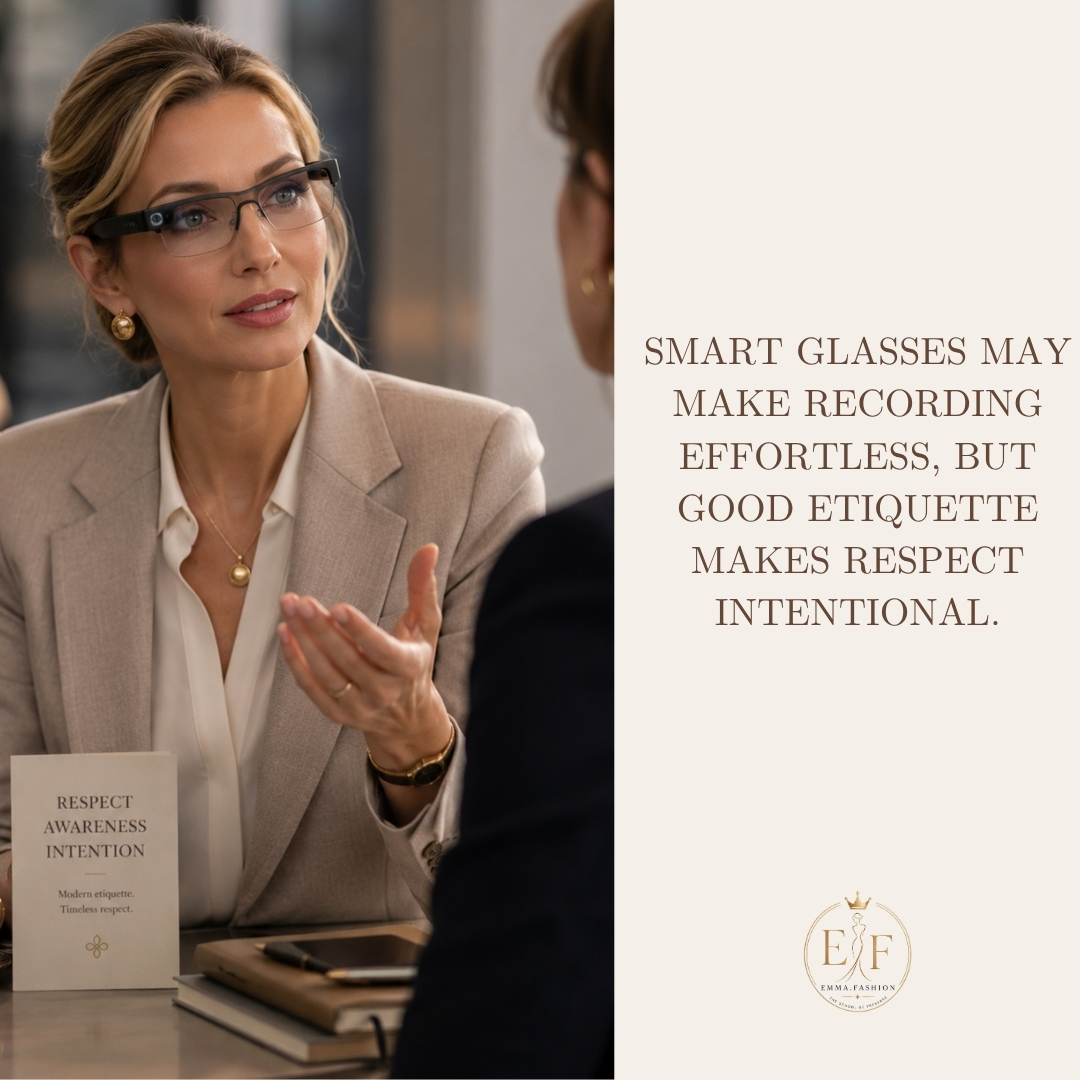
Smart glasses introduce an unusual question into everyday etiquette: When someone looks at you, are they simply looking—or are they also recording?
For most of human interaction, eye contact has carried a relatively simple social meaning. We look at someone to acknowledge them, listen to them, observe their expression, or communicate attention. A camera, by contrast, has traditionally been visible. Taking out a phone or raising a camera creates a recognizable moment in which everyone around us can understand that recording may be happening.
Smart glasses begin to blur that distinction. A device worn naturally on the face can photograph, film, listen, or interact with digital technology while appearing remarkably similar to ordinary eyewear.
That does not automatically make the technology inconsiderate. But it does make the person wearing it responsible for creating clarity where the technology creates ambiguity.
Technology may make recording effortless, but etiquette asks us to remain intentional.
Respect begins by allowing other people to know when they are becoming part of our content.
Table of Contents
- 1. The Camera Is Becoming Less Visible
- 2. Consent Is More Than a Legal Question
- 3. The New Etiquette of Looking
- 4. Ask Before Someone Becomes Your Content
- 5. Consider the Context Before You Record
- 6. Smart Glasses in Professional Settings
- 7. What About Public Spaces?
- 8. Respect the Person Who Says No
- 9. Transparency Is the New Courtesy
- 10. Presence Still Matters
- Frequently Asked Questions
- Work with Emma
1. The Camera Is Becoming Less Visible
We have already adapted our etiquette to smartphones
When someone lifts a phone and points it toward us, we understand what may be happening. We can move away, turn our face, ask whether a photograph is being taken, or decide whether we want to participate.
The physical gesture itself provides information.
Smart glasses can remove much of that signal.
The wearer may simply be standing across from us, looking in our direction. We may not know whether the glasses are inactive, taking a photograph, recording video, livestreaming, or interacting with another digital feature.
This creates a new kind of social uncertainty.
And uncertainty matters because good etiquette is partly about helping other people feel comfortable enough to understand the situation they are in.
The more invisible technology becomes, the more visible our intentions may need to become.
When technology removes the obvious signs of recording, courtesy has to put clarity back into the interaction.
2. Consent Is More Than a Legal Question
Etiquette asks a different question
Discussions about recording often begin with a legal question:
Am I allowed to record here?
It is an important question, but etiquette asks another:
How might the person in front of me experience being recorded?
Something can be technically permitted and still feel intrusive.
Imagine having coffee with a friend while she wears smart glasses capable of recording. Perhaps she is not recording at all. Yet if you do not know, part of your attention may shift from the conversation to the device.
Is this being recorded?
Will something I say appear online?
Am I part of a video without realizing it?
The uncertainty itself changes the interaction.
What we can do is not always what we should do
Etiquette therefore goes beyond asking what we can do.
It asks what consideration requires us to do.
The legal question establishes what may be permitted.
The etiquette question asks us to consider the person standing in front of us.
3. The New Etiquette of Looking
Eye contact now carries another possibility
There is something particularly interesting about smart glasses because they place technology directly within one of our most meaningful forms of communication: eye contact.
Eye contact traditionally communicates attention.
It can say:
I see you.
I am listening.
You have my attention.
But when eyewear can also contain a camera, another possibility enters the exchange:
I may be capturing you.
That does not mean we should become suspicious every time we see someone wearing smart glasses.
Nor does it mean the technology cannot become a natural part of everyday life.
It means our social conventions need to evolve alongside our devices.
Create clarity where technology creates ambiguity
The responsibility should not fall entirely on everyone else to identify whether a device is recording.
When we are the person using the technology, we can remove unnecessary uncertainty.
A simple explanation—
“I’m going to record this for a moment. Are you comfortable with that?”
—can restore the clarity the device itself no longer provides.
4. Ask Before Someone Becomes Your Content
Documenting your experience is different from documenting another person
Social media has made recording everyday life feel ordinary.
A beautiful restaurant. A birthday celebration. A conversation with friends. A walk through a city. A professional event.
We document constantly.
But there is an important distinction between documenting our experience and turning another person into part of our content.
Someone sitting across from us has not automatically agreed to become part of a video simply because we have the technology to capture the moment discreetly.
Give the other person a choice
Before intentionally recording another person, consider asking.
It does not need to become an elaborate permission process in every casual situation. Often a simple sentence is enough:
“I’m recording a little video—do you mind being in it?”
That small moment of transparency gives the other person something valuable:
Choice.
And choice is at the heart of respectful digital etiquette.
5. Consider the Context Before You Record
The same behavior can feel very different in different places
Etiquette is rarely based on one rule that applies identically everywhere.
Context matters.
Recording a scenic walk through a public park is different from recording a private dinner conversation.
Filming yourself at an outdoor festival is different from recording inside someone’s home.
Capturing a travel experience is different from documenting a person sharing something personal with you.
Before recording, consider three simple questions.
Where am I?
Is this a public, professional, private, intimate, or sensitive environment?
Who might be captured?
Are people merely passing through the background, or am I intentionally recording identifiable individuals?
What would they reasonably expect?
Would someone in this situation normally expect the conversation or experience to remain private?
Good etiquette lives in this awareness of context.
The goal is not to create anxiety around technology.
It is to prevent convenience from replacing consideration.
6. Smart Glasses in Professional Settings
Technology does not remove professional boundaries
The workplace adds another layer of complexity.
Smart glasses can be useful professional tools. They may assist with communication, documentation, training, accessibility, or hands-free access to information.
But professional environments also contain confidential conversations, proprietary information, client privacy, and moments when people reasonably expect not to be recorded.
Walking into a meeting wearing camera-enabled glasses may therefore create uncertainty even when the recording function is turned off.
Transparency becomes part of professional presence
If the glasses are necessary for your work, explain their purpose when appropriate.
If you intend to record, obtain whatever permission the situation and organization require.
And if the technology is unnecessary during a sensitive conversation, consider whether removing it would make the interaction more comfortable.
Professional presence is not simply about using the newest technology confidently.
It is also about understanding its effect on the people around us.
Being technologically comfortable should not mean making everyone else socially uncomfortable.
7. What About Public Spaces?
Not every person in the background requires permission
Public spaces make the etiquette less straightforward.
People already appear incidentally in photographs and videos every day. Someone walking behind a tourist taking a photograph does not generally expect to be consulted before every image is captured.
Smart glasses do not make ordinary public photography inherently inappropriate.
But intention still matters.
Incidental and intentional recording are not the same
There is a difference between someone appearing briefly in the background and deliberately directing your attention toward a stranger so that you can record them without their knowledge.
There is also a difference between capturing the atmosphere of a public place and documenting someone during an embarrassing, vulnerable, emotional, or private moment simply because it happens within view.
The better question is not always:
Can I record this?
Sometimes it is:
Do I need to?
The ability to capture a moment does not automatically make the moment ours to capture.
8. Respect the Person Who Says No
No explanation should be required
One of the simplest principles of smart glasses etiquette may also become one of the most important:
If someone tells you they do not want to be recorded, take the request seriously.
They should not need an elaborate explanation.
They may be concerned about privacy.
They may dislike appearing online.
They may work in a profession where public exposure matters.
They may simply prefer not to be photographed or filmed.
Their reason does not need to satisfy us before their preference deserves consideration.
Remember who has the information
Wearable technology changes the balance of awareness.
The person operating the device knows what it is doing.
The person looking at it may not.
That gives the wearer a particular responsibility.
Courtesy means recognizing that imbalance rather than taking advantage of it.
9. Transparency Is the New Courtesy
We may need new social habits
As technology becomes smaller and more seamlessly integrated into what we wear, etiquette may increasingly depend on transparency.
We may need to become comfortable saying:
“These glasses can record, but I’m not recording right now.”
Or:
“I’d like to capture this—are you comfortable with that?”
These sentences may initially feel unnecessary.
Eventually, they may become as ordinary as asking before posting a photograph of someone else.
Etiquette has always evolved with technology
We developed expectations around telephones, email, smartphones, social media, video calls, and messaging.
Wearable technology is simply presenting us with another moment of adaptation.
The technology changes.
The principle underneath good etiquette remains remarkably consistent:
Consider how your behavior affects someone beyond yourself.
Transparency does not make technology less sophisticated.
It makes our use of it more considerate.
10. Presence Still Matters
Not every moment needs to become content
Perhaps the most interesting etiquette question surrounding smart glasses has nothing to do with recording.
It has to do with presence.
Technology increasingly allows us to occupy two spaces simultaneously: the physical experience in front of us and the digital world layered over it.
But another person should not have to compete constantly with the technology we are wearing.
If someone is speaking to us, attention remains a form of respect.
If we are sharing a meal, the moment does not always need to become content.
If something beautiful happens, experiencing it may sometimes be more meaningful than capturing it.
The most sophisticated technology still requires human judgment
Smart glasses may make documentation almost invisible.
That makes intention even more important.
The sophistication of new technology should not be measured only by how seamlessly it disappears into our lives.
It should also be measured by whether we can use it without allowing other people to disappear from our awareness.
Because modern etiquette is not about resisting technology.
It is about remaining human while using it.
Smart glasses may make recording effortless, but good etiquette makes respect intentional.
Frequently Asked Questions
Is it rude to record someone with smart glasses without telling them?
In many social situations, yes. Even when recording is technically possible or legally permitted, good etiquette means considering whether the other person reasonably expects privacy and allowing them to know when they are becoming part of your recording.
Should I tell people when I am recording with smart glasses?
When identifiable people are intentionally being included in your recording, informing them is the respectful default. This is especially important during conversations, gatherings, meetings, and other situations where people may not expect to be recorded.
What should I do if someone asks me not to record them?
Respect the request whenever reasonably possible. Good etiquette does not require someone to justify why they are uncomfortable being recorded.
Are smart glasses appropriate in professional settings?
They can be, depending on the workplace and purpose, but transparency matters. Meetings, client conversations, confidential discussions, and private workspaces may require permission or may prohibit recording altogether.
How can I use smart glasses without making other people uncomfortable?
Be transparent about when you are recording, ask permission when appropriate, respect requests not to be filmed, and remain attentive to the social context. The goal is to make the technology understandable rather than leaving others to wonder what it is doing.
Work with Emma
Modern etiquette is about awareness
Modern etiquette is not a collection of rigid rules.
It is the ability to read a situation, understand how our choices affect other people, and respond with awareness.
As technology becomes increasingly integrated into what we wear, how we communicate, and how we document our lives, social intelligence becomes even more important.
The devices may be new.
The principles of consideration, respect, and presence remain remarkably timeless.
Through Emma.Fashion, I explore the relationship between personal image, presence, style, and modern etiquette—and how we can navigate a changing world without losing the human awareness that makes an interaction feel respectful.
Technology will continue to evolve.
Our etiquette will evolve with it.
But perhaps the standard we should carry forward is simple:
Use the technology. Enjoy its possibilities. But never allow its convenience to make the people around you feel invisible.