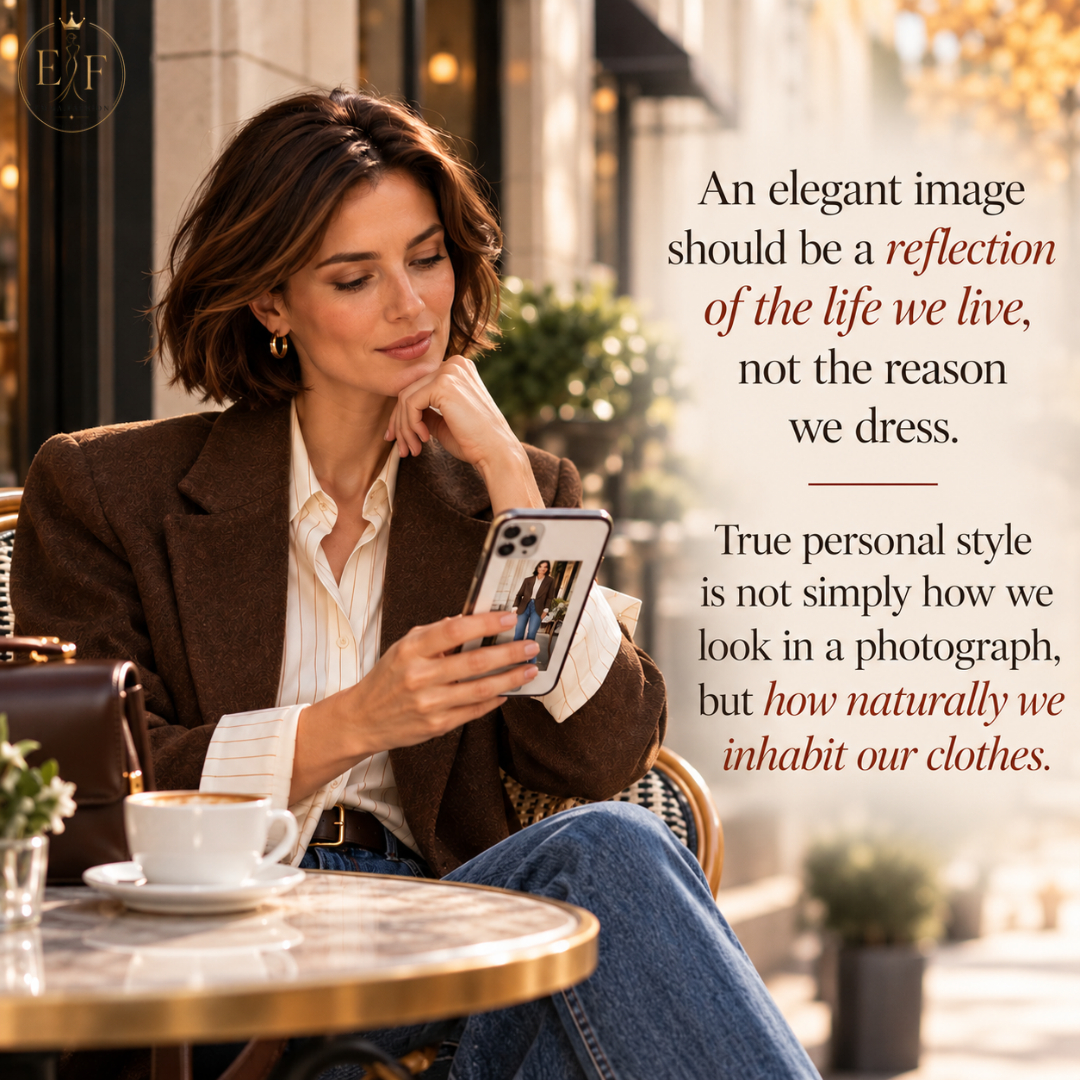
You put on an outfit and feel ready to leave. The proportions feel right, the fabric moves comfortably, and something about the combination feels like you. Then you take a photograph.
On the screen, the outfit seems less interesting. The texture disappears. The shape looks different. You add a belt, change your shoes, or reach for a more noticeable accessory. Before long, you are choosing for the photograph as much as for the day.
There is nothing wrong with wanting a beautiful image. But the moment invites a question: Would you still wear the outfit if no one photographed it?
The question is less about whether we should photograph our clothes and more about the authority we give the image. A photograph can help us understand an outfit. It cannot tell us everything about the experience of wearing it.
Table of Contents
- 1. When the Photograph Becomes the Reference
- 2. What a Camera Sees—and What It Leaves Out
- 3. The Quiet Pressure to Wear Something Different
- 4. Let Photography Serve Your Personal Style
- 5. Personal Style, Personal Image, and the Photos We Share
- 6. Dress for the Day You Will Actually Live
- 7. When the Outfit Matters More Than the Photograph
- Frequently Asked Questions
- Work with Emma
1. When the Photograph Becomes the Reference
Looking at an outfit in a photograph can be useful. A little distance may help us notice a proportion we want to adjust or discover a combination we would like to wear again. The difficulty begins when the photograph becomes the final judge.
We may dismiss a dress because its beauty feels too quiet on a small screen. We may choose shoes that complete the image but make walking uncomfortable. Or we may keep adjusting an outfit that already felt natural because we imagine how someone else will see it. At that point, the imagined viewer has entered the dressing room.
Personal style has always involved being seen. Clothing communicates, and caring about presentation is part of moving thoughtfully through the world. Yet there is a difference between considering how we appear and allowing a photograph to decide whether our choices have value.
An outfit deserves to be considered in relation to the woman wearing it: her preferences, her responsibilities, her surroundings, and what she needs to do.
The photograph can offer another perspective. It should not become the only perspective that matters.
2. What a Camera Sees—and What It Leaves Out
A camera can reward clarity: a recognizable silhouette, a deliberate pose, and a carefully controlled surface. Life asks something subtler of our clothes—ease, movement, texture, and the sense that a woman inhabits them.
Think of a softly tailored jacket. In a still photograph, its relaxed shape may seem unremarkable. In person, you notice how the fabric falls as the woman walks, how she slips her hands into the pockets, and how comfortably it accompanies her gestures. Or consider a simple dress whose appeal lies in the way the skirt moves. A single frame may capture its outline while missing much of its character.
The photograph also leaves out what only the wearer knows: whether a waistband presses when she sits, whether a sleeve allows her to reach, whether she spends the afternoon pulling a neckline into place. These details belong to style because they affect how we carry ourselves.
Clothing that needs constant attention can draw us away from the conversation, the work, or the people before us.
Some beauty is experienced rather than captured
A beautiful outfit does not always reveal itself in a single moment. Sometimes its appeal becomes clearer through movement. A skirt that follows the body naturally. A jacket that settles comfortably around the shoulders. A fabric that changes subtly in the light. A woman who moves with ease because she is not continually adjusting what she wears.
These qualities may be difficult to capture in a photograph, but they are central to the experience of personal style.
Some outfits reveal their beauty gradually, through the way they are worn.
3. The Quiet Pressure to Wear Something Different
When we regularly share our outfits, repetition can begin to feel more visible.
A favorite dress may still suit us beautifully, yet we hesitate because it has already appeared in photographs. A familiar combination may feel less worth sharing simply because it is familiar.
But a wardrobe develops meaning through use. The jacket we reach for before an important meeting, the earrings we wear without deliberation, and the dress that feels right in several settings become part of our recognizable style.
Repetition allows us to develop a relationship with our clothes. We learn how to wear them, what to pair with them, and when they serve us best.
Recognition grows through consistency
There is also an interesting relationship between repetition and personal image. We often assume that being memorable requires constantly presenting something new. Yet recognizable personal style frequently develops through continuity.
A woman may become associated with a particular silhouette, a favorite color, a distinctive accessory, or a consistent level of refinement. These elements create visual familiarity. They allow others to recognize her style without requiring her to reinvent herself for every photograph. And perhaps more importantly, they allow her to recognize herself.
Before setting something aside, it helps to ask:
Have I stopped enjoying this piece, or have I only become accustomed to seeing it in photographs?
The answer may save a valued garment from being mistaken for an exhausted idea.
A signature style does not lose its meaning because it has been seen before.
4. Let Photography Serve Your Personal Style
Photographing outfits can support a thoughtful wardrobe.
A private folder of combinations can make busy mornings easier, remind us of forgotten pieces, and help us recognize what we repeatedly enjoy wearing.
The most useful photographs are not always the most polished. They are often the ones that help us remember an outfit that worked.
Alongside the image, consider the experience.
Could you walk comfortably?
Did the clothes suit the setting?
Did you feel like yourself?
By the end of the day, were you still glad you had chosen them?
An outfit that looks beautiful and feels awkward gives you useful information.
So does one that appears simple in a photograph but serves you beautifully throughout the day.
Photograph the outfit after living in it
Try photographing a combination after you have worn it, then noting what you would repeat or adjust. Perhaps the shoes were more comfortable than expected, maybe the jacket worked beautifully over the dress, or the handbag looked perfect but was too small for everything you needed. Or perhaps the outfit felt so natural that you barely thought about it throughout the day. That information is valuable.
You can create a simple personal wardrobe reference by keeping photographs of outfits that worked well and organizing them by occasion:
- Professional outfits
- Casual everyday combinations
- Social occasions
- Travel outfits
- Seasonal favorites
You might also include a short note about comfort, weather, or the activity. Over time, these photographs can reveal patterns in your personal style. They show not only what you enjoy looking at, but what you genuinely enjoy wearing.
The image becomes one source of understanding, alongside your own experience.
5. Personal Style, Personal Image, and the Photos We Share
Personal style and personal image are connected, but they are not identical
Personal style is expressed through the clothes we choose and how we wear them. It reflects our preferences, identity, lifestyle, and the visual language through which we feel most recognizable.
Personal image is broader. It takes shape through the impression we create with our appearance, behavior, communication, and presence. The photographs we post online carry part of that impression into spaces where people may never meet us in person. They become a visible representation of how we choose to present ourselves.
But that representation is necessarily incomplete.
A photograph may communicate elegance, creativity, professionalism, or confidence. It cannot fully convey how we move, listen, speak, respond to others, or make people feel in our presence.
Our online image should remain connected to our everyday identity
There is nothing wrong with choosing a beautiful photograph. A thoughtfully composed image can communicate personal style with clarity. It may help others recognize our aesthetic preferences, our attention to detail, or the consistency of our visual identity.
For professionals, authors, entrepreneurs, and others who maintain a public presence, photographs can also become part of personal branding. But the most meaningful personal image is not necessarily the most carefully controlled one. It is the one that remains connected to the person behind it.
When our photographs reflect how we actually dress and live, they create continuity between our online image and our everyday presence. We feel recognizable both on the screen and in the room.
When maintaining an image begins to replace expressing a style
The relationship changes when we begin choosing clothes primarily to maintain an online image.
We may start asking:
Will this photograph well?
Have I already posted this outfit?
Is this interesting enough to share?
Does this look like the image people expect from me?
These questions are not inherently wrong. But when they become more important than comfort, identity, context, or enjoyment, the photograph begins influencing the wardrobe in a different way.
Instead of using images to communicate our personal style, we may begin adjusting our personal style to serve the images. And gradually, we risk losing touch with the preferences that made our style recognizable in the first place.
An elegant image matters, but it should remain evidence of a life—not become the purpose of one.
The most authentic outfit may be the one that grows more expressive as you move through the day.
6. Dress for the Day You Will Actually Live
Before reaching for the camera, take a moment to consider where you are going. Perhaps you will commute, sit through meetings, carry groceries, meet a friend, or spend an afternoon moving between responsibilities. Your clothes need to accompany those ordinary actions as well as express your taste.
A useful question is:
If there were no photograph today, what would I choose—and why?
You may choose exactly the same outfit. The striking coat, the beautiful shoes, or the distinctive accessory may bring you pleasure regardless of whether anyone records them. That pleasure is a meaningful part of personal style. Or you may realize that one element is there chiefly for the picture.
You can then decide whether it belongs in the day ahead.
A simple exercise in dressing with intention
The next time you get dressed, try making your decision before taking a photograph.
Consider three questions:
1. Does this outfit feel like me?
Look for the qualities that make your style recognizable, whether that means color, silhouette, texture, femininity, simplicity, or a particular level of refinement.
2. Does it work for the day ahead?
Think about movement, comfort, activities, weather, and the expectations of the setting.
3. Would I enjoy wearing it even if no one saw a photograph?
This question helps separate personal enjoyment from the desire to create an image.
Once you have answered, wear the outfit.
If you photograph it later, allow the image to provide additional information rather than replace the decision you have already made.
Polish remains valuable. So do care, beauty, and deliberate presentation.
Personal style simply deserves a fuller measure than how successfully it becomes content.
7. When the Outfit Matters More Than the Photograph
Perhaps the most important distinction is between presenting an outfit and inhabiting it. Presenting an outfit asks how it appears. Inhabiting an outfit asks how it becomes part of our experience. Both have a place.
We naturally care about how we look, and photographs can preserve meaningful moments. But a wardrobe should not exist primarily to provide new images. It should accompany the woman who wears it. Through work, travel, conversations, ordinary errands, celebrations, and the quiet moments that may never be photographed.
An elegant image matters, but it should remain evidence of a life rather than become the purpose of one.
The most authentic outfit may be the one that grows more expressive as you move through the day: sleeves pushed back while you work, a skirt catching the air as you walk, a jacket settling comfortably around your shoulders.
You chose it, you lived in it. And, whether or not anyone took a photograph, it felt like yours.
Personal style is not only what others see. It is also what we experience while wearing our clothes.
Frequently Asked Questions
Has social media changed the way we choose our clothes?
Social media can influence how we evaluate outfits, especially when we regularly photograph and share what we wear. We may become more attentive to how clothing appears on a screen, whether an outfit feels visually interesting, or whether we have already posted it. These influences are not necessarily negative, but personal style becomes more meaningful when photographs remain one source of information rather than the final measure of an outfit’s value.
Why do some outfits look better in person than in photographs?
A photograph captures a limited view of an outfit. Lighting, camera angle, posture, and the moment captured can change how proportions, colors, and textures appear. Some garments reveal their beauty through movement, fabric drape, or the way they interact with the body throughout the day. A single photograph may not communicate those qualities fully.
Is repeating the same outfit bad for personal style or personal branding?
No. Repetition can strengthen personal style by creating consistency and recognition. Familiar silhouettes, colors, accessories, and favorite garments often become part of a recognizable visual identity. For personal branding, consistency can also help connect online presentation with everyday appearance. An outfit does not lose its value simply because it has appeared in photographs before.
How can I use outfit photographs to improve my wardrobe?
Create a private collection of outfit photographs that helps you remember combinations you enjoyed wearing. Consider taking the photograph after wearing the outfit and adding a note about comfort, movement, weather, or the occasion. Over time, this can help you recognize your preferred silhouettes, useful combinations, and wardrobe gaps without relying only on how an outfit looks on a screen.
What is the relationship between personal style, personal image, and social media photographs?
Personal style reflects how you express your identity through clothing. Personal image is the broader impression created through appearance, behavior, communication, and presence. Social media photographs communicate part of that image to others, but they cannot represent the full experience of who you are. When your photographs reflect how you genuinely dress and live, they can create continuity between your online presentation and your everyday identity.
Work with Emma
Develop a personal style that feels recognizable beyond the photograph
A beautiful wardrobe should do more than create beautiful images.
It should reflect your identity, support your lifestyle, and help you feel comfortable in the environments you move through.
Through Emma.Fashion personal styling, image consulting, wardrobe guidance, and color analysis, we can explore the colors, silhouettes, textures, and details that make your style recognizable.
We can also consider how those choices contribute to your personal image, both in everyday life and in the photographs you choose to share.
The goal is not to create a different version of yourself for the camera.
It is to develop a personal style that remains consistent with who you are, whether you are photographed, meeting someone in person, working, traveling, or simply enjoying an ordinary day.
Your image may introduce you. Your presence gives that image meaning.
And your personal style should feel like yours long after the photograph has been taken.