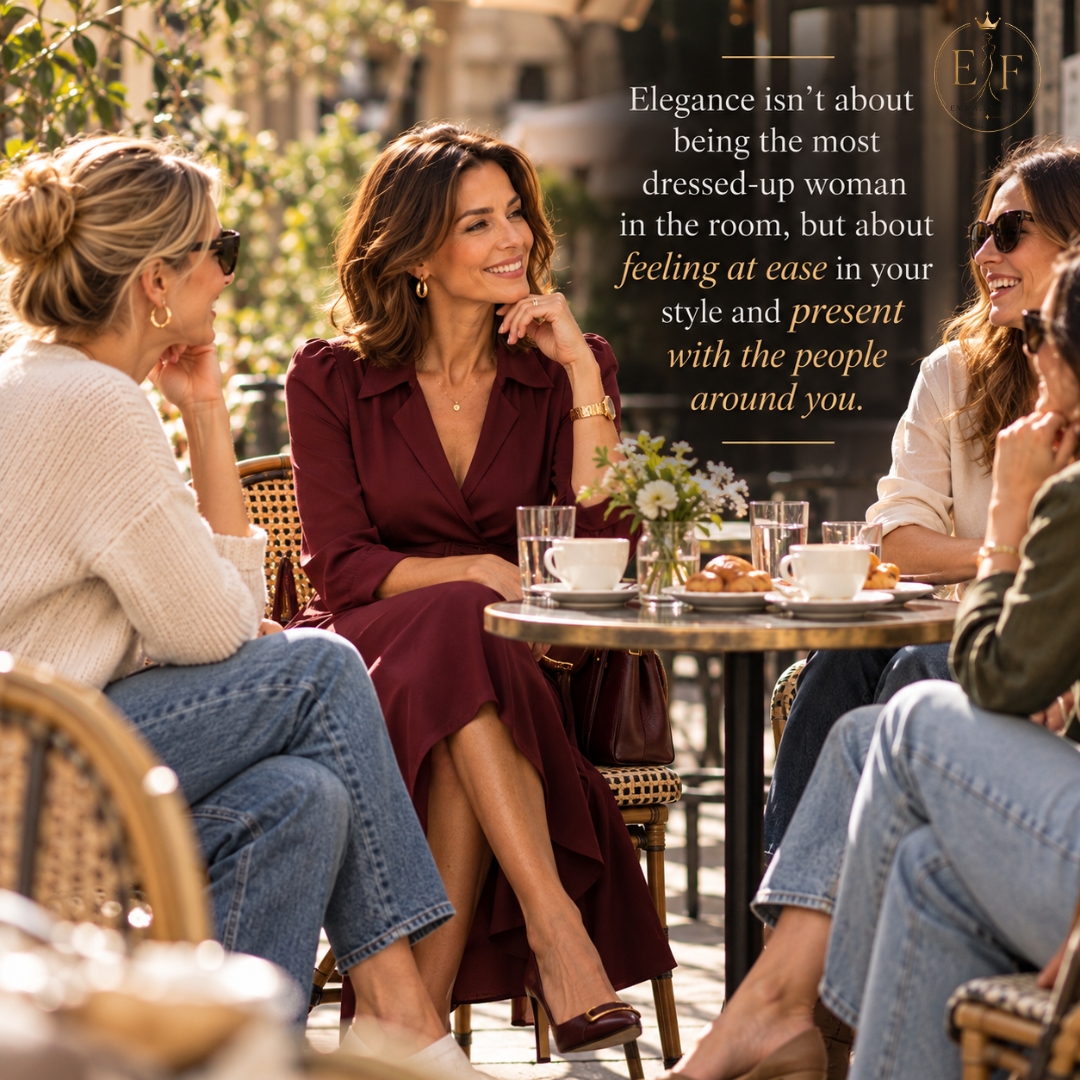
You arrive at a gathering wearing a dress you love. Perhaps you have added a small pair of earrings, a beautiful bag, and shoes that make the outfit feel complete. At home, everything felt natural. Then you walk into the room and notice that everyone else is wearing jeans, casual tops, or sneakers.
Suddenly, you become aware of your clothes in a different way. You wonder whether you misunderstood the invitation. You consider taking off your jacket. You may even feel the urge to say, “I think I overdressed.”
Being the most dressed-up woman in the room can make you question a choice that felt entirely right a few minutes earlier. But before deciding that your elegance is a mistake, pause. There is a difference between dressing differently from the people around you and dressing without regard for the occasion.
At Emma.Fashion, I see style etiquette as the relationship between personal expression and awareness of others. You can honor your taste while remaining responsive to the setting. The question is how comfortably your clothes allow you to enter the shared experience.
Table of Contents
- 1. A Difference in Style Is Not Always a Mistake
- 2. Read the Occasion Before Judging the Outfit
- 3. Let Elegance Feel Ordinary
- 5. Respond to Comments with Ease
- 6. Adjust When It Helps You Participate
- 7. Find Your Own Expression of Casual
- 8. Bring Your Attention Back to the People
1. A Difference in Style Is Not Always a Mistake
A dress may be your easiest everyday choice. For another woman, that same level of ease may come from jeans and a sweater. You may enjoy defined proportions, beautiful fabrics, or a finished outfit even when the day is informal.
These preferences do not automatically make your clothes too formal.
Sometimes what feels “dressed up” to other people is simply what feels like you.
The useful distinction is between a difference in personal style and a mismatch with the occasion. A simple day dress at a casual lunch may express your taste perfectly well. A delicate evening gown at a backyard afternoon where everyone is helping prepare food asks a different question.
**Difference alone is not a reason to change. Context gives you the information you need.**
2. Read the Occasion Before Judging the Outfit
Before you decide that you have overdressed, look beyond what everyone is wearing.
What did the invitation communicate? Where are you gathering? What will you be doing? Can you sit, walk, eat, and join in comfortably?
Perhaps you are wearing tailored trousers and a silk blouse to a dinner where others have chosen jeans. If your clothes suit the setting and allow you to participate naturally, there may be nothing to correct.
If the invitation explicitly asked for very casual clothes because the evening includes a beach walk, the practical demands deserve attention. Shoes that cannot manage the sand may matter more than whether your blouse looks polished.
Etiquette also asks us to respect the purpose of a gathering. A celebration honoring someone else deserves sensitivity to the host’s wishes and any stated dress expectations. Enjoying elegance does not remove that responsibility.
When you are uncertain beforehand, a simple question helps: “Will we be indoors for dinner, or spending most of the evening outside?” It gives you useful information without turning the invitation into an outfit consultation.
3. Let Elegance Feel Ordinary
One of the most uncomfortable things about feeling overdressed is the sudden impulse to explain yourself.
You may begin apologizing for the dress, mentioning that you came from somewhere else, or insisting that you did not mean to make an effort. Yet an outfit you enjoy does not always need a justification.
If your clothes are appropriate, let them be part of an ordinary evening.
Greet your host. Put down your bag. Join the conversation. You do not need to introduce your outfit before introducing yourself.
There is also no need to turn your preference into a standard for everyone else. “I just think people should make more effort” can create distance where none existed. Other people may have chosen their clothes thoughtfully, according to different preferences or circumstances.
Your enjoyment of dressing beautifully can remain personal. It does not require agreement from the room.
4. Make Your Warmth Visible
When your clothes look more formal than those around you, your manner can help people understand how to approach you.
A relaxed greeting, a warm expression, and genuine interest make connection easier. Sit with others. Listen to their stories. Offer help when it is useful. Allow yourself to laugh without worrying about whether the moment looks elegant.
Imagine arriving at a friend’s house in a softly tailored dress while everyone else is wearing shorts. Your friend welcomes you and points toward the kitchen, where the others are preparing dinner. You set down your bag, ask where you can help, and begin talking with someone slicing vegetables.
The dress is still there. But now it belongs to a woman who is participating.
If your clothes make you reluctant to sit on the available chairs, step into the garden, or share in the activities, it is worth considering a more adaptable choice next time. Elegance becomes easier to live with when it leaves room for ordinary interaction.
5. Respond to Comments with Ease
“You’re so dressed up!” can mean several things. It may be admiration, surprise, playful teasing, or a simple observation. Give yourself a moment before treating it as criticism.
A brief, friendly answer is usually enough:
- “I felt like wearing this dress today.”
- “This is one of my favorites. It’s actually very comfortable.”
- “Thank you. I’m happy to be here.”
If someone says, “Now you’re making me feel underdressed,” you can reassure them without apologizing for your own appearance: “You look completely at ease. I just enjoy wearing dresses.”
Then let the conversation move on. Ask how their week has been or return to what the group was discussing.
If a remark feels pointed, you can still answer calmly: “I feel comfortable in this.” You do not need to defend your taste at length or persuade anyone to share it.
6. Adjust When It Helps You Participate
Sometimes a small adjustment makes the evening more comfortable.
You might remove a structured jacket, exchange heels for flats you brought for walking, or put away an accessory that keeps catching on things. These choices are useful when they help you settle into the activity.
Ask yourself: **Will this adjustment help me participate, or am I making it because I feel uneasy about being different?**
You may decide to change something. You may decide that your outfit already works. Either response can come from good judgment.
Being flexible with your clothes is part of knowing how to wear them. A thoughtfully chosen outfit should allow you to respond to the day as it unfolds.
7. Find Your Own Expression of Casual
If you repeatedly feel too formal in your everyday surroundings, it may help to develop a casual expression of your style.
You can preserve the qualities you love while changing the level of formality.
For a woman drawn to classic elegance, that might mean a cotton dress with flat sandals, softly tailored trousers with a fine knit, or dark jeans with a simple blouse. For someone who loves expressive details, it might mean an uncomplicated outfit with one distinctive piece of jewelry.
Fabric, footwear, structure, and accessories all influence how formal an outfit feels. A dress does not belong only to formal occasions, just as trousers do not automatically make an outfit casual.
Start with the qualities you want to retain: perhaps femininity, clarity, color, or beautiful texture. Then ask how those qualities could appear in clothes suited to a relaxed afternoon.
This gives you more freedom. You have a wider range of choices that still feel recognizably yours.
8. Bring Your Attention Back to the People
Once you have considered the setting and made any useful adjustment, allow the outfit to leave the center of your attention.
Notice who has arrived. Listen to the person beside you. Enjoy the meal. Thank the host for bringing everyone together.
Continually checking whether you look different can keep you from discovering how welcome you already are.
You can be the most dressed-up woman in the room and still be entirely at home there. Your elegance becomes easier for others to experience when you inhabit it comfortably and remain interested in them.
**Wear what feels like you. Let your warmth make room for others.**
Frequently Asked Questions
Is it bad etiquette to be the most dressed-up woman in the room?
Not necessarily. Being more dressed up than others is not automatically a breach of etiquette. The important distinction is whether your outfit respects the setting, the purpose of the occasion, and any dress expectations communicated by the host. If your clothing is appropriate and allows you to participate comfortably, dressing differently from others is not a mistake.
What should I say when someone tells me I am overdressed?
A brief, friendly response is usually enough. You might say, “I felt like wearing this dress today,” or “This is one of my favorites.” You do not need to apologize for enjoying elegant clothing or explain your choices at length. Respond warmly and allow the conversation to move naturally toward another subject.
How can I look elegant without appearing too formal?
Choose a more relaxed expression of the qualities you enjoy. A simple cotton dress with flat sandals, softly tailored trousers with a fine knit, or dark jeans with a beautiful blouse can feel refined without appearing overly formal. Fabric, footwear, structure, and accessories all influence the formality of an outfit.
Should I change my outfit if everyone else is dressed casually?
Not simply because your outfit is different. First consider whether your clothes suit the setting and allow you to participate in the activities. If a small adjustment, such as removing a jacket or changing shoes, makes you more comfortable, it may be helpful. But you do not need to change an appropriate outfit merely to look like everyone else.
How can I feel confident when my personal style is different from everyone else's?
Begin by recognizing that personal style naturally varies from one person to another. If your outfit reflects your taste and respects the occasion, you can allow yourself to enjoy it without seeking approval from the room. Focus on greeting people warmly, participating in conversations, and enjoying the gathering. Confidence becomes easier when your attention moves from how different you look to the people and experiences around you.
Work with Emma
### Find the balance between personal elegance and everyday ease
Personal style should allow you to feel like yourself in different environments, whether you are attending a formal celebration, meeting friends for lunch, or spending a relaxed afternoon with family.
Through Emma.Fashion personal styling, image consulting, wardrobe guidance, and color analysis, we can explore how to preserve the qualities that make your style recognizable while adapting their expression to different occasions and lifestyles.
You do not need to abandon refinement to feel comfortable in casual settings.
Nor do you need to dress like everyone else to feel that you belong.
The goal is to develop a wardrobe that gives you choices, so you can respond naturally to the occasion without feeling disconnected from yourself.
**Elegance is not about being the most dressed-up woman in the room. It is about being comfortable in your own style while remaining open, warm, and present with the people around you.**