We often judge an outfit by looking at the woman wearing it.
Does the color flatter her?
Does the silhouette suit her?
Are the proportions balanced?
Does the outfit feel polished, current, and personal?
These questions matter. But they tell us only whether an outfit is visually successful.
Elegance asks something more.
It asks whether the clothes make sense for the life happening around them.
A beautifully dressed woman who cannot comfortably walk where the occasion requires, who has misunderstood the level of formality, or whose clothing creates unnecessary distraction in a setting centered on someone else may be stylish, but the outfit is not fully responsive to the moment.
This is where style and etiquette meet.
Dressing for real life means considering three things at once: the self, the setting, and the people with whom we share it.
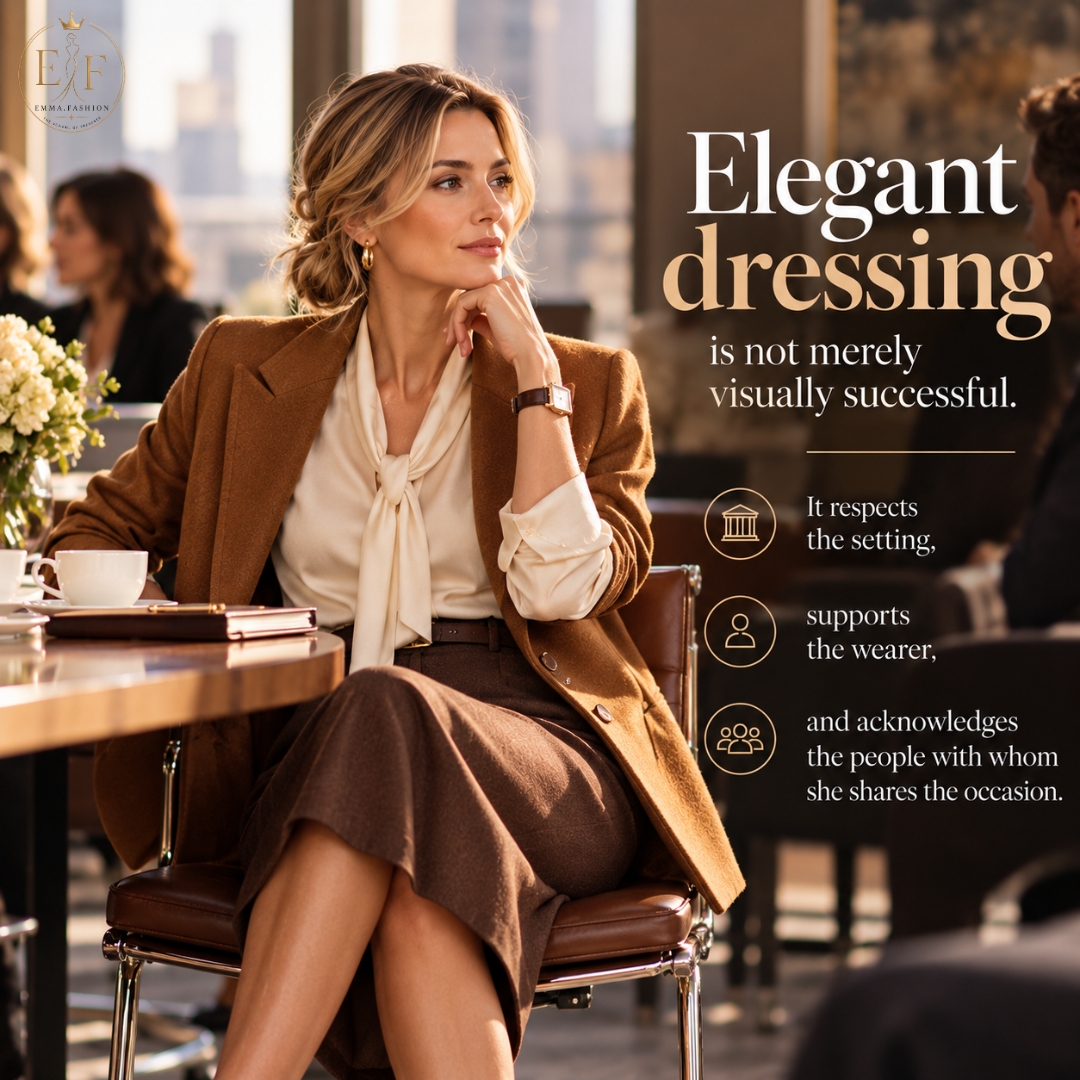
Elegant dressing is not merely visually successful. It respects the setting, supports the wearer, and acknowledges the people with whom she shares the occasion.
Table of Contents
- 1. Style Does Not Exist Outside Context
- 2. Appropriateness Is Not the Opposite of Individuality
- 3. Dress for What You Will Actually Be Doing
- 4. Consider the Physical Environment
- 5. Consider the People Sharing the Occasion
- 6. Understand the Difference Between Being Seen and Taking Over
- 7. Comfort Is Part of Good Etiquette
- 8. Dress Codes Are Information, Not an Identity
- 9. When You Do Not Know What to Wear, Observe the Context
- 10. Adapt Without Erasing Yourself
- 11. The Most Elegant Outfit Supports the Life Inside It
- Frequently Asked Questions
- Work with Emma
1. Style Does Not Exist Outside Context
The same outfit can communicate differently in different places
Imagine a beautifully tailored cream suit.
In one setting, it may communicate confidence, polish, and sophistication.
In another, it may feel unnecessarily formal.
At an outdoor event on uneven grass, the trousers may become impractical.
At an occasion where the host has requested very casual dress, it may create more distance than elegance.
The suit itself has not changed.
The context has changed its meaning.
This is why style cannot be evaluated entirely through the mirror.
The mirror tells us how an outfit relates to our body.
It cannot tell us everything about how that outfit relates to the situation we are about to enter.
Elegance is contextual
Before deciding whether something works, we need to know:
Where am I going?
What will happen there?
Who will be there?
What is the purpose of the occasion?
What will I need to do comfortably?
What level of formality is expected?
These questions do not make dressing less creative.
They give creativity a context.
2. Appropriateness Is Not the Opposite of Individuality
Dressing appropriately does not mean disappearing
The word appropriate sometimes sounds restrictive.
It can suggest rules, conformity, or the idea that we must suppress our individuality to satisfy other people’s expectations.
But thoughtful appropriateness is not about becoming visually anonymous.
It is about understanding the situation well enough to express yourself intelligently within it.
You can respect a professional environment without dressing exactly like every colleague.
You can honor a formal occasion while maintaining your personal style.
You can adapt to a conservative setting without abandoning color, femininity, creativity, or individuality.
Context creates boundaries, not necessarily a uniform
Think of context as a frame.
Inside that frame, there may still be considerable freedom.
A wedding invitation may establish a level of formality.
Your personality determines how you interpret it.
A workplace may require professional dress.
Your personal style determines whether that becomes refined minimalism, feminine tailoring, sophisticated color, or another expression entirely.
A religious setting may call for greater modesty.
That does not prevent beauty, elegance, or individuality.
Good style understands both the rules and the freedom within them.
3. Dress for What You Will Actually Be Doing
The imagined occasion and the real occasion are not always the same
We sometimes dress for an image of an event rather than the event itself.
The invitation says garden party, and we imagine a beautiful dress with delicate heels.
But the actual garden has grass.
There may be gravel.
You may stand for long periods.
The temperature may be high.
Suddenly, the shoes that completed the outfit in front of the mirror become the reason you cannot comfortably participate.
The outfit looked right.
It did not function right.
Ask what the day requires from your clothes
Before choosing an outfit, consider the activities involved.
Will you:
- Walk a significant distance?
- Sit for several hours?
- Stand for long periods?
- Move between indoors and outdoors?
- Carry something?
- Help prepare or serve food?
- Navigate stairs, grass, sand, or uneven ground?
- Move between different temperatures?
- Travel before arriving?
- Spend time with children?
- Participate rather than simply observe?
These practical questions belong in style decisions.
Clothing should not merely photograph well at the beginning of an occasion.
It should allow you to live through the occasion well.
4. Consider the Physical Environment
Place is part of the dress code
Not every dress code appears on an invitation.
Sometimes the environment itself tells us what we need to know.
A beach ceremony communicates something.
So does a cathedral.
A rooftop restaurant.
A corporate boardroom.
A country club.
A backyard dinner.
An art opening.
A school event.
A funeral.
A conference.
A home where you know shoes will be removed at the door.
Each environment contains practical and social information.
Beautiful clothes should belong to the place
Fabric weight matters in heat.
Footwear matters on grass.
Layers matter when temperatures change.
Volume matters in crowded spaces.
Modesty may matter in religious or cultural environments.
Even the size of a handbag can become relevant if an event requires you to move through a crowded reception or sit in closely arranged seating.
This is not overthinking.
It is awareness.
The more accurately we understand the environment, the less our clothes interfere with our ability to be present within it.
5. Consider the People Sharing the Occasion
Etiquette begins when we remember that we are not dressing alone
Personal style is personal.
Social occasions are not.
When we attend a wedding, funeral, professional event, religious service, dinner, celebration, or gathering, we enter an experience that belongs partly to other people.
Our clothing becomes one small element within that shared environment.
Good etiquette asks us to recognize that.
At a wedding, the couple is at the center of the occasion.
At a funeral, the purpose is remembrance and support.
At a professional event, clothing should allow competence and communication to remain central.
When entering someone’s home, we are guests in a space they have created.
Consideration does not require self-erasure
This does not mean dressing timidly.
Nor does it mean worrying constantly about whether someone might disapprove of us.
Consideration is different from people-pleasing.
It simply asks:
What does this occasion belong to, and how can my clothing respect that?
Sometimes respect is expressed through formality.
Sometimes through modesty.
Sometimes through restraint.
Sometimes through making the effort to dress beautifully because the occasion matters.
And sometimes through being relaxed enough not to turn an informal gathering into a performance.
6. Understand the Difference Between Being Seen and Taking Over
Presence does not require becoming the center of every room
There is nothing wrong with being noticed.
Personal style can be expressive, memorable, colorful, dramatic, creative, and distinctive.
But social intelligence includes understanding when visibility contributes to an occasion and when it begins competing with it.
A dramatic outfit at a fashion event may be completely appropriate.
The same desire to attract attention may feel different at an occasion intended to honor someone else.
The question is not whether we are allowed to look beautiful.
Of course we are.
The question is whether the clothing understands the hierarchy of the moment.
Elegance knows when to speak more softly
Sometimes the most sophisticated style decision is not adding more.
It is knowing when enough is enough.
A quieter accessory.
A less theatrical silhouette.
A more restrained neckline.
One statement rather than five competing ones.
This is not about diminishing yourself.
It is about recognizing that confidence does not require constant visual proof.
There is a difference between having presence and demanding attention.
7. Comfort Is Part of Good Etiquette
Clothes affect behavior
We often treat comfort as though it were purely personal.
But uncomfortable clothing can affect everyone around us.
Shoes that hurt may make us reluctant to walk.
A dress that constantly needs adjusting divides our attention.
A garment that feels too tight after dinner may make us want to leave early.
A jacket unsuitable for the temperature may leave us distracted throughout a conversation.
Clothing influences posture, movement, attention, and mood.
And those things influence interaction.
Comfort should support presence
This does not mean that every garment must feel like leisurewear.
Structure can be comfortable.
Tailoring can be comfortable.
Heels can be comfortable for the woman accustomed to wearing them.
A fitted dress can be comfortable when it fits correctly.
The important question is whether your clothing allows you to participate naturally.
Can you sit?
Walk?
Eat?
Reach?
Breathe?
Listen?
Stay present?
If your attention is constantly being pulled back toward your clothing, the outfit is asking too much of you.
Real elegance allows you to forget the clothes enough to remember the people.
8. Dress Codes Are Information, Not an Identity
Start with what the host is communicating
Dress codes can be frustrating because their meaning is not always perfectly clear.
Cocktail.
Business casual.
Festive.
Smart casual.
Black tie optional.
But the purpose of a dress code is not to tell you who to become.
It is to establish a shared level of expectation.
It gives guests a reference point so that the visual atmosphere of an occasion feels reasonably coherent.
Interpret rather than imitate
Once you understand the level of formality, translate it through your personal style.
If cocktail attire is requested, one woman may choose a beautifully simple midi dress.
Another may wear an elegant trouser ensemble.
Another may choose color, print, or an expressive accessory.
The dress code provides the context.
Personal style provides the interpretation.
This is a much more useful approach than asking:
What am I supposed to wear?
Ask instead:
What does this occasion require, and how do I express myself appropriately within that requirement?
9. When You Do Not Know What to Wear, Observe the Context
Look beyond the label
Sometimes there is no dress code.
Or the wording is too vague to be useful.
This is where observation and social intelligence become valuable.
Consider:
The venue
A dinner in someone’s backyard creates different expectations from dinner in a formal restaurant.
The time of day
Morning, afternoon, and evening events often carry different degrees of formality.
The purpose
A networking event, birthday dinner, religious ceremony, fundraiser, and family gathering each have different social centers.
The host
What kind of gathering are they likely to create?
The other guests
What is the general social or professional context?
The activity
What will you actually be doing once you arrive?
When necessary, ask
There is nothing unsophisticated about asking for clarification.
A simple:
“What are you thinking in terms of dress?”
can prevent considerable uncertainty.
Etiquette is not a test designed to catch people making mistakes.
Its purpose is to make social interaction easier.
10. Adapt Without Erasing Yourself
Context should refine your expression, not replace it
One of the fears surrounding appropriate dressing is that adaptation will gradually erase personal style.
It does not have to.
Perhaps your signature color appears in a blouse rather than an entire outfit.
Perhaps your love of dramatic jewelry becomes more restrained in a conservative workplace.
Perhaps your preference for relaxed silhouettes is expressed through beautifully cut trousers at a professional event.
Perhaps femininity appears through fabric and color rather than a romantic silhouette.
Perhaps your love of fashion appears through one exceptional detail rather than an outfit that dominates the occasion.
You are still there.
Your style has simply learned to communicate within another context.
Adaptation can make style more sophisticated
Anyone can repeat the same visual formula everywhere.
The more interesting skill is knowing how to remain recognizable while changing the expression.
This is why style and etiquette belong together.
Style asks:
Who am I?
Context asks:
Where am I?
Etiquette asks:
Who am I sharing this moment with?
Elegant dressing holds all three questions at once.
11. The Most Elegant Outfit Supports the Life Inside It
We should judge clothes after they leave the mirror
An outfit can be beautifully proportioned.
Perfectly coordinated.
Flattering.
Current.
Photogenic.
And still fail the life it was chosen for.
Real dressing happens beyond the mirror.
It happens while we walk across a lawn.
Sit through dinner.
Enter a sacred space.
Give a presentation.
Meet someone’s parents.
Attend a funeral.
Celebrate a wedding.
Travel.
Work.
Host.
Help.
Listen.
Participate.
Clothes accompany us into relationships, environments, responsibilities, and experiences.
That is why the most successful outfit is not necessarily the one that receives the most compliments.
It may be the one that allows the woman wearing it to move through the occasion with such ease that eventually the clothes recede and her presence becomes what people remember.
Elegance is relational
Perhaps this is the distinction between merely looking elegant and dressing elegantly.
Looking elegant can be judged from the outside.
Dressing elegantly requires awareness.
Awareness of yourself.
Awareness of place.
Awareness of purpose.
Awareness of other people.
And enough confidence to understand that consideration does not diminish individuality.
It gives individuality intelligence.
There will never be one perfect formula for dressing for real life because real life keeps changing.
The office is different from dinner.
Dinner is different from worship.
A wedding is different from a funeral.
A city is different from a beach.
A friend’s home is different from a public event.
And the same woman may need to move among all of them.
The goal is not to create a separate identity for every setting.
It is to develop enough clarity in your own style that you can adapt its expression without losing yourself.
Dress for who you are.
Dress for where you are.
And remember who else is there.
That may be one of the simplest definitions of modern style etiquette.
“Elegant dressing is not merely visually successful. It respects the setting, supports the wearer, and acknowledges the people with whom she shares the occasion.”
Frequently Asked Questions
What does it mean to dress appropriately without losing your personal style?
Dressing appropriately means understanding the setting, activity, level of formality, and people involved, then interpreting those considerations through your own style. You do not need to erase your personality or dress exactly like everyone else. The goal is to adapt the expression of your style while preserving the colors, silhouettes, details, or qualities that still feel authentically yours.
Is being overdressed always considered bad etiquette?
Not necessarily. Being slightly more polished than others is not automatically inappropriate, and different people naturally interpret formality differently. The more important question is whether your clothing respects the purpose and atmosphere of the occasion. An outfit becomes less successful when its level of formality or theatricality creates unnecessary distance, discomfort, or competition with the event itself.
How do I know what to wear when there is no dress code?
Consider the venue, time of day, purpose of the gathering, expected activities, host, and general social or professional context. These details often reveal more than a dress-code label alone. If you are still uncertain and the level of formality matters, it is perfectly appropriate to ask the host for guidance.
Why is comfort part of good style etiquette?
Comfort affects how naturally you can participate in an occasion. Clothing or shoes that constantly require adjustment, restrict movement, or leave you physically uncomfortable can distract you from conversation and interaction. Good clothing supports your presence so that you can focus less on managing the outfit and more on the people and experience around you.
How can I balance individuality with consideration for other people?
Begin by separating self-expression from the need to attract attention. You can wear color, interesting accessories, distinctive silhouettes, or other signature elements while still respecting the purpose of an occasion. Consideration does not require making yourself invisible. It means allowing your personal expression to exist in relationship with the setting and the people who share it.
Work with Emma
Personal style becomes more useful when it can move through real life
Knowing what looks good on you is important.
Knowing how to translate that knowledge across different environments is what makes personal style truly functional.
Through Emma.Fashion personal styling, image consulting, wardrobe guidance, and color analysis, we can explore not only the colors, silhouettes, and details that express who you are, but how those elements can adapt to your profession, lifestyle, social occasions, travel, and changing seasons of life.
The goal is not to give you another list of rules about what you should and should not wear.
It is to develop enough clarity that you can read the context, understand your own style, and make thoughtful decisions without losing yourself in the process.
Because elegant dressing is not simply about creating a beautiful image.
**It is about creating alignment between the woman, the clothes, the occasion, and the life actually being lived.**