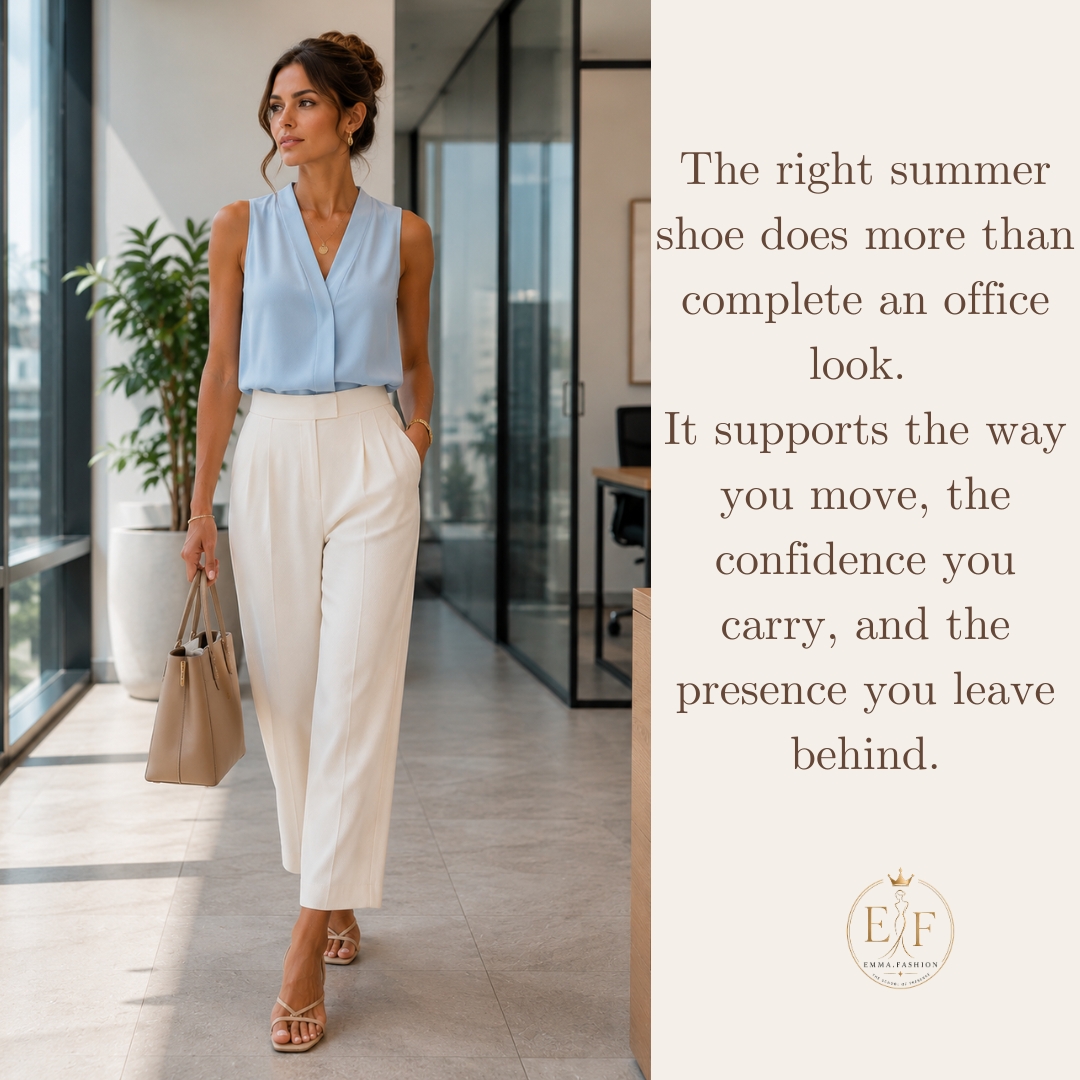
A stylist’s guide to summer office shoes: what works, what doesn’t, and how to balance comfort, professionalism, and personal style.
Summer shoes are where professional style often becomes complicated. The weather calls for lightness and ease, but the workplace still requires polish, awareness, and a sense of intention. Shoes must balance comfort, professionalism, personal style, and the culture of the office.
The right summer office shoe is not simply the most elegant option, or even the most comfortable one. It is the shoe that respects both the woman wearing it and the environment she is entering. Professional style has evolved, which means the question is no longer only, “Are sandals allowed?” The better questions are: what kind of sandal, in what workplace, with what outfit, for what level of visibility, and what does the overall look communicate?
Start With Context: What Kind of Office Are You Dressing For?
There is no universal answer to summer office footwear because there is no universal office. A shoe that feels perfectly appropriate in one professional environment may feel noticeably out of place in another.
A conservative corporate office may require closed-toe shoes, polished flats, slingbacks, or classic pumps. A business casual workplace may allow refined sandals, clean sneakers, or modern loafers. Creative industries often give more room for sculptural shapes, color, texture, and expressive footwear. Client-facing professions require a higher level of polish because your appearance becomes part of how credibility is communicated.
Hybrid and relaxed offices add another layer. Because people come in less often, the days you are physically present can carry more weight. In leadership or high-visibility roles, shoes should support authority without sacrificing ease.
Before choosing the shoe, read the room. Consider company culture, dress codes, client expectations, geographic location, and your own professional role. Context is not a limitation. It is the foundation of elegant decision-making.
The Summer Office Shoe Test: Four Questions to Ask
When choosing summer shoes for the office, use a simple framework.
- Is it polished? Does the shoe look intentional, maintained, and connected to the outfit?
- Is it appropriate for the environment? Would it feel natural in the room, meeting, or client interaction?
- Can you move with confidence? Can you walk, stand, commute, and work without visible discomfort?
- Does it support your presence? Does the shoe help you feel composed, or are you constantly adjusting, slipping, or thinking about your feet?
A shoe that distracts you from your own presence is rarely the right professional shoe.
Slingbacks: The Refined Summer Office Essential
Slingbacks are one of the most reliable summer office shoes because they offer lightness without losing structure. They feel less heavy than a closed pump, but still polished enough for meetings, client-facing environments, and professional settings.
They work beautifully with tailored trousers, midi skirts, sheath dresses, lightweight summer suits, and even refined denim in relaxed workplaces.
A pointed toe creates a sharper, more elongated line. An almond toe feels softer and more classic. A kitten heel offers elegance without excess height, while a block heel provides stability for long days. Neutral colors such as black, beige, ivory, tan, and navy are versatile, but an intentional color can also feel sophisticated when the rest of the outfit remains composed.
Loafers: Structure Without the Weight of Winter
Loafers bring quiet confidence to summer office dressing. They communicate competence, ease, and modern professionalism without requiring a heel.
For summer, choose lighter interpretations: soft leather, refined suede where climate allows, woven finishes, slimmer soles, or lightweight constructions. Backless loafers may work in relaxed or creative workplaces, but they require more context awareness.
Loafers style well with linen trousers, cropped pants, tailored Bermuda shorts where appropriate, midi skirts, and shirt dresses.
The distinction is important: a refined summer loafer should feel intentional and breathable, not heavy or visually winter-like.
Ballet Flats and Mary Janes: Feminine, Practical, and Modern Again
Ballet flats, square-toe flats, almond-toe flats, Mary Janes, and refined mesh styles have returned as modern office options. They can be feminine, practical, and elegant when chosen carefully.
The strongest versions have structure, quality materials, elegant proportions, and enough design intention to feel connected to a professional outfit. A beautiful leather ballet flat can soften tailored trousers. A square-toe flat can modernize a midi skirt. A Mary Jane can add personality when styled with restraint.
The risk is choosing shoes that feel overly casual, juvenile, flimsy, or disconnected from the rest of the look.
The difference often lies not in the category of shoe, but in its design, material, and the way it completes the silhouette.
Can You Wear Sandals to the Office?
Sometimes, yes. But it depends on the sandal and the office.
Sandals that may work include minimal leather sandals, refined block-heel sandals, elegant low-heel sandals, structured slingback sandal hybrids, and sophisticated designs with controlled exposure.
Sandals that often feel too casual include beach flip-flops, rubber slides, heavily distressed styles, overly flimsy sandals, or anything that visually belongs to vacation wear.
Open toes require nuance. Grooming matters. Office culture matters. Safety requirements matter. Client-facing roles matter. The rest of the outfit matters too. A refined sandal with tailored trousers may communicate ease and sophistication, while the same sandal with a very casual dress may look too relaxed for work.
An open toe does not automatically make a shoe unprofessional. But excessive casualness can make the entire outfit lose its sense of intention.
Mules and Backless Shoes: Modern Ease or Too Casual?
Mules and backless shoes can feel modern, minimal, and elegant, but they require careful judgment. Flat mules, heeled mules, backless loafers, and minimalist slip-ons work best when the rest of the outfit has structure.
They are strongest in creative offices, fashion environments, relaxed business settings, or polished outfits where tailoring provides balance.
They may be less appropriate in conservative corporate environments, formal presentations, certain leadership settings, or workplaces requiring secure footwear.
The key question is simple: does the shoe look intentionally minimal, or simply unfinished?
Espadrilles at Work: Where Is the Line?
Espadrilles can be beautiful in summer, but they carry a strong vacation association. The jute sole, relaxed construction, and resort mood can make them difficult in professional settings.
Refined espadrille wedges, closed-toe espadrilles, and minimalist leather-and-jute designs may work in creative environments, warm climates, relaxed offices, or summer business-casual settings.
They become more office-appropriate when paired with structured pieces: a crisp shirt dress, tailored linen trousers, or a polished midi skirt.
As always, context matters more than rigid rules.
Sneakers in the Summer Office
Sneakers have become part of many modern professional wardrobes. The best office options are clean minimalist leather sneakers, refined low-profile sneakers, simple neutral designs, and intentionally styled fashion sneakers.
More difficult options include visibly worn athletic shoes, running shoes without contextual reason, or overly bulky gym styles in conservative environments.
Sneakers can work with wide-leg trousers, modern suits, midi skirts, shirt dresses, and polished separates. The goal is for the sneaker to look like part of the outfit, not like the shoe you forgot to change after your commute.
What About Flip-Flops?
Traditional flip-flops are generally difficult in professional settings because they communicate beachwear, extreme casualness, leisure, and lack of structure.
However, there is a difference between a rubber flip-flop and an elevated thong sandal. Leather toe-post sandals or minimalist designer interpretations may work in relaxed, creative, or warm-climate offices when styled with refinement.
The deeper question is this: is the design refined enough to belong to the outfit, or does it still carry the visual language of the pool and beach?
The Comfort Question: Professionalism Should Not Require Pain
Professional women should not have to tolerate pain in order to look credible. Discomfort changes posture, movement, expression, and attention. Eventually, it changes presence.
Summer makes comfort even more important. Feet may swell in hot weather. Commutes may be longer or warmer. Standing, walking, and transitioning between outdoor heat and indoor air conditioning all affect how footwear feels throughout the day.
Consider heel height, arch support, breathable materials, blister prevention, and the reality of your workday. A shoe that looks perfect but makes you move awkwardly does not support your image.
Comfort is not the opposite of professionalism. When chosen well, it is part of professional intelligence.
Shoes That Can Quietly Undermine an Otherwise Polished Outfit
Often, it is not the style category that weakens professional presence. It is poor condition, poor fit, or lack of coherence.
- Visibly worn soles
- Damaged heels
- Peeling materials
- Shoes that are too small
- Feet sliding out of sandals
- Overly casual beach styles
- Shoes that make walking visibly difficult
- Footwear disconnected from the formality of the outfit
Polish is often found in details. Shoes do not need to be expensive, but they should look cared for, intentional, and aligned with the rest of the outfit.
The Best Summer Office Shoes by Workplace
Conservative Corporate
- Slingbacks
- Pumps
- Polished loafers
- Refined flats
- Low block heels
Business Casual
- Ballet flats
- Mary Janes
- Loafers
- Minimalist sneakers
- Refined sandals where accepted
Creative Office
- Sculptural flats
- Modern mules
- Fashion sneakers
- Elegant sandals
- Distinctive color or design
Client-Facing Roles
- Polished slingbacks
- Refined flats
- Elegant low heels
- Structured loafers
Relaxed or Hybrid Office
- Clean sneakers
- Elevated sandals
- Soft loafers
- Modern flats
- Refined espadrilles where appropriate
How to Build a Small Summer Office Shoe Capsule
A thoughtful summer office shoe capsule does not need to be large. In many wardrobes, five pairs are enough:
- A refined slingback
- A polished flat
- A lightweight loafer
- A minimal office-appropriate sandal
- A clean, elegant sneaker
The exact capsule should reflect your workplace, commute, climate, wardrobe colors, lifestyle, and personal style identity.
The goal is not to own every option. It is to have the right options for the rooms you actually enter.
Style, Identity, and the Shoes We Choose
Footwear communicates more than practicality. It can express authority, creativity, femininity, restraint, confidence, ease, or modernity.
Two women may wear the same summer suit and communicate something entirely different through footwear. One chooses a pointed slingback and creates polish. Another chooses a minimalist sneaker and communicates modern ease. Another chooses a sculptural sandal and adds creative distinction.
None is automatically better. Each creates a different message.
Shoes do more than finish an outfit. They influence how we move through the room — and movement is part of presence.
The Best Summer Office Shoe Creates Alignment
The best summer office shoe aligns the weather, the workplace, the outfit, the woman, and the demands of the day.
Professional style is not about choosing the most formal shoe in the room. It is about choosing with enough awareness that your footwear supports your comfort, your credibility, and your presence.
When shoes support both the body and the image, they stop being an afterthought. They become part of how you show up.
Frequently Asked Questions
Can women wear open-toe shoes to the office?
<p>In many workplaces, yes. Open-toe shoes can be appropriate when they are refined, well-maintained, and aligned with the dress code. Conservative offices may still prefer closed-toe shoes.</p>
Are sandals appropriate for business casual workplaces?
<p>Refined sandals can work in business casual settings when they look intentional and polished. Avoid beach sandals, rubber slides, or overly flimsy styles.</p>
Can you wear sneakers to the office in summer?
<p>Yes, in many modern workplaces. Choose clean, minimalist, low-profile sneakers and style them as part of the outfit, not as casual commute shoes.</p>
Are slingbacks considered professional?
<p>Yes. Slingbacks are often one of the most professional summer shoe options because they feel lighter than pumps while still offering structure and polish.</p>
Are mules appropriate for work?
<p>Mules can be appropriate in creative, relaxed, or business casual environments when they look refined and intentional. They may be less suitable for conservative offices or formal presentations.</p>
Can you wear espadrilles to the office?
<p>Espadrilles can work in relaxed offices, warm climates, or creative environments when the design is refined. Traditional resort-style espadrilles may feel too casual for formal workplaces.</p>
Are flip-flops ever appropriate at work?
<p>Traditional rubber flip-flops are rarely appropriate for professional settings. Elevated leather thong sandals may work in very relaxed or creative environments, depending on the full outfit and office culture.</p>
What are the most comfortable professional shoes for hot weather?
<p>Comfortable professional options include slingbacks with low heels, polished flats, lightweight loafers, refined sandals, and clean minimalist sneakers, depending on your workplace.</p>