Most of us begin getting dressed by asking practical questions. What should I wear today? Is this appropriate? Does this match? Is it fashionable enough, polished enough, or right for the occasion?
These questions matter. Clothing must respond to weather, responsibilities, social expectations, and the environments we enter. Yet when practical questions become the only questions we ask, something essential is overlooked. The first consideration is not always about the clothing itself. It is about the experience we want to create while wearing it.
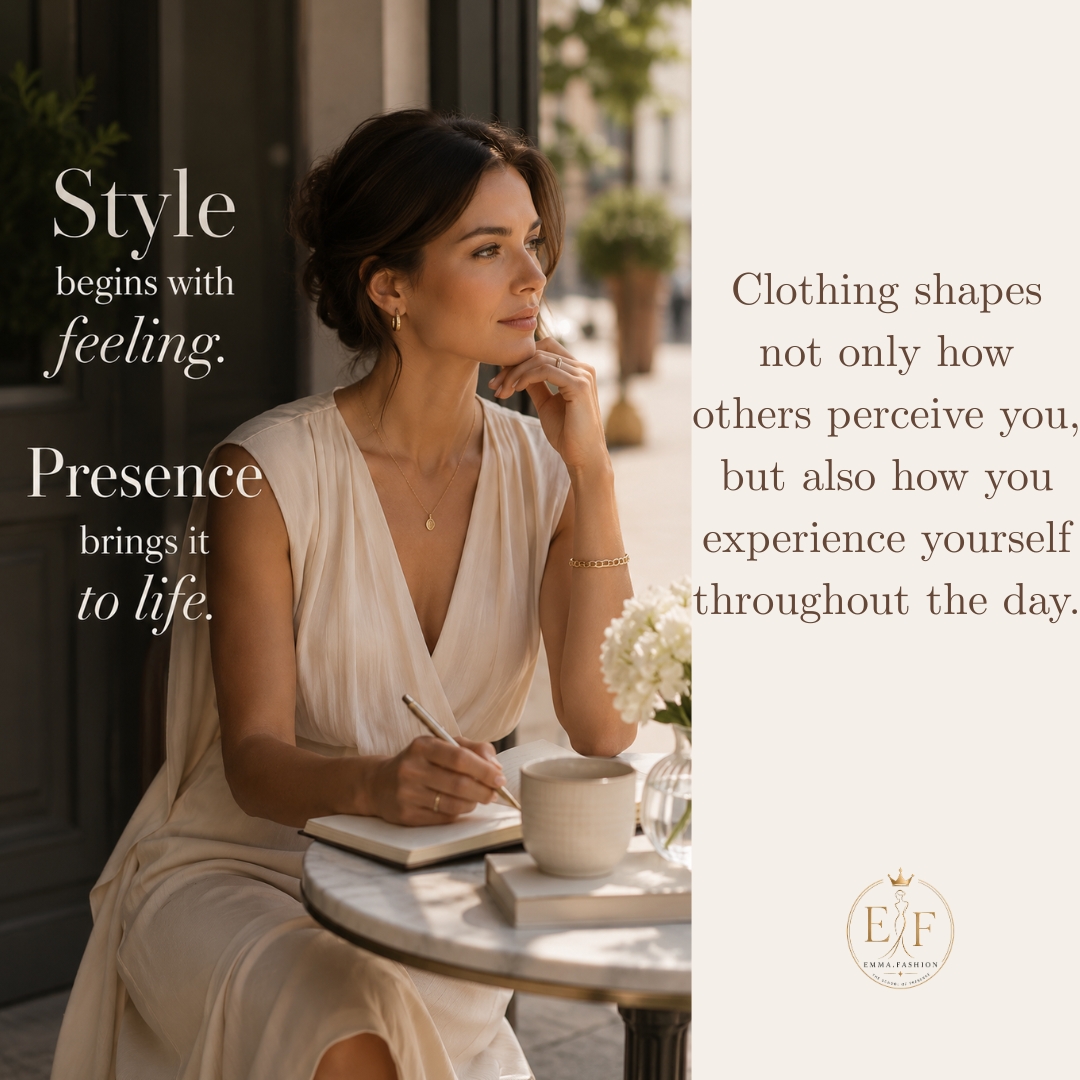
How do you want to feel today? The answer may be composed, capable, approachable, elegant, creative, calm, or simply at ease. Clothing influences how others perceive us, but it also shapes how we experience ourselves throughout the day. When feeling becomes the starting point, getting dressed becomes less about assembling an acceptable outfit and more about creating alignment between the inner self and its visible expression.
Dressing Begins with Feeling, Not Fashion
Before clothing communicates anything externally, we experience it internally. We feel the fabric against the body. We notice whether the waistband restricts us, whether the shoes make us feel steady, whether the color brings energy to the face, and whether the silhouette feels familiar or foreign.
These sensations may seem secondary to appearance, but they quietly shape the way we move through the day. A jacket that creates structure can make us feel gathered. A soft knit may offer reassurance. A fluid dress can introduce ease into the body. A sharply cut trouser may help us feel more focused and capable.
Clothing can support emotional states such as confidence, calm, energy, competence, creativity, ease, and elegance. It does not manufacture these qualities from nothing, nor does it replace inner work. It creates conditions in which certain qualities may become easier to access.
This is why two garments that look equally attractive can feel entirely different once worn. One may support the person you are that day. The other may require you to perform a version of yourself that feels distant from your actual state.
We do not simply wear clothes. We live our days inside them.
An outfit accompanies us into conversations, decisions, responsibilities, and private moments. It can either support our attention or continuously interrupt it. When clothing feels aligned, we are less preoccupied with ourselves and more available to what the day requires.
Feelings Create Better Style Decisions
Many style decisions are made from the outside in. We begin with a trend, a photograph, a rule, or an idea of what a well-dressed woman is supposed to wear. We then try to adapt ourselves to the image.
An alternative is to begin with intention.
You might decide that you want to feel capable before an important workday. You may want to feel approachable at a networking event, graceful at a dinner, relaxed while traveling, feminine during an ordinary afternoon, or expressive while working on something creative.
Once the emotional intention becomes clear, the practical choices often become easier. Feeling capable may lead you toward a structured jacket, a clean silhouette, and shoes that allow you to move decisively. Feeling approachable may suggest softer color, less severe tailoring, or an accessory with warmth and personality. Feeling relaxed may call for natural fabrics and uncomplicated proportions.
The intention does not dictate one correct outfit. Several different combinations may support the same feeling. The value of the question is that it creates coherence.
Instead of choosing each garment separately, you begin to understand the relationship between them. The fabric, color, shape, and level of formality all contribute to one experience. The outfit begins to make sense as a whole because it is organized around a clear emotional purpose.
This approach can also reduce trend-driven purchases. A garment may be fashionable and beautiful, but if it does not support the way you want to feel or the life you are actually living, its relevance may be limited. Intention helps the eye distinguish between what is appealing and what is personally useful.
The Psychology of Enclothed Cognition
The idea that clothing can influence the wearer is often discussed through the concept of enclothed cognition. In simple terms, clothing may affect psychological experience through both its symbolic meaning and the physical experience of wearing it.
We develop associations with garments over time. A tailored suit may represent authority or competence. Athletic clothing may suggest movement and energy. A particular dress may carry the memory of an important achievement. A familiar sweater may become associated with safety and rest.
When we wear these garments, the associations do not disappear. They can subtly influence posture, attention, confidence, emotional regulation, and the way we approach a task.
This does not mean that a blazer will automatically make someone confident or that a beautiful dress will transform a difficult day. Clothing is not magic. It cannot resolve every insecurity or replace preparation, experience, and self-knowledge.
What it can do is create support.
A garment may remind the body to stand differently. A familiar silhouette may reduce self-consciousness. A carefully chosen color may change the emotional tone of the morning. Shoes that feel stable can influence the pace and certainty of movement. An outfit that reflects the level of responsibility you are carrying may help you enter the day with greater coherence.
The objective is not to use clothing to become someone else. It is to use clothing intelligently, creating conditions that support the qualities you already possess and wish to bring forward.
Different Days Require Different Feelings
There is no single emotional goal that should guide every outfit. Personal style is not a fixed performance, and presence does not require us to express the same quality in every setting.
An important meeting may call for composure, credibility, and focus. A weekend may ask for freedom, restoration, and ease. Creative work may benefit from energy, curiosity, and a degree of visual experimentation.
For an Important Meeting
You may want to feel composed rather than impressive. Clothing that offers structure can help create this experience: a well-cut jacket, tailored trousers, a refined dress, polished shoes, and accessories that do not compete for attention.
The intention is not to make the outfit severe. It is to remove distraction. When the clothing feels resolved, your attention can remain with the work, the conversation, and the decisions being made.
For a Restorative Weekend
You may want to feel relaxed, free, and refreshed. Natural fabrics, flowing silhouettes, soft knits, and comfortable footwear may support a slower rhythm.
Relaxed dressing does not need to mean careless dressing. A linen shirt, fluid trousers, a simple dress, or a beautifully proportioned knit set can offer ease while preserving intention.
For Creative Work
You may want to feel inspired, expressive, and alert. Interesting textures, artistic jewelry, an unexpected color combination, or a distinctive shoe can introduce energy into the visual experience.
Creative dressing does not require novelty for its own sake. One expressive element may be enough to shift your state of mind and signal permission to think more freely.
The question remains the same, but the answer changes with the day. This flexibility is not inconsistency. It is responsiveness.
Why We Sometimes Dress Against Ourselves
There are days when our clothing contradicts the experience we want to create.
We want to feel calm, yet choose garments that feel restrictive or require constant adjustment. We want confidence, yet wear something so unfamiliar that we spend the day monitoring ourselves. We want authenticity, yet dress primarily for approval. We want ease, yet choose shoes that make every step an act of endurance.
These contradictions create internal tension. The outfit may look successful, but the wearer does not feel supported by it.
Sometimes this happens because we have learned to prioritize the gaze of others. We ask what appears flattering, current, expensive, youthful, professional, or impressive before asking whether the clothing allows us to remain connected to ourselves.
At other times, we are dressing for an imagined identity. We purchase for a future lifestyle, a different body, or a version of womanhood that does not reflect our current responsibilities and values. The clothes may represent aspiration, but they do not provide ease in the present.
This does not mean aspiration has no place in style. Vision can guide evolution. But when the distance between the woman and the image becomes too wide, style begins to feel like performance.
A more useful approach is to dress from the present while allowing room for growth. The wardrobe can acknowledge who you are today and still contain signs of where you are going.
Dressing from Presence Instead of Pressure
Pressure asks, what should a woman wear? Presence asks, what allows me to feel most like myself today?
The first question tends to search for an external answer. The second begins with observation.
Presence means acknowledging today’s body, today’s responsibilities, today’s energy, and today’s season of life. It does not demand that you dress for an imagined future self at the expense of the woman who must live through the current day.
Perhaps you are moving through a demanding professional season and need clothing that simplifies decisions. Perhaps your body has changed and familiar proportions no longer offer the same sense of ease. Perhaps your social life has become quieter, your work more visible, or your values more refined.
These changes do not signal a failure of style. They are information.
Dressing from presence means listening to that information without judgment. It allows style to evolve gradually, with coherence, instead of forcing a dramatic reinvention that feels disconnected from identity.
The goal is not to ask clothing to create a new person. It is to allow clothing to express the person who is already here, while giving her enough room to continue becoming.
Feeling Is Not Separate from Looking
Appearance and emotion are often treated as separate concerns. One is assumed to be superficial and visible; the other private and psychologically meaningful. In reality, they constantly influence one another.
When clothing feels aligned, movement changes. Posture may soften or become more upright. Gestures become less guarded. Self-consciousness decreases. The wearer no longer needs to adjust, conceal, or manage the outfit continually.
This is part of why elegance is often experienced as ease. The eye notices proportion, quality, and restraint, but it also notices the relationship between the woman and what she is wearing.
A technically perfect outfit can lose its elegance when the wearer appears uncomfortable or absent from herself. A simple outfit can become compelling when it is inhabited with confidence and natural movement.
Feeling at ease does not mean becoming invisible or avoiding challenge. It means creating enough physical and psychological support that you can direct your attention outward. You can listen, participate, lead, and respond without being trapped in constant awareness of your appearance.
Looking elegant often begins with feeling sufficiently at home in what you wear.
Build a Wardrobe Around Emotional Intention
An intentional wardrobe should not be organized only by garment category, color, or season. It can also be understood through the experiences it supports.
Begin by noticing which pieces consistently make you feel confident, peaceful, strong, creative, joyful, or refined. These garments reveal something important about your personal style. They show which materials, silhouettes, colors, and details help you return to yourself.
Before getting dressed, ask:
-
How do I want to feel today?
-
What kind of energy do I want to bring into the room?
-
Which clothes naturally support that feeling?
-
Which pieces allow me to move without distraction?
-
What always makes me feel recognizably like myself?
Over time, patterns will emerge. You may discover that structure gives you calm, rather than restriction. You may realize that soft color creates confidence because it feels more authentic than black. You may learn that dresses offer ease, while another woman feels most herself in trousers.
These observations are more valuable than generic lists of wardrobe essentials. A wardrobe becomes useful when it is built around the woman’s actual psychology, lifestyle, and visual identity.
You can also identify emotional gaps. Perhaps your wardrobe contains many clothes for competence but very few that support creativity. Perhaps everything is practical, but nothing offers pleasure. Perhaps you own elegant evening pieces but struggle to feel refined in ordinary life.
The objective is not to create a separate wardrobe for every mood. It is to build enough range that your clothing can respond intelligently to different emotional and practical needs.
How Emotional Intention Changes by Context
Context remains essential. How you want to feel should work in conversation with where you are going. Personal expression is strongest when it respects both identity and environment.
In a Conservative Professional Environment
You may want to feel credible, composed, and prepared. Tailoring, defined silhouettes, refined footwear, and controlled accessories can support those qualities. Personality may appear through color, texture, or one distinctive detail rather than through dramatic contrast.
In a Business Casual Workplace
You may want to feel capable but approachable. Softer tailoring, fluid trousers, knit jackets, loafers, refined flats, and restrained color can create a balance between professionalism and ease.
In a Creative Environment
You may want to feel expressive, curious, and original. Unusual proportions, artistic jewelry, distinctive color, sculptural footwear, or a strong print may support creative energy while maintaining visual coherence.
In a Client-Facing Role
You may want to feel trustworthy, attentive, and polished. Clothing should support the client experience rather than compete with it. Consistency, fit, grooming, and comfort become especially important because your presence is part of the service you provide.
During a Relaxed or Personal Day
You may want to feel free, restored, and connected to yourself. Comfortable silhouettes, natural materials, uncomplicated shoes, and familiar pieces can reduce visual and mental effort without abandoning personal style.
The emotional intention may differ in each setting, but the deeper principle remains stable. Clothing should support the person you need to be without asking you to become someone unrecognizable.
The Question Beneath the Outfit
Style becomes more meaningful when it begins from the inside rather than the outside. This does not make appearance irrelevant. Color, fit, proportion, grooming, and appropriateness still matter. They simply become part of a larger conversation.
The goal is not to impress everyone you meet. It is to create a wardrobe that supports the person you are each day and the life you are actually living.
When you begin with how you want to feel, clothing choices become less reactive. You are no longer dressing only in response to trends, expectations, or the fear of getting it wrong. You are dressing with intention.
The most beautiful outfits are not always the most dramatic. Often, they are the ones that allow a woman to move through the world with confidence, ease, and presence.
Perhaps the most important question is not, “What should I wear today?”
It is, “Who do I want to be, and how do I want to feel, as I move through this day?”
Frequently Asked Questions
How does clothing affect the way you feel?
Clothing can influence comfort, posture, attention, confidence, and self-perception through its physical qualities and the meanings we associate with it. It does not create emotions automatically, but it can support the way you want to feel.
What should I ask myself before choosing an outfit?
Ask how you want to feel, what the day requires, what energy you want to bring, and which clothes help you feel most like yourself while remaining appropriate for the context.
What is emotional dressing?
Emotional dressing is choosing clothing with awareness of the emotional state you are experiencing or want to support. It may involve selecting garments that create calm, confidence, energy, comfort, creativity, or ease.
What is enclothed cognition?
Enclothed cognition describes the idea that clothing may influence psychological experience through both the symbolic meaning of a garment and the physical experience of wearing it.
Can clothes really make you more confident?
Clothing cannot manufacture lasting confidence, but familiar, well-fitting, and contextually appropriate clothes can reduce self-consciousness and create conditions that help confidence become more accessible.
How can I dress more like myself?
Notice which silhouettes, colors, fabrics, and details consistently make you feel comfortable, recognizable, and aligned. Build from those patterns rather than relying only on trends or external expectations.
How do I build an intentional wardrobe?
Begin with your real lifestyle, current body, responsibilities, preferred emotional states, and personal style patterns. Choose pieces that work together and support the way you want to move through your actual days.
Should I dress for who I am or who I want to become?
Dress in alignment with the woman you are today while allowing your wardrobe to evolve with your vision. Growth feels more authentic when it extends your identity rather than replacing it.