The rise of AI in fashion marks a shift in how we approach style. What once began with inspiration — magazines, runways, curated imagery — is now moving toward automation. Styling apps suggest outfits, virtual try-ons simulate fit, and algorithms recommend what to buy next.
The question is no longer whether AI can assist with style — it already does. The real question is deeper: can something as personal as style, shaped by identity, emotion, and presence, truly be interpreted by technology?
The New Era of Style
AI has transformed fashion from a space of exploration into a space of optimization. It studies what you buy, what you save, what you return, and what you ignore. It reduces time, simplifies choices, and offers direction.
But style has never been only about efficiency. It has always been a reflection of who you are — and who you are becoming.
What AI Can Understand About Your Style
Surface-Level Intelligence
AI is highly effective at identifying patterns. It can analyze your purchase history, saved images, preferred colors, and body measurements. It recognizes repetition and builds recommendations based on what you consistently choose.
This makes AI powerful in predicting what you are likely to wear again.
Behavioral Data
AI also observes behavior. It tracks when you shop, what you click, what you ignore, and how much you spend. It begins to map your lifestyle — whether your wardrobe leans toward workwear, casual pieces, or occasional dressing.
But while AI can recognize what you do, it does not always understand why you choose it.
Can AI Understand Personality and Values?
The Promise
AI attempts to categorize style into personality types — minimalist, expressive, classic, or trend-driven. It organizes wardrobes around lifestyle and occasions, offering a sense of structure.
The Limitation
Personality is not fixed. It evolves with experience, confidence, and context. Values are often unspoken, shaped by emotion rather than data.
Style is not only preference. It is identity, intention, and self-perception.
AI can approximate personality — but it cannot fully understand presence.
Can AI Build a Style That Reflects You?
Where It Works
- Capsule wardrobe suggestions
- Outfit combinations based on past behavior
- Reducing decision fatigue
- Creating efficient, repeatable looks
Where It Falls Short
- Moments of transition — career changes, identity shifts
- Emotional connection to clothing
- The difference between what feels comfortable and what feels aligned
Style is not only about what fits. It is about what reflects who you are becoming.
The Future of AI in Clothing Decisions
The future will likely bring AI-curated wardrobes, automated shopping suggestions, and personalized digital styling assistants. Clothing decisions may become increasingly guided by algorithms.
AI will influence a large percentage of everyday choices — but not all of them.
Because people do not dress only for function. They dress for meaning, emotion, and identity.
Pros and Cons of AI in Personal Style
✔️ Pros
- Saves time and reduces overwhelm
- Offers personalized suggestions
- Improves fit accuracy
- Helps build foundational wardrobes
- Makes styling more accessible
✖️ Cons
- Reinforces existing patterns, limiting evolution
- Lacks emotional intelligence
- Cannot fully interpret context or nuance
- May lead to homogenized style
- Reduces intentional decision-making
Risk: Style becomes predictable instead of expressive.
Where Stylists and Personal Image Experts Fit
The human advantage lies in understanding what data cannot capture.
A stylist understands your transitions — not just your patterns. Your intentions — not just your habits. Your presence — not just your appearance.
What AI cannot replace:
- Emotional intelligence
- Contextual awareness
- Identity development
- Confidence-building through alignment
A stylist does not just select clothing. They help you see yourself clearly.
The Future: Collaboration, Not Replacement
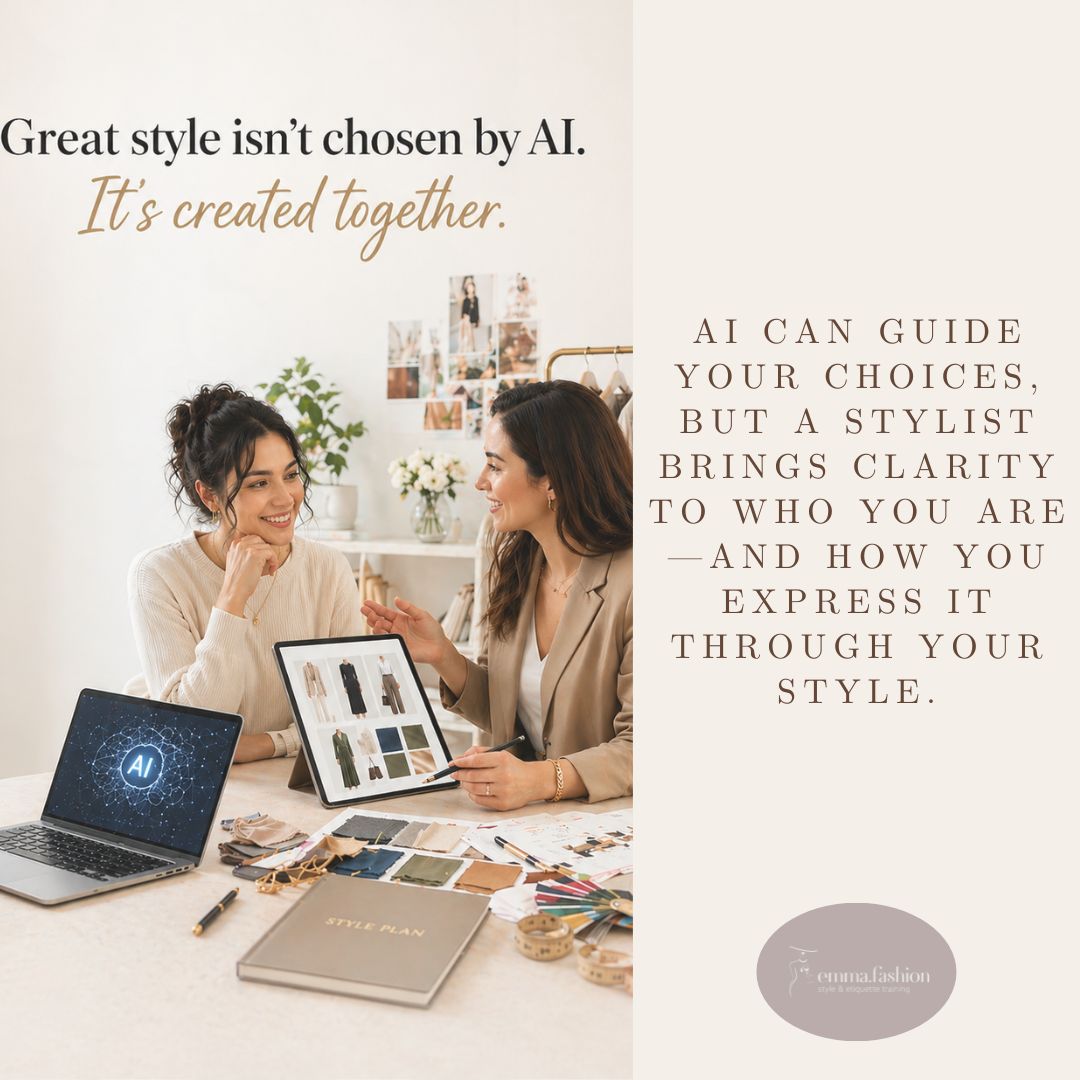
The most powerful approach is not AI versus human insight. It is their collaboration.
- AI handles efficiency
- The individual — or stylist — provides meaning
AI can suggest. You decide.
AI may shape how we shop, but it should not define how we express ourselves.
Because style is not only data. It is identity made visible.
And presence cannot be automated — it must be understood.
Frequently Asked Questions
Can AI replace personal stylists?
No. AI can assist with efficiency and suggestions, but it cannot replace human understanding, emotional intelligence, and identity development.
Is AI accurate in predicting personal style?
AI is accurate in identifying patterns and preferences, but it does not fully understand deeper motivations or personal evolution.
What is the biggest limitation of AI in fashion?
Its lack of emotional and contextual understanding. Style is influenced by identity and intention, not just data.
Can AI help build a wardrobe?
Yes. AI can help create efficient and cohesive wardrobes, especially for foundational pieces.
How should AI be used in personal style?
As a tool for efficiency and inspiration, not as a replacement for personal judgment and intentional styling.